
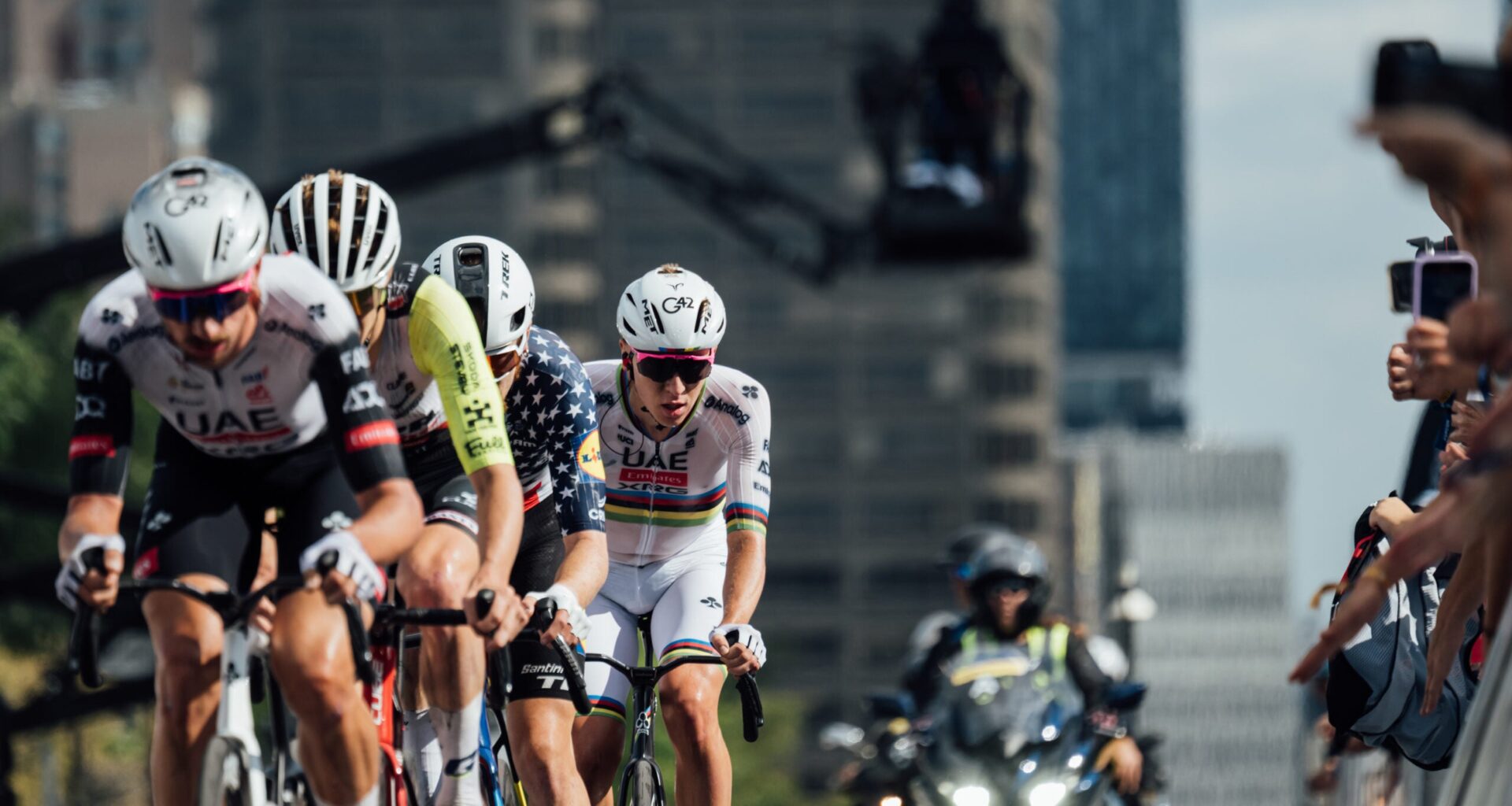
We dive into the power numbers of Tadej Pogačar, Brandon McNulty, and Quinn Simmons at the Grand Prix Cycliste de Montréal.
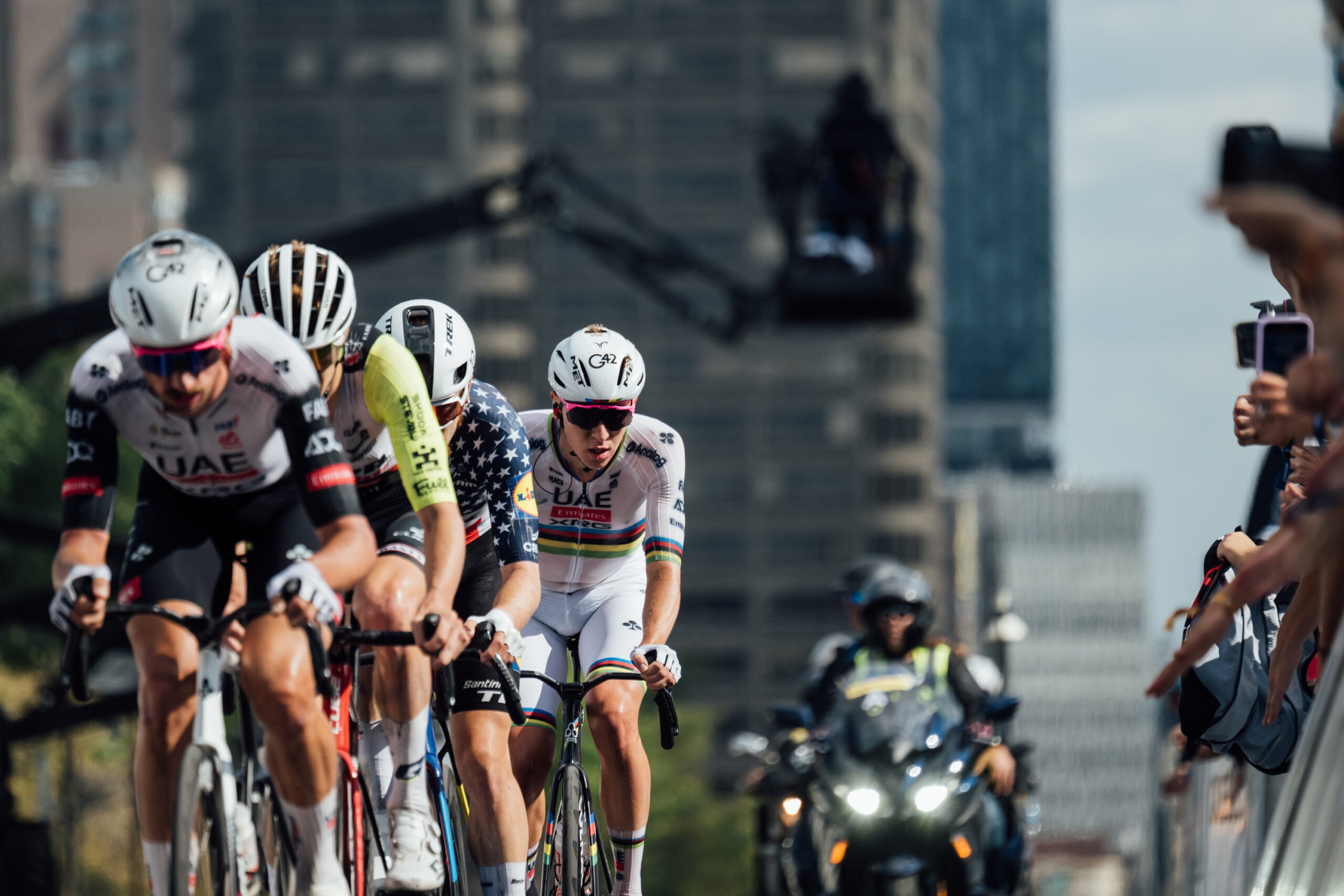
(Photo: Chris Auld)
Published September 15, 2025 02:26PM
Brandon McNulty was following attacks in the first kilometer of the Grand Prix Cycliste de Montréal, a 209km classic in the same host city as the 2026 UCI Road World Championships, and things were extremely difficult from the start. The American’s peak 3min, 4min, and 5min power all came in the first five minutes of the race.
With all that energy expended, you might expect McNulty to be a bit tired by the end of the race. Yet, the opposite was true. McNulty’s peak 20min, 30min, and 1 hour power occurred in the final portion of the GP de Montréal – and one of those efforts included a solo bridge to Tadej Pogačar.
Prior to the weekend in Canada, the world champion hadn’t raced since the Tour de France. His form was highly questionable, especially after an anonymous finish of 29th place at Friday’s GP de Québec. But Montréal’s route was harder, much harder.
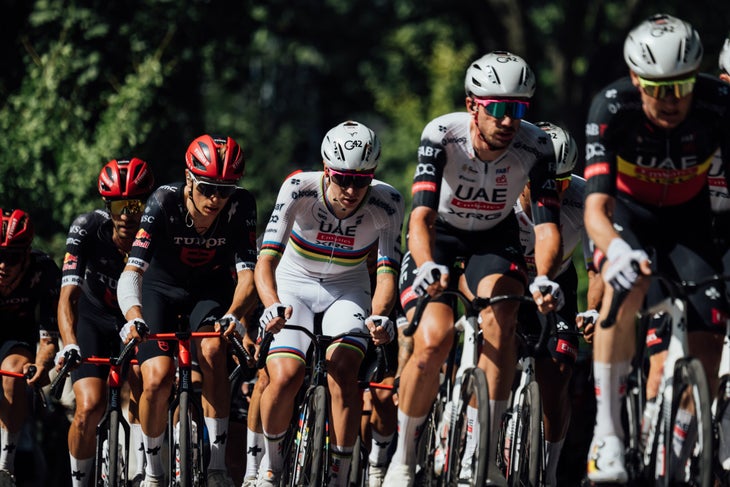 Montréal’s course was much harder than Québec. (Photo: Chris Auld)
Pogačar was the defending champion of the GP de Montréal, and few expected a different result from his solo win in 2024. The Slovenian has been quietly preparing for next week’s UCI Road World Championships in Rwanda. He will attempt to defend his rainbow jersey in the Men’s Elite Road Race, which takes place on a 267.5km route with 6,096 meters of climbing.
This year’s GP de Montréal consisted of 209km with 3,899 meters of climbing, or an average of 18.7 meters of climbing per kilometer. For context, a grand tour mountain stage might have 30 meters of climbing per kilometer, while a hilly race like Amstel Gold might have 12 meters of climbing per kilometer.
Rwanda’s Worlds route has 23 meters of climbing per kilometer, which means that it is closer to a mountain stage than an Ardennes Classic. There is no doubt that Pogačar is the favorite, but after watching the GP de Montréal, it might be a lot closer than we initially thought. Here is what happened.
Pogačar raced the GP de Montréal in a defensive manner, especially compared to his 101km solo effort at the 2024 UCI Road World Championships. He trusted his UAE Team Emirates-XRG teammates to set the pace for the majority of the race. They kept the early break in check, and Pogačar stayed relaxed for the first three-quarters of the race.
Before we skip to the finale, we have to acknowledge McNulty’s efforts in the first half hour of the race. These are numbers that most amateurs couldn’t dream of hitting. At somewhere around 70 kg, McNulty is pushing well over 500w for a few minutes at a time. He was helping control the break formation and keep Pogačar in position. By the time most viewers tune in with 60km to go, these efforts are long forgotten.
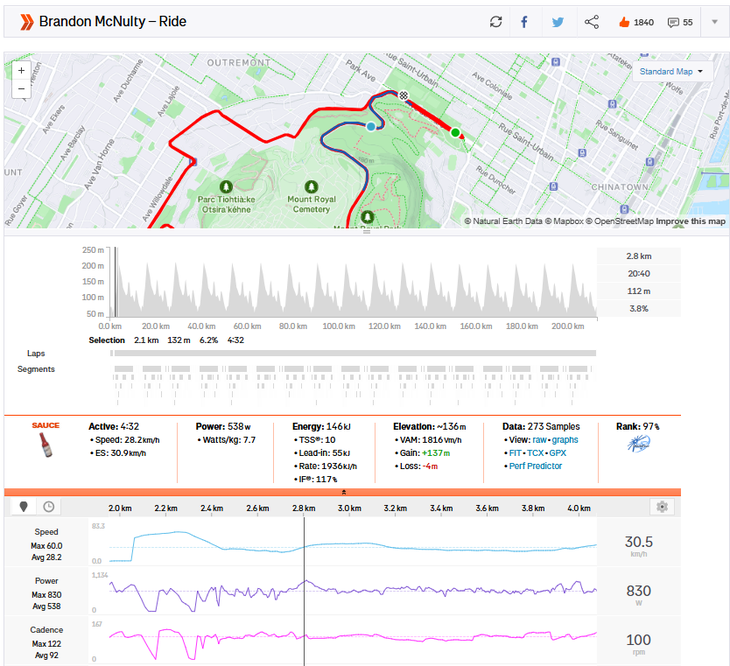
McNulty – First 2km of the race
Time: 4:32
Average Power: 538w (~7.7w/kg)
Peak 3min Power: 575w (~8.2w/kg)
Most of us would be falling off our bikes after a VO2 Max effort like this, but McNulty still had 205km and five hours of racing to go.
For the next few hours, McNulty and Team UAE Emirates-XRG controlled the pace. This was the “easy” portion of the race, but McNulty still averaged 318w (NP 382w) for almost four hours. The peloton was shrinking by the minute, and there were only 36km to go when McNulty attacked at the base of the main climb on course, the Montee Camilien Houde.
Quinn Simmons followed immediately, but Pogačar waited for other riders to close the gap. Louis Barré accelerated next, and that was the signal for Pogačar to jump across. For a few hundred meters, Barré was on the world champion’s wheel, so we know almost exactly the power that Pogačar was doing on the climb. This was a massive effort for all four riders, and it would set the stage for the rest of the race. No one would return to the front group from this point on – these four riders would battle for the podium.
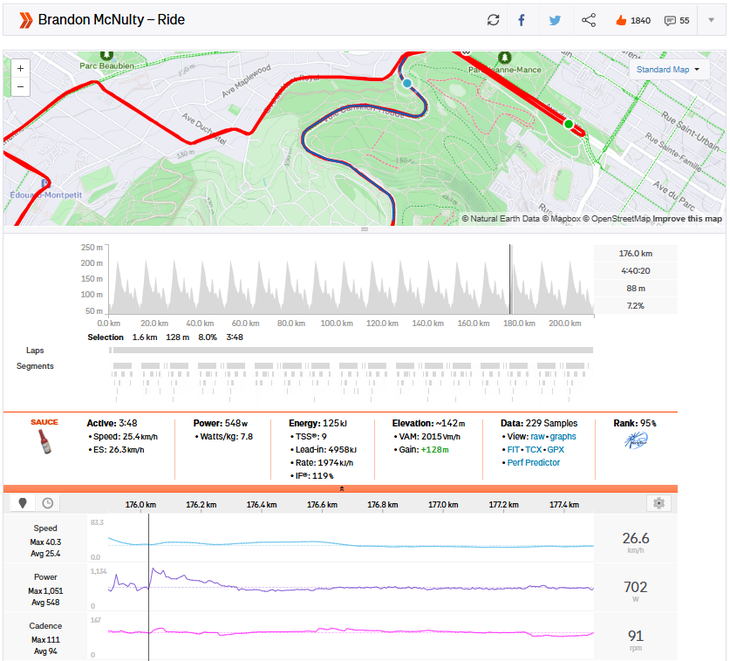 McNulty – Montee Camilien Houde with 36km to go
McNulty – Montee Camilien Houde with 36km to go
Time: 3:48
Average Power: 548w (~7.8w/kg)
Pogačar: 3:49 at ~7.7w/kg
Simmons: 3:48 at 554w (7.6w/kg)
Barré on Pogačar’s wheel: 28 seconds at 538w (7.7w/kg)
For the next 10km, McNulty pulled the group of four without asking for a single pull. Simmons and Barré sat behind him, while Pogačar relaxed at the back of the group. McNulty was setting up the inevitable, and with 23km to go, Pogačar attacked. Simmons was slow to react, but the American tried valiantly to get across. McNulty clawed his way back to Captain America’s wheel, while Barré said goodbye to the leaders.
Compared to the previous climb which split the race, Pogačar went three seconds faster this lap, despite pushing into the wind for nearly the entire climb. The American national champion pushed over 500w for four minutes, but Pogačar had put 18 seconds into him by the top of the climb. It was a race-winning attack by the world champion, one of those efforts that we are bound to see in Rwanda. But there was still another twist in the tale.
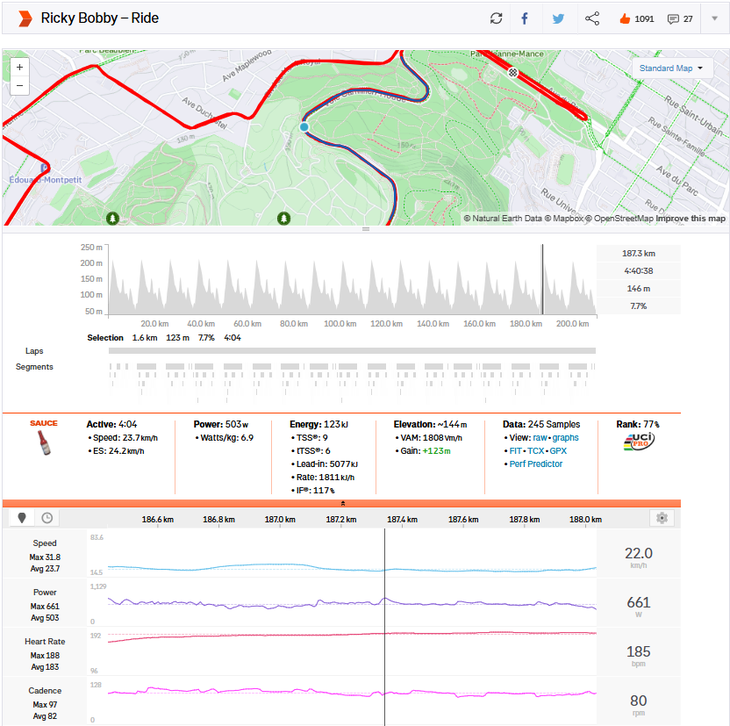 Simmons – Montee Camilien Houde with 24km to go
Simmons – Montee Camilien Houde with 24km to go
Time: 4:04
Average Power: 503w (6.9w/kg)
Pogačar: 3:46 at ~8w/kg
We’d seen this movie before: UAE Team Emirates-XRG sets up an attack by Tadej Pogačar. The world champion goes solo, and that’s a wrap.
But with 16.5km to go, Pogačar was slowly being reeled back in. Not by Simmons, but by his teammates, McNulty. The world champion seemed to wait on the next climb, and then there were two UAE Team Emirates-XRG riders at the front, with Simmons about 35 seconds behind. And that’s how the race would finish.
The time gaps grew, but Simmons held on for third ahead of Neilson Powless and Adam Yates. After his heroic efforts, Barré jumped away from the chase group again, holding on for sixth place after more than five hours of racing.
Pogačar and McNulty were on a training ride for the final few kilometers, riding side-by-side, chatting and smiling at 50 kph. They rolled across the line, celebrating together, with McNulty taking the win ahead of the rainbow jersey. Pogačar had been the strongest rider on the climb, but you could make a great case for McNulty being the strongest rider in the race.
McNulty was the first rider to attack in the final 40km, and his acceleration set up the winning move for Pogačar. On top of that, McNulty pulled for 10km straight in between his attack and Pogačar’s. While the American was pushing over 400w, the world champion was sitting in the draft at 200-300w.
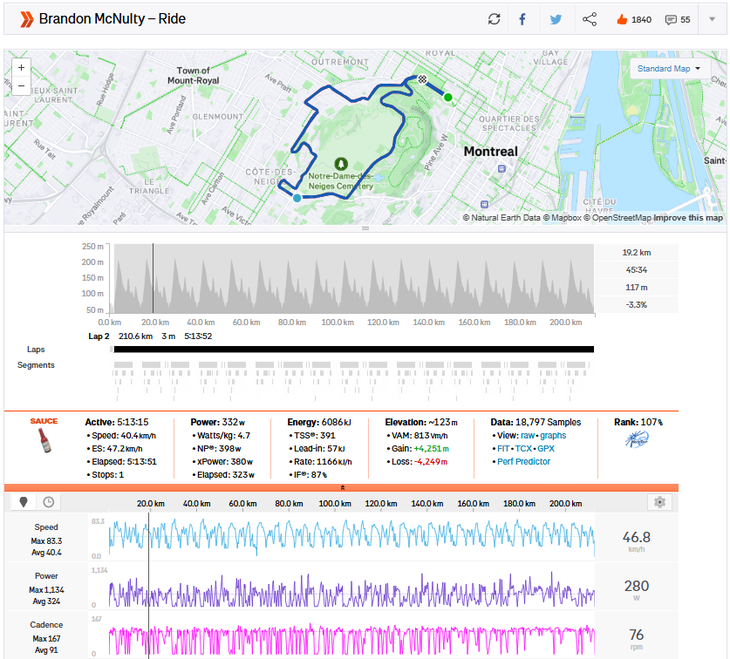 McNulty – GP de Montréal
McNulty – GP de Montréal
Time: 5hrs 13min 15sec
Average Power: 332w (~4.7w/kg)
Normalized Power: 398w (~5.6w/kg)
The pair was smiling together in Montréal, but things will look a lot different in Rwanda. Team USA put three riders in the Top 4 at the GP de Montréal. However, McNulty and Powless will not be competing at the world championships. Simmons will represent Team USA, while McNulty is heading to the Tour de Luxembourg and Powless’ schedule remains a question mark.
Our biggest takeaway from the GP de Montréal is this: Everyone expected Tadej Pogačar to win. So when he attacked with 24km to go, it wasn’t a surprise that no one could follow him. What we didn’t expect were these performances from McNulty and Simmons. But maybe we should have.
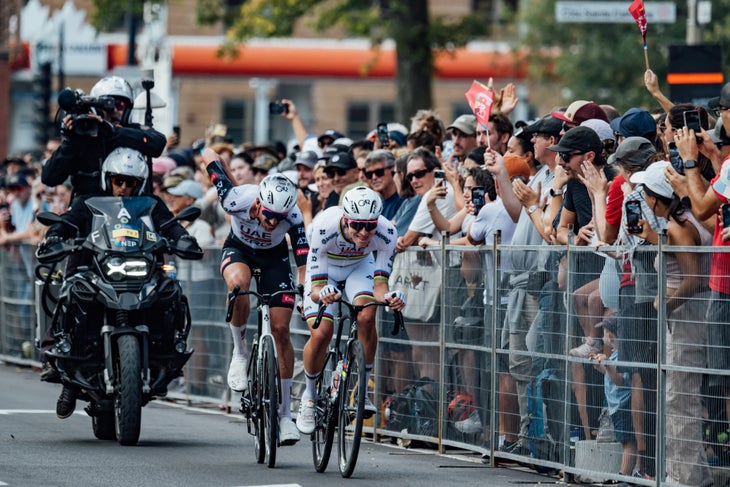 Pogačar leads McNulty. (Photo: Chris Auld)
McNulty has had a slow and steady buildup in the WorldTour. He was a superstar Junior, but he didn’t win much in his first few years as a pro. But in the last two years, McNulty has shown that he is one of the strongest riders in the world. He won his first WorldTour stage race this year at the Tour de Pologne, he has won stages in the Giro and Vuelta, and he was arguably the strongest rider in this year’s GP de Montréal.
Simmons was also a Junior superstar – in fact, he was the Junior World Champion. He has been getting better and better, and he took his first WorldTour wins in 2025. Captain America is a rider who has perfected the art of peaking, and there isn’t any doubt that he’s in incredible shape ahead of the Road World Championships. Not only did he finish 3rd in the GP de Montréal, but he held on to finish solo after getting worked over by two of the strongest riders in the world. If there is anyone who can follow Pogačar at the world championships, I would keep an eye on Quinn Simmons.
Power Analysis data courtesy of Strava
Strava sauce extension
Riders: