
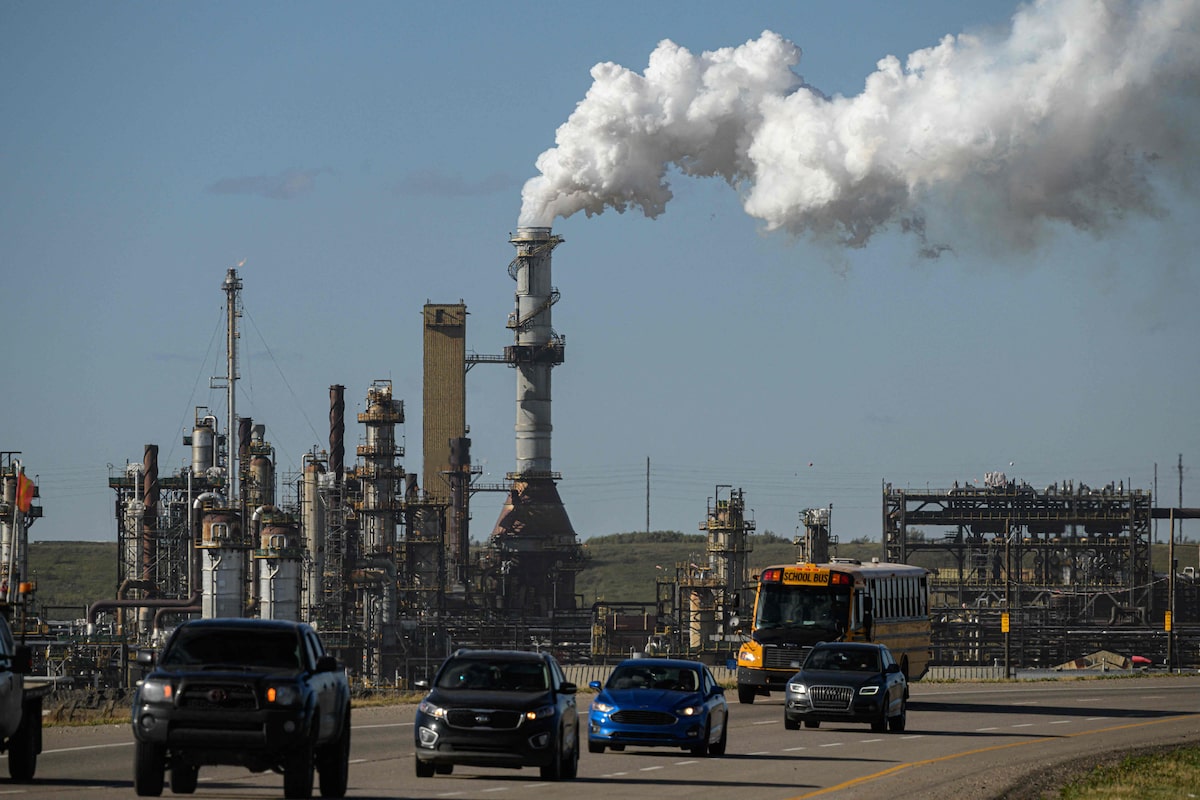
The Canadian Climate Institute says if current trends continue, emissions are projected to be 20 per cent to 25 per cent under 2005 levels by 2030, well under the legislated target of 40 per cent to 45 per cent below.ED JONES/AFP/Getty Images
Canada made no progress reducing total greenhouse-gas emissions last year, and weakening federal and provincial climate policies make it certain that the country will fall far short of its 2030 target, according to data compiled by a climate think tank.
In an early estimate, the Canadian Climate Institute said emission-reduction momentum has stalled nationally, remaining at 8.5 per cent below 2005 levels, about the same as in 2023, with oil and gas accounting for a large and growing share.
On the current trajectory, emissions are on track to be 20 per cent to 25 per cent under 2005 levels by 2030, well under the legislated target of 40 per cent to 45 per cent below, the institute said on Thursday.
The figures were included in the institute’s annual look at what the government’s official data are likely to hold when released in the next several months. The previous three editions proved close to the government’s numbers.
The gap puts meeting the 2050 target at risk, the institute said.
Increases in oil sands production have swamped any of the industry’s progress in per-barrel emission reductions, and cuts in many other sectors of the economy have slowed, said Dave Sawyer, the institute’s principal economist.
“We have been more cautious in the past, saying typically, if policies were implemented as announced, or as developing, we could see good progress. But now we think it’s out of reach,” Mr. Sawyer told reporters.
Opinion: Want a pipeline? Let’s use nuclear power to reduce oil sands emissions
Oil and gas emissions rose 1.9 per cent in 2024, accounting for 31 per cent of the national total, according to the report, prepared by the institute’s 440 Megatonnes project. The electricity sector leads industries in reduction, falling 1.9 per cent to reach 59 per cent below 2005 levels.
Current federal, provincial and territorial policies appear set to limit overall improvements, Mr. Sawyer said. Ottawa and the provinces have weakened carbon-pricing programs and reduced the availability of electric-vehicle subsidies. The government of Prime Minister Mark Carney has paused a federal EV sales mandate, and Saskatchewan has said it will extend the lives of three coal-fired power plants.
Oil sands production is expected to keep breaking records, while discussions about a proposed $16.5-billion carbon capture and storage project drag on.
The country would require reduction of 40 megatonnes of carbon-dioxide equivalent a year between now and 2030 to hit the target. “And that’s well beyond current policy or historical progress,” Mr. Sawyer said.
Canada’s commitment to climate action has come under question as Mr. Carney – who has been one of the world’s most prominent voices in sustainable finance – has pledged to ease the way for a series of major industrial projects to counteract the effects of tariffs imposed by U.S. President Donald Trump. He has promised to achieve the goal of turning Canada into a “superpower” in both clean and conventional energy.
Early this year, Mr. Carney removed the consumer carbon price, a move the institute said could add 20 megatonnes of emissions by 2030. He has also established the Major Projects Office to fast-track “nation-building” projects. The office is already considering a potential expansion of the LNG Canada project in Kitimat, B.C., and eventually could rule on a new oil pipeline – a prospect welcomed by Alberta Premier Danielle Smith.
Other projects among the first tranche announced include two critical-minerals mines, modular nuclear reactors in Ontario and an expansion of the Port of Montreal.
Carney announces five major projects to be reviewed for fast-tracking
Globe Climate: Wildfire ash speeds up glacier melt
The emissions impact of the construction push is not yet known, Mr. Sawyer said. Expanding exports of liquefied natural gas would be emissions-intensive, but other possible projects such as electricity corridors and a Nova Scotia offshore wind farm would be positive, he said.
If the Pathways Alliance, the coalition of oil sands producers designing the massive carbon-capture network, goes ahead with the project, that could be “a large and very lumpy emission reduction,” he said.
The institute said the country, which just struggled through another summer of destructive wildfires, should not backslide on climate policy. Instead, government should modernize industrial carbon pricing, finalize new methane regulations for oil and gas, invest in clean electricity, and make EVs and clean fuels widely available and affordable.