
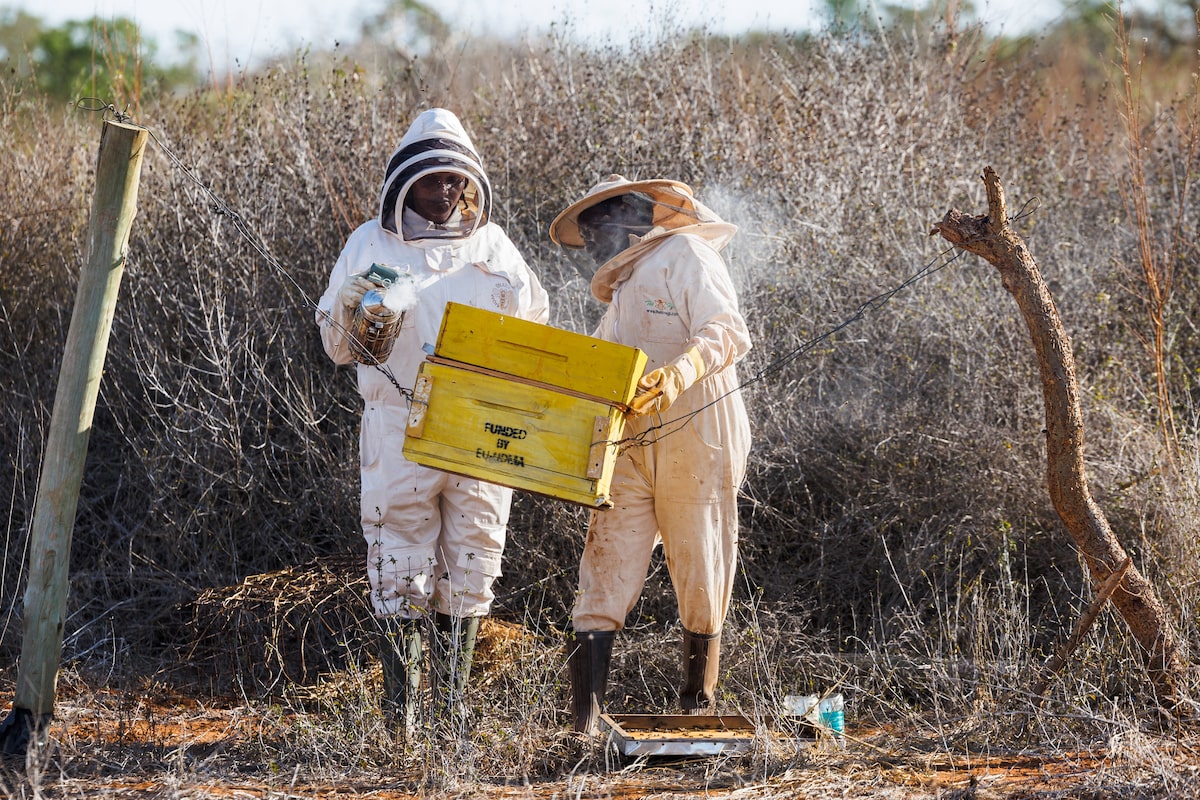
William Mwanduka inspects bee hives integrated into a fence around an acre of his farm in Taita Taventa County, Kenya. The technique meant to deter elephants has been implemented in several African countries including Ivory Coast, Tanzania and Mozambique.TONY KARUMBA/Getty Images
Each rainy season in southern Ivory Coast, farmers in the town of Grihiri watch in frustration as herds of elephants migrating south from the Dassioko forest in search of fresh water and food cut through their cocoa farms and destroy their crops.
Now, some farmers are hoping a tiny but mighty ally can help save their livelihoods by deterring these African forest elephants from entering their fields: bees.
Plans are under way to place the insects’ hives on strategic spots along the 150-kilometre migration paths, in effect creating living fences that redirect the elephants’ movements away from the farms.
The mighty animals, silly as it may seem, are naturally afraid of bees.
A bee’s stinger can’t penetrate an elephant’s thick skin, which is up to 3.8 centimetres deep. Instead, the swarming insects aim for sensitive areas such as the trunk, belly, mouth and eyes. Elephants remember the painful sting, and in future encounters react to the buzzing sound and smell by flapping their ears and retreating.
Each rainy season in southern Ivory Coast, farmers in Grihiri face crop losses as migrating elephants trample their fields.
Konan Ambroise, owner of a three-hectare farm that produces up to two tonnes of cocoa every year, says the elephants have taken such a heavy toll that he is desperate for a solution.
“When they enter the field, they eat the cocoa pods or destroy them by breaking them with their feet,” he said. At the time of the interview, Mr. Ambroise could not work in his fields because the elephants, which migrate between June and August, were roaming on the farm. “They destroy everything we have to eat, like the plantain trees, the onions.”
The father of five, who relies on cocoa sales to pay school fees for his children, was part of a consultation process led by the regional government that looked at using bees as a potential elephant deterrent. He had observed that elephants were avoiding the north end of his plantation, where hives are perched in a large tree.
An elephant destroys a cocoa farm in the Sassandra region.Amadou Bamory/Supplied
“Elephants fear bees, meaning that elephants avoid co-habiting with bees,” said Amadou Bamory, director of the water and forests department in the Gbôklé-Sassandra region, where Grihiri is located.
Mr. Bamory’s department is set to train local farmers in beekeeping in order to establish hives along the elephants’ routes in Grihiri and around their home base near the Dassioko forest. The pilot phase will test how many hives are needed, how they should be spaced and how large an area they can shield from elephants, he said.
The issue urgently needed a solution, Mr. Bamory said. A 2024 study by his department found that migrating elephants destroyed more than 14,000 tonnes of cocoa in Grihiri in that year alone.
“Farmers can no longer go to their fields, even neighbouring fields, because going there poses a threat,” he said.
The idea has been implemented with success elsewhere in Africa, including Tanzania, Mozambique and Kenya. A 2024 study by Kenyan wildlife preservation services and the University of Oxford found that elephants approaching small-scale farms in Kenya avoid live beehive fences up to 86 per cent of the time during peak crop seasons.
Mwanajuma Kibula and Loise Kawira inspect bee hives used on a farm as a deterrent to crop-raiding elephants in Sagalla village, Kenya.TONY KARUMBA/Getty Images
The insects may prove to be a safer and more effective deterrent than humans, who often risk their lives trying to get elephants away from their plantations. In 2023 the consequences of migrating elephants turned deadly for the first time in Grihiri, when a farmer was stomped to death by a herd as he worked in his fields.
Despite the destruction they wreak, elephants have a special place in Ivory Coast. They are at the centre of the country’s national emblem and featured on stamps and currency. Their long ivory tusks even inspired the country’s name.
Once abundant, the African forest elephant population has shrunk drastically in recent decades, in Ivory Coast and elsewhere in Africa. Between 1994 and 2017, their numbers plummeted by 86 per cent in the country, to just 225 elephants from 1,611. They are classified as “critically endangered” on the International Union for Conservation of Nature’s Red List, which is the world’s extinction risk indicator.
The increase in elephant migration is rooted partly in deforestation. A 2020 study on the decline of West Africa’s forest elephants found that Ivory Coast has the highest deforestation rate in sub-Saharan Africa; an estimated 265,000 hectares of forest are lost each year. With the trees thinned out, elephants leave their habitat and wander for months searching for food.
“Before, the forests were thick with trees,” Mr. Ambriose said. “They were abundant.”
In addition to saving crops and preventing human-animal conflict, beehive fences offer yet another benefit: The honey produced is an additional source of income, making the idea a triple win for farmers.