

A new study done for the City of Cambridge has suggested around $50 million over two decades to help bring down greenhouse gas emissions at several buildings in that city.
The feasibility study looks at how to reduce greenhouse gas emissions and found 10 Cambridge buildings, including local sports arenas, community centres and city hall are the biggest emitters in the city.
The buildings mentioned in the study include the following:
City Hall
David Durward Centre / Centre for the Arts
Allan Reuter Centre / Fire Station 3
WG Johnson Centre
Galt Arena Gardens
Hespeler Memorial Arena
Duncan McIntosh Arena
Dickson Arena
Bishop Operations Centre
Queens Square library
147 changes have been suggested to bring these buildings up to the minimum performance set by the Federation of Canadian Municipalities. Some of these changes include measures such as switching primarily to electricity from natural gas and making changes to renewable energy, refrigeration and optimization.
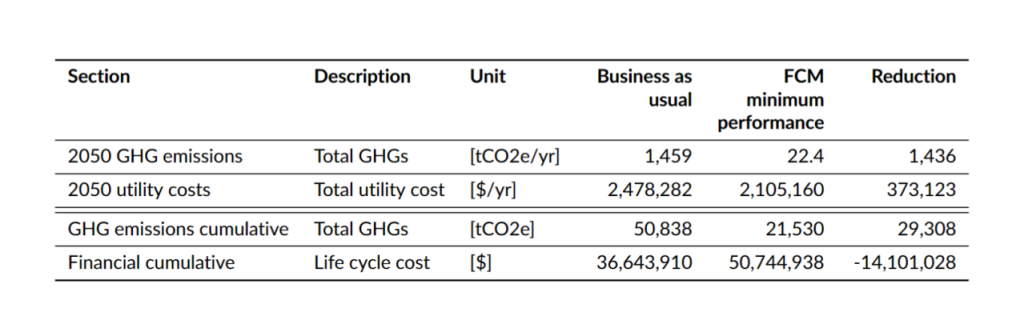 Results page of inputting changes and their costs (Credit: City of Cambridge)
“This scenario would imply a $14.1 million life cycle cost premium vs the Business as Usual scenario ($50.7 million vs $36.6 million between now and 2050 across the 10 observed sites),” read the report to Cambridge council. “This life cycle costing considers inflation, projected utility costs, capital costs and federal carbon charges.”
The goal is to reduce emissions by 50 per cent at these locations by 2033 and 80 per cent by 2043. The city also declared a climate emergency in 2019, and is working with other municipalities in the region to reduce corporate emissions by 80 per cent by 2050.
If successful, it would mean a reduction of 1,436 tonnes of CO2 are not being emitted by these buildings per year. According to the Government of Canada’s Greenhouse Gas Equivalencies Calculator, this would be the equivalent of 440 cars, 19.2 tankers of gasoline or 59,833 tanks of propane.