
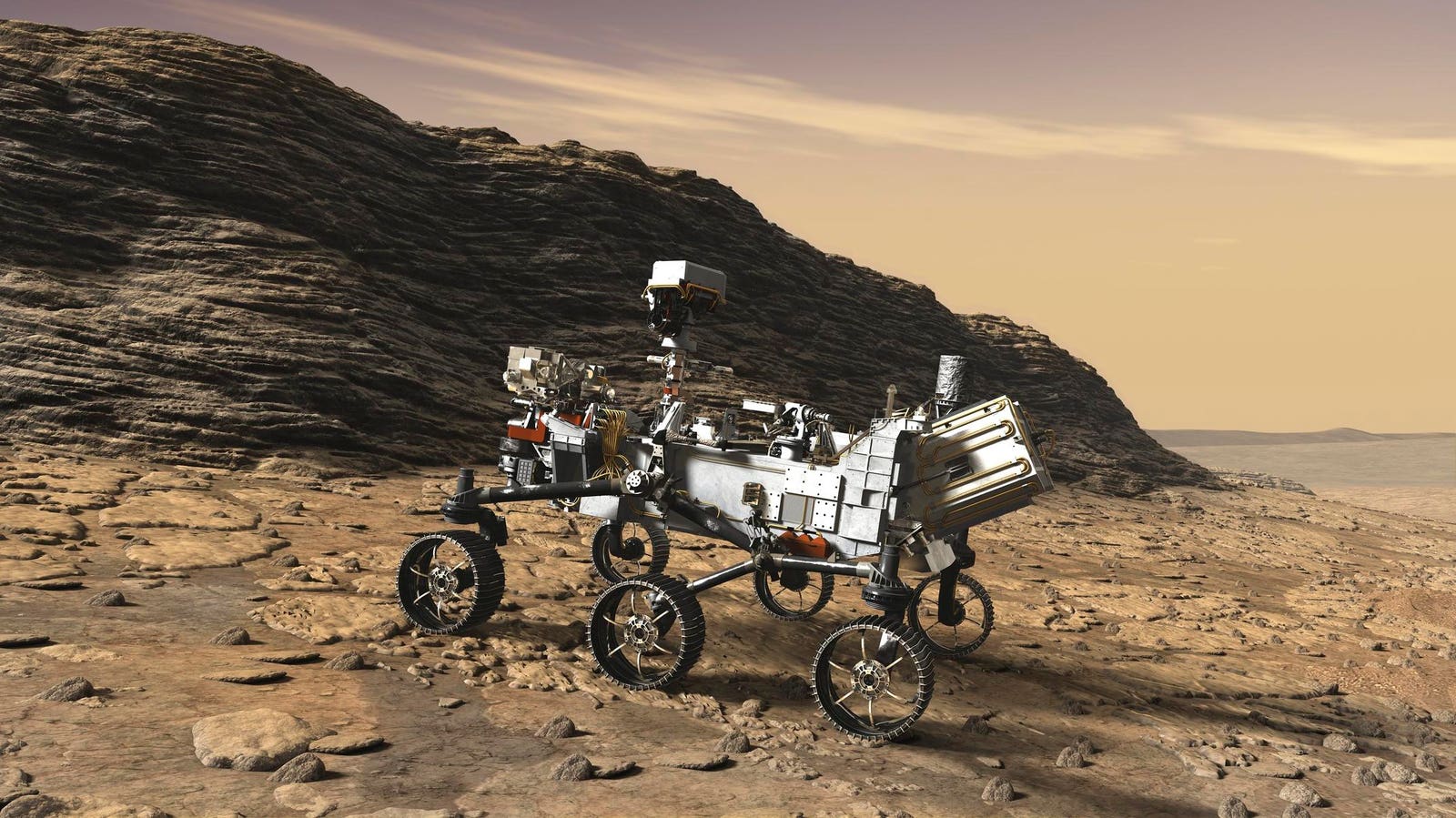
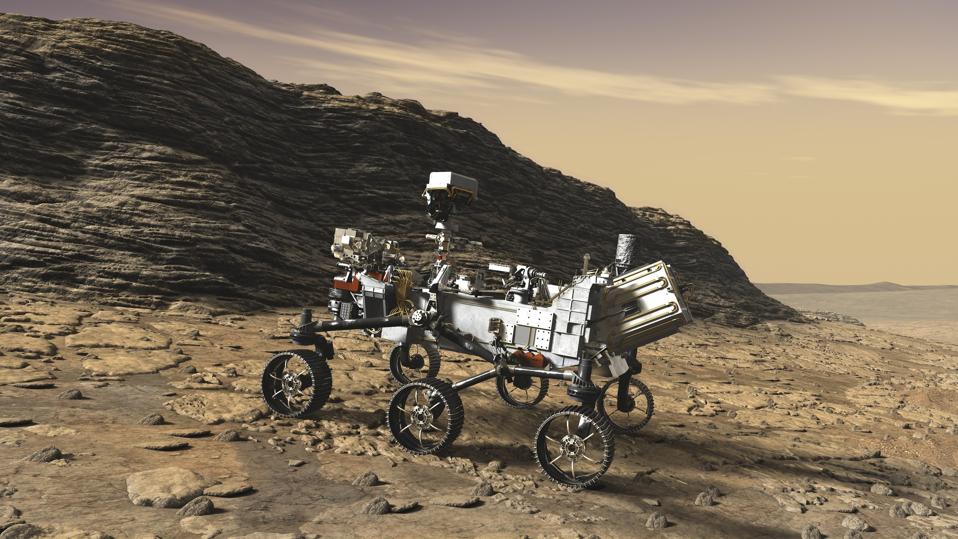
Artist’s concept of the Perseverance rover studying an outcrop. Perseverance will use powerful instruments to investigate rocks on Mars down to the microscopic scale of variations in texture and composition. It will also acquire and store samples of the most promising rocks and soils that it encounters, and set them aside on the surface of Mars.
getty
NASA’s news that its Perseverance Rover found potential biosignatures in rocks at Mars’ Jezero Crater is somewhat down for the count as the findings are now being challenged by leading geoastronomer Stephen Mojzsis. Mojzsis may be best known for throwing cold water on NASA’s 1996 announcement detailing putative evidence that the “Allan Hills” Mars meteorite contained evidence of ancient microfossils.
Mojzsis, currently at the University of Bayreuth’s Bavarian Geoinstitute in Germany, is now disputing the Perseverance Rover’s “potential biosignature” hypothesis which was published only a couple of weeks ago in the journal Nature.
There is nothing about this chemistry that cannot be explained by reactions that can happen in the absence of life, Mojzsis told me via email. The documented organic matter, phosphate minerals and proto-sulfide minerals are all found in meteorites, Mojzsis, who was not one of the Nature paper’s referees, told me.
Mojzsis suspects that similar non-biological chemical reactions could have occurred in these Martian rocks.
Although Mojzsis is always professionally cautious, his early reaction to the Allan Hills 84001 meteorite announcement (which was found in Antarctica in 1984) is now seen by the larger planetary science community as prescient.
In fact, NASA’s assertions about microfossils in that Mars meteorite are now viewed with serious doubt; with most geologists noting that just because the meteorite’s interior morphology may resemble bacterial microfossils, the more likely explanation is that they were caused by non-biological processes whether in Antarctica or on Mars.
On The Sample Hunt
But that doesn’t mean we shouldn’t be heartened that Perseverance is still fulfilling its principal mission and out there collecting samples in an area of Mars that does seem to be promising for finding ancient signatures of life in whatever form.
NASA’s most recent announcement involves an area of Mars’ Jezero Crater that does seem to have been habitable some 3.5 billion years ago. During its ongoing exploration and sampling of the area, Perseverance collected a core sample from the Bright Angel rock formation.
The formation is really just a set of rocky outcrops on the edges of an ancient river valley that NASA says is thought to have been carved out by water rushing into the crater. During its time in the area, the rover collected a sample called “Sapphire Canyon.”
Now stored in a sealed tube inside the rover, the “Sapphire Canyon” sample is biding its time waiting to be ferried back to Earth via what researchers hope will be a future follow-on sample return mission.
Intriguing Minerals
We show that organic-carbon-bearing mudstones in the Bright Angel formation contain submillimeter-scale nodules and millimeter-scale reaction fronts enriched in ferrous iron phosphate and sulfide minerals, likely Vivianite and Greigite, respectively, the Nature paper’s authors write.
Vivianite is frequently found on Earth in sediments, peat bogs, and around decaying organic matter, says NASA. And, similarly, certain forms of microbial life on Earth can produce Greigite, NASA notes.
The combination of these minerals, which appear to have formed by electron-transfer reactions between the sediment and organic matter, is a potential fingerprint for microbial life, which would use these reactions to produce energy for growth, says NASA.
But are biosignatures the best explanation for these minerals at Jezero?
Vivianite is an interesting phosphate mineral; not one of those things that are touted as a “biomineral,” says Mojzsis. The 1890 Augustinovka meteorite that fell to Earth in Ukraine indicates that Vivianite can form in extraterrestrial or impact-related environments, he says. Greigite is also found in meteorites, including carbonaceous meteorites, says Mojzsis.
NASA argues that it seems unlikely that chemical byproducts of these ancient mudstones would be produced abiotically given the conditions known to be prevalent in Jezero Crater at the time these mudstones were formed.
There are ways to produce them without biological reactions, including sustained high temperatures, acidic conditions, and binding by organic compounds, says NASA. But the rocks at Bright Angel do not show evidence that they experienced high temperatures or acidic conditions, and it is unknown whether the organic compounds present would’ve been capable of catalyzing the reaction at low temperatures, NASA reports.
Yet Mojzsis again disagrees. Were microbes eating organic matter and breathing rust and sulfate in the iron and carbonaceous meteorites where similar minerals were also found? he asks. I think not, says Mojzsis.
What is NASA missing in its quest to find biosignatures on Mars?
We lack a firm idea of how life began on Earth, says Mojzsis. Any discussion of “biosignatures” rests on non-existent foundations if we do not have the slightest clue what the earliest most primitive life forms were actually like, he says.
The Nature paper’s lead author sees it differently.
The authors anticipate and welcome further discussion in the peer-reviewed scientific literature as a next step in the process of evaluating our findings, Perseverance mission scientist Joel Hurowitz and the Nature paper’s lead author at SUNY Stony Brook, told me via email.
The Bottom Line?
I have yet to see any compelling evidence whatsoever that life arose on Mars, says Mojzsis.
ForbesWhy Mars Could Hold The Keys To Understanding Life Here On EarthBy Bruce Dorminey