
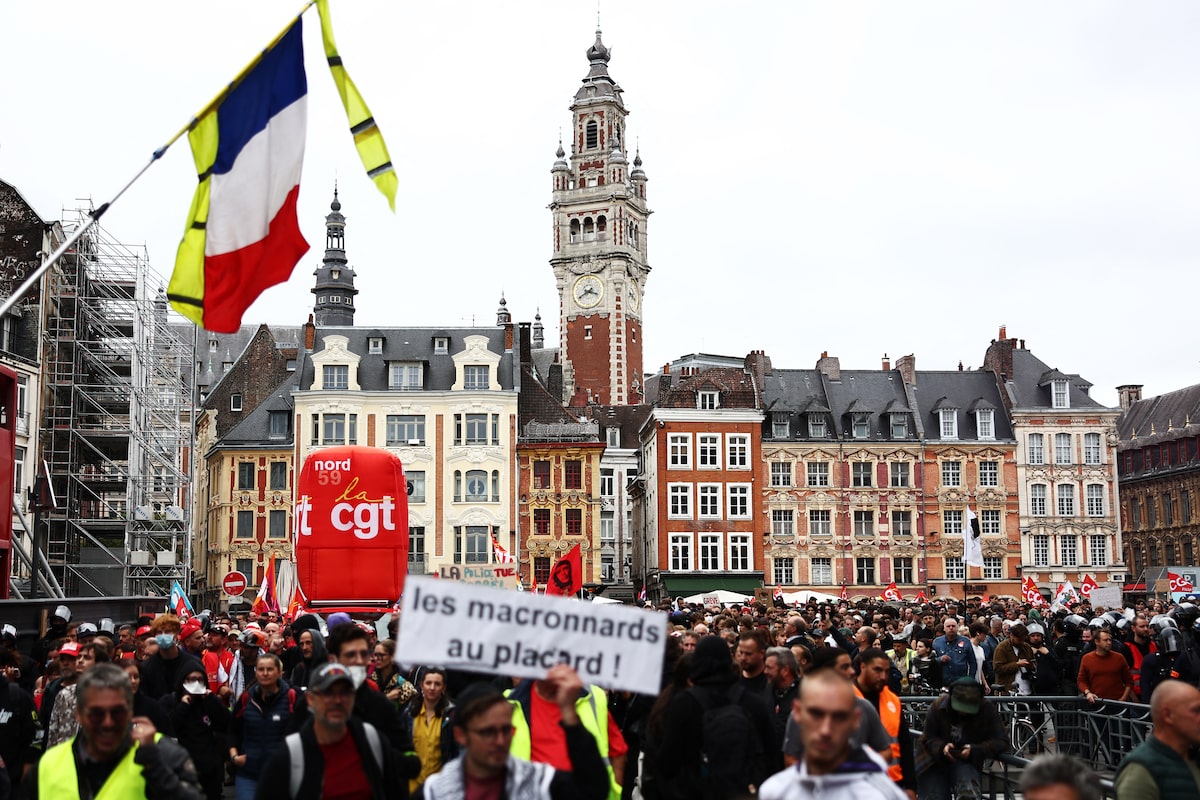
French protestors at La Grand’Place in Lille, France, last week during a day of nationwide strikes and protests. French political turmoil is expected to hamper economic growth in the region.SAMEER AL-DOUMY/AFP/Getty Images
Euro zone economic growth continues to hold up as Germany’s budget largesse props up sentiment and offsets turmoil in France, but more weakness may be ahead as U.S. tariffs start to exert their full effect, key data showed on Tuesday.
The euro zone has been expanding quicker than economists had expected this year, sparking debate over whether the bloc is simply more resilient than thought and how much damage French political turmoil will do across the 20 nations. Seemingly adding to the resilience case, the HCOB flash composite PMI edged up to 51.2 in September from 51.0 in August for its ninth consecutive month of growth.
But the underlying trend was mixed and suggested that the industrial rebound may be fizzling out, leaving services to support growth.
“The details are not as rosy as the headline index suggests,” Oxford Economics’s Riccardo Marcelli Fabiani said.
“Sentiment was soft and incoming orders from abroad continued worsening, pointing to no strong rebound happening after the drop in exports following the introduction of tariffs,” he said.
Another concern is that the steady improvement in PMI figures is solely attributable to Germany, where fiscal expansion is likely to drive growth for years to come.
“France stands out negatively,” ING economist Bert Colijn said. “With heightened political uncertainty, the French economy appears to be mirroring this sense of instability.”
EU turns to private funding to boost quantum technology ambition
Opinion: The EU’s deal with Trump could blow up at any time
Germany’s PMI bounced to a 16-month high of 52.4, beating poll expectations for a modest lift to 50.6 from 50.5. But in France, activity contracted for a 13th month and at the fastest pace since April, with its PMI falling to 48.4. Echoing the euro zone number, British firms also reported a loss of momentum and confidence as the PMI fell slowed to 51.0 in September from 53.5 in August.
The euro zone is still to take the full hit from U.S. tariffs, which will slow its already modest growth rate even further, the Organisation for Economic Cooperation and Development said in a separate report.
“The full effects of tariff increases have yet to be felt – with many changes being phased in over time and companies initially absorbing some tariff increases through margins – but are becoming increasingly visible,” the OECD added.
This will slow euro zone growth to just 1.0 per cent next year from 1.2 per cent this year, as increased trade frictions and geopolitical uncertainty negate the boost from lower ECB interest rates and Germany’s fiscal expansion.
Growth in the U.K. is also seen dropping to 1.0 per cent next year from 1.4 per cent in 2025 on a tighter fiscal stance, higher trade costs and greater uncertainty.
“Fiscal expansion is expected to boost economic activity in Germany, but expected consolidation in both France and Italy will dampen growth,” the OECD added.
However, the OECD confirmed the ECB’s view that inflation will now hold at or just below the 2 per cent target, which will keep alive hopes for more policy easing, especially as consumption growth softens.