
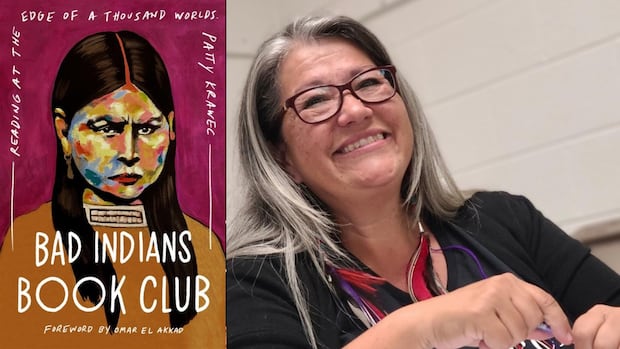
The Next Chapter25:32What does it mean to be a Bad Indian?
When a friend asked Patty Krawec, who is Anishinaabe and Ukrainian, for a few book recommendations to better understand Indigenous issues and perspectives, she put together a reading list.
The list resonated deeply and quickly grew into something more: first a book club, then a podcast, where Krawec brought Indigenous and other marginalized writers into conversation with engaged readers.
Those rich and “really good” discussions became the foundation for her latest book, Bad Indians Book Club. The book captures the spirit of a year-long journey through Indigenous literature, drawing from powerful conversations with both authors and readers.
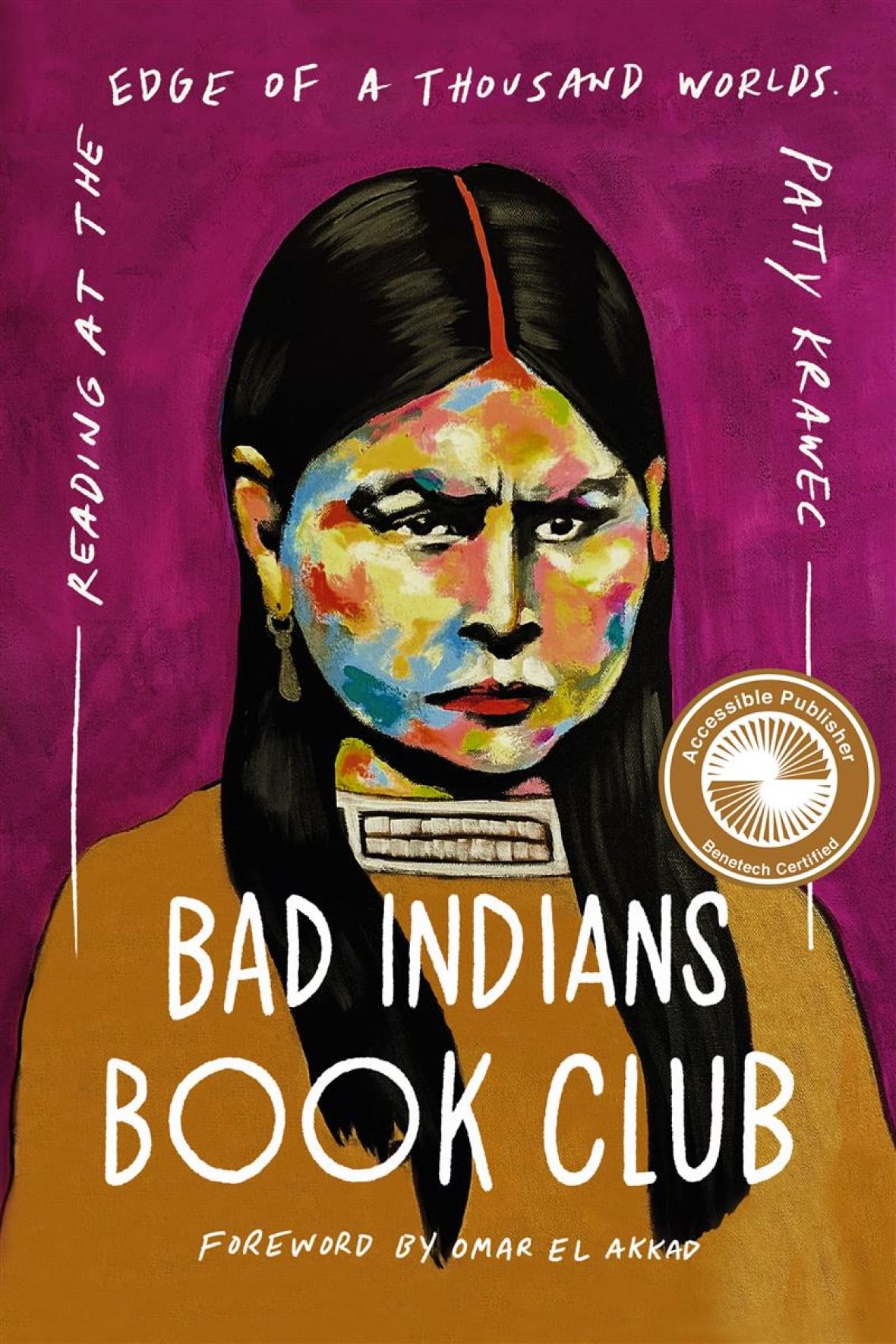 (Goose Lane Editions)
Krawec explores works of history, science, gender, memoir and fiction — all written by “Bad Indians” and others like them, whose refusal to accept the dominant narratives of the wemitigoozhiwag (European settlers) opens up new possibilities for identity, belonging and existence.
A member of the Lac Seul First Nation in Treaty 3 territory, Krawec is an activist and former social worker. Her work, centred on how Anishinaabe belonging and thought can shape faith and social justice, has been featured in Sojourners, Rampant Magazine and Midnight Sun, among others.
She is also the author of Becoming Kin: An Indigenous Call to Unforgetting the Past and Reimagining Our Future. Krawec currently lives in Niagara Falls.
Krawec joined The Next Chapter‘s Antonio Michael Downing to reflect on what she’s learned from writing Bad Indians Book Club.
Your book is called Bad Indians Book Club. Who is invited? How do you define a “Bad Indian”?
Everybody is invited. Bad Indians Book Club is really about reading against the stories that are told about all of us.
We know that there are multiple stories about white people. They do all kinds of stuff. They star in everything. They’re on the cover of all the books. But, there’s a single story about Indigenous people, Black people, queer people, Palestinians and Jewish people. We know that the single story being told about ourselves is not true. We know that we’re not a homogenous group with clear boundaries between other groups.
Part of the way of correcting that is to listen to each other, to read each other’s stuff, to get together and talk about what we’re reading. That’s why everybody is invited, because everybody needs to challenge these overarching stories that keep us all separate from each other.
A “Bad Indian” is really just somebody who does that, who is willing to stand up against — whether it’s through activism or reading or teaching — stand up against these structures or norms or assumptions.
We know that the single story being told about ourselves is not true.- Patty Krawec
I hear you — what I hear when I hear Bad Indian, I hear, ‘Be what people don’t want, but stay true to you, even though there’s a cost to that,’ and that’s a really courageous path to take.
It can be, yeah, because I mean, as marginalized people, we all know the good ones, right? The ones that get accepted, the ones that get promoted, and held up as a good example of their race, all that kind of model minority thing.
Bad Indians just refuse that. And it really is a global name because even people from India aren’t Indians. They’re Bangalorian and Punjabi and Bengali … and they were named Indians by Europeans back in the 1400s, and so Indian really just means ‘The local people we can’t be bothered to get to know, and that’s global.’
You include writers from a variety of backgrounds and experiences alongside Indigenous authors. Why did you take this approach?
Originally the list really was about Indigenous writing.
[But] in February, we were talking about history — because February is Black History Month — [that] Black people are also Indigenous in their own right, as well as just [that they’re] often part of our communities — so I included the author, Tiya Miles, who’s written a number of really good books about Afro-Cherokee history.
She made a comment in [a] conversation, that there are gaps — and this was from her own experience in graduate school — that there are gaps in Black studies where Native people should be, and that there are gaps in Native studies where Black people should be.
A Bad Indian is really just somebody who does that, who is willing to stand up against — whether it’s through activism or reading or teaching — these structures or norms or assumptions.- Patty Krawec
That got me thinking about the gaps — about the gaps in my reading, about the gap in understanding being Indigenous as a global political circumstance — and so then I started looking for other voices that could fill those gaps.
You finished with a very touching letter to your mom. Why was it important to close out the book with that shout out to your mom?
My mom taught me to love reading, she raised me to be surrounded by books. I was that kid that would read soup can labels or the back of the cereal box if I had nothing else available.
As I was looking for a way to wrap up the book, I had to acknowledge the person who taught me how to love reading because that’s what radicalizes you, it gets you willing to get at the root of things.
I had to acknowledge the person who taught me how to love reading because that’s what radicalizes you, it gets you willing to get at the root of things.- Patty Krawec
Our politics are not the same, our spiritual convictions are not the same, but we both agree that the world could be so much more than it is, that there is so much justice waiting for us to take hold of it and bring a better world into being.
This interview has been edited for length and clarity.