
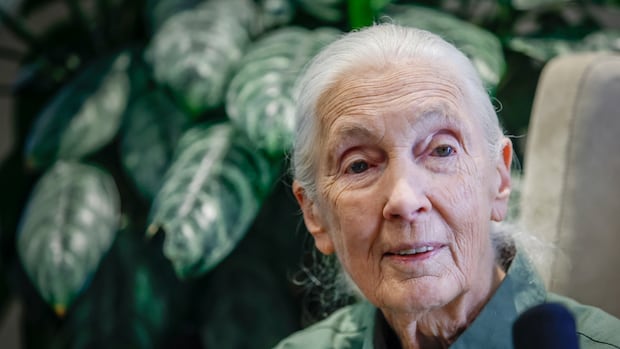
Jane Goodall, a world-famous expert on chimpanzees, is being remembered in Toronto for her groundbreaking research, conservation efforts and environmental activism.
The Toronto Zoo says it has lowered its flags in her honour and will set out books of condolences for its visitors to sign in her memory.
Goodall, who changed the way the world looked at primates, has died at 91. She died of natural causes, the Jane Goodall Institute said in an Instagram post on Wednesday.
In a statement on Instagram on Wednesday, the Toronto zoo said it was “deeply saddened” to learn of her death.
“Dr. Goodall was not only a pioneering scientist and one of the world’s most influential conservation leaders, but also a tireless advocate for animal welfare and stronger protection for wildlife here in Canada and around the world,” the zoo said in the post.
“We honour her life, her voice, and her enduring legacy, and we are profoundly grateful for the paths she blazed in science, conservation, and advocacy,” it continued.
“Dr. Goodall’s legacy lives on in every young mind she inspired, every species saved through her influence, and in the work we continue at your Toronto Zoo to protect wildlife and safeguard hope for future generations.”
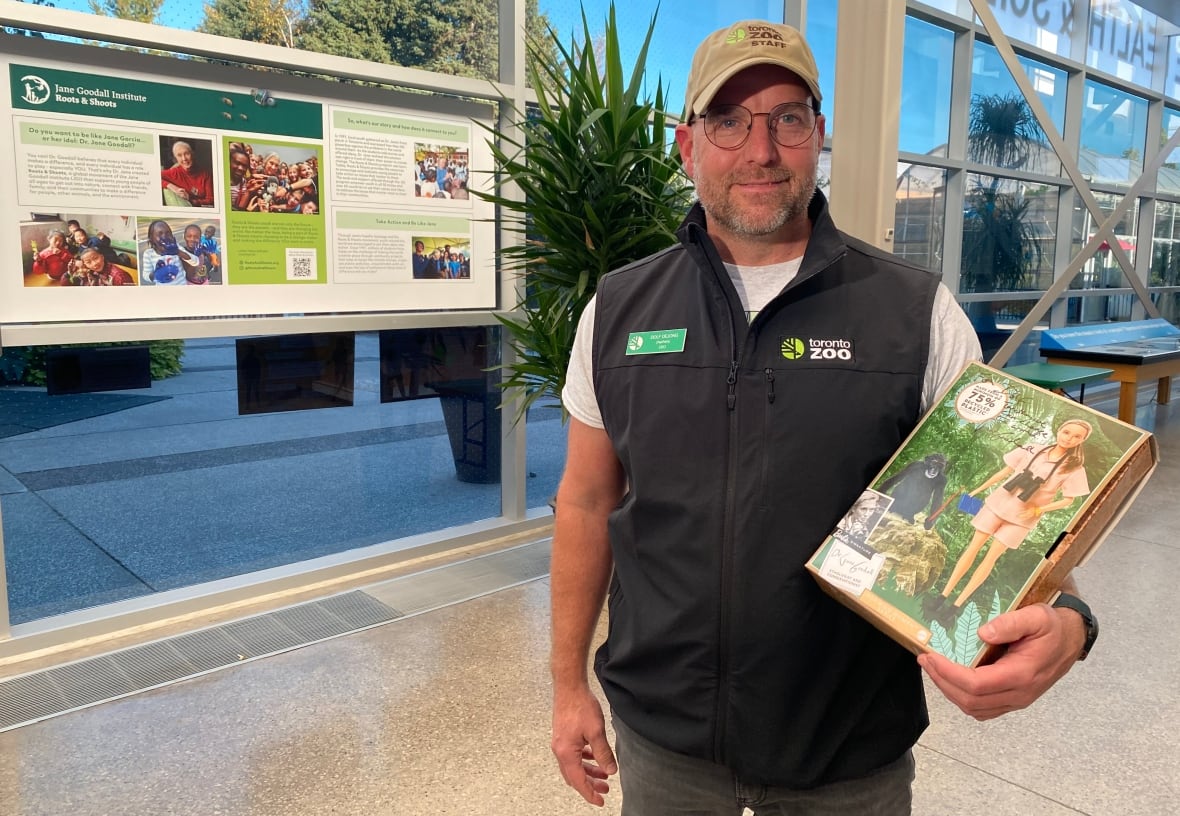 Dolf DeJong, CEO of the Toronto Zoo, says: ‘We’re really just talking about the grandmother of the conservation movement, somebody who took animals from this perception of being numbers to being individuals and really helped us reconnect with the natural world in ways that were missing until she showed up.’ (Tyler Cheese/CBC)
Dolf DeJong, CEO of the Toronto Zoo, said her death is a huge loss for the conservation community.
“We’re really just talking about the grandmother of the conservation movement, somebody who took animals from this perception of being numbers to being individuals and really helped us reconnect with the natural world in ways that were missing until she showed up,” he said.
“She took an approach of hope, of caring, of optimism and of personal action and we need more of that, not less.”
DeJong said the Jane Goodall Act Act (Bill S-241), a federal bill that has yet to become law, was named after her because it aims to create some of the strongest protections for animals in captivity in the world and improve standards for animal well-being. The federal bill passed second reading in the Senate in 2023. It was dropped from the Senate order paper last year.
“When you have the grandmother of conservation showing up and endorsing a piece of legislation, it gives it the attention it’s finally due. It takes it from being a marginal issue to being mainstream. And that really let us advance the discussion, the narrative around animal well-being,” he said.
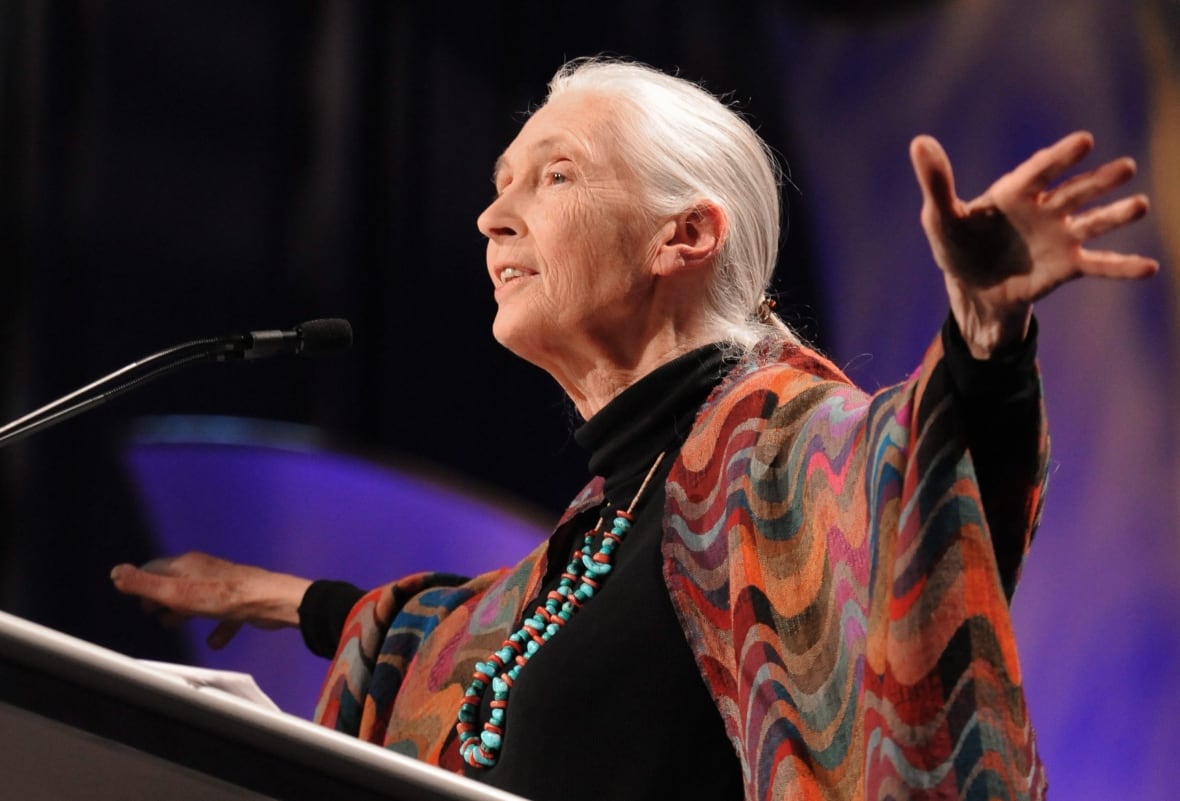 Goodall gestures as she accepts the Minerva Award in Long Beach, Calif. in 2009. (Katy Winn/The Associated Press)
Bella Lam, executive director of the Jane Goodall Institute Canada at the University of Toronto, said she is in shock after learning of her death. She said she knew Goodall for the last 10 years.
“She was larger than life and inspired so many of us,” Goodall said.
Lam said Goodall, who often visited Canada twice a year, has touched the lives of many Canadians. Goodall was known for her message of hope in the future, she said. She believed that people could make a difference in the world, Lam said.
“The lasting impact, it’s really in the way that she’s moved from just being a scientist to being somebody who’s really advocating … for all of us to live in harmony with nature to protect this one precious planet we all call home,” Lam said.
Lam said Goodall the person, as opposed to Goodall the celebrity, had a sense of humour and carried herself with grace and had a joy for life.
 Wildlife veterinarian Izzy Hirji says: ‘While there is a huge void in this world without her, her inspiration has been passed onto millions, if not billions of people. And we are all the light that will carry her message forward.’ (Spencer Gallichan-Lowe/CBC)
Wildlife veterinarian Izzy Hirji said he was inspired by Goodall since he was a young boy and became a veterinarian because of her.
He met Goodall through the institute’s Roots and Shoots program, an initiative she designed to inspire young people through environmental, conservationist and humanitarian projects.
He said she was a gracious, humble and inspiring human being.
At her last lecture in Toronto last September, he said, Goodall was “full of glee” and promoting a message of peace for a “turbulent world.”
“While there is a huge void in this world without her, her inspiration has been passed onto millions, if not billions of people. And we are all the light that will carry her message forward,” he said.
“I just wish we had more angels in the world like her. The world is a very difficult place these days. People like that give us hope. All we can do is continue to be that hope and continue to act in her legacy.”