
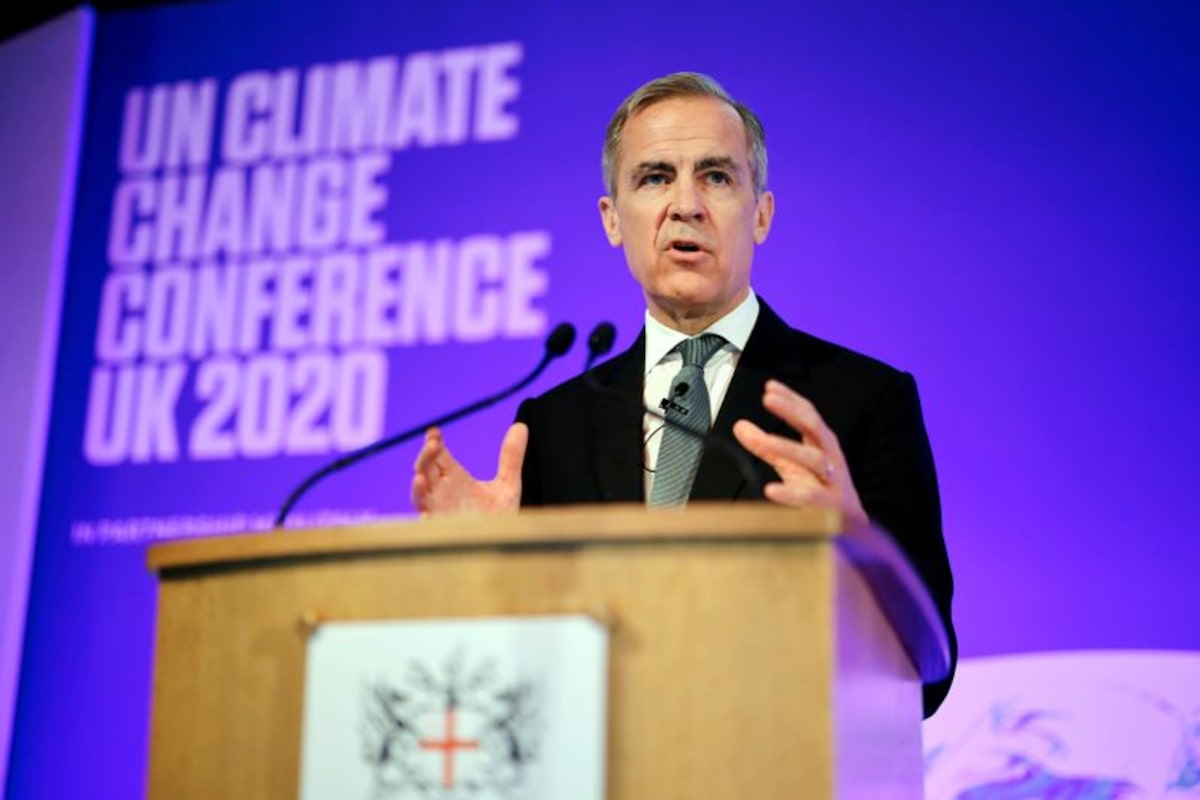
Mark Carney makes a keynote address for the 26th UN Climate Change Conference of the Parties, or COP26, in London in February of 2020. Mr. Carney helped establish the Net-Zero Banking Alliance while serving as a UN special envoy on climate action and finance.POOL New/AFP/Getty Images
Almost exactly four years after Prime Minister Mark Carney convinced Canada’s largest financial institutions to join a global alliance committing them to net-zero emissions related to their lending, the organization is shutting down.
The Net-Zero Banking Alliance (NZBA), which Mr. Carney helped to establish in April, 2021, while serving as a United Nations special envoy on climate action and finance, ceased operations Friday after losing most of its membership. Political pressure from Republican lawmakers in the United States led the NZBA’s largest American members to abandon the group in late 2024 and all of Canada’s largest lenders also bailed earlier this year.
The Prime Minister’s office did not respond to a request for comment.
Analysis: Canada’s industrial carbon pricing system is a mess. Here’s how Carney can fix it
When the NZBA was first established ahead of the 26th UN Climate Change Conference of the Parties, or COP26, Vancouver City Savings Credit Union was the sole Canadian member of the group that included 63 financial institutions from 32 countries with US$40-trillion in assets. Royal Bank of Canada, Toronto-Dominion Bank, Bank of Nova Scotia, Bank of Montreal, Canadian Imperial Bank of Commerce and National Bank of Canada jointly announced plans to join the group in October, 2021.
The NZBA went on to publish more than a dozen reports that, according to its website, helped almost 150 banks around the world develop climate-related business strategies and set more than 500 sectoral net-zero targets.
Following a widespread backlash to climate-related corporate initiatives that accelerated after the election victory of U.S. President Donald Trump in November, 2024, businesses started a mass exodus from environmentally focused groups.
The Net Zero Asset Managers Initiative (NZAMI), the sister organization to the NZBA for institutional investors that had more than 325 members managing a combined US$57.5-trillion in assets, also suspended operations in January after its largest member – BlackRock Inc. – decided to leave.
Shortly before leaving the NZBA, the chief executives of RBC and BMO suggested the alliance was no longer the best mechanism for financial institutions to pursue their climate goals.
“If our countries have an objective to get to a certain point, we will be part of that, and therefore pulling out of NZBA hypothetically doesn’t lead to non-commitment to net-zero climate change,” RBC CEO Dave McKay said at a Jan 8 conference, one week before the lender left the alliance. “It just means that mechanism, that organization that fostered oversight and policies and rules around what you can and can’t do and how you report, maybe that is not the right mechanism to do it.”
Speaking at the same conference, BMO CEO Darryl White said the bank was still committed to climate transition, but added, “We also have a commitment, particularly here in Canada, to our legacy energy customers, and we will not abandon that.”
“What mechanism you choose to join or bodies that you choose to align with to enforce that – that’s just a pathway,” Mr. White said. “The ultimate goal is unchanged.”