
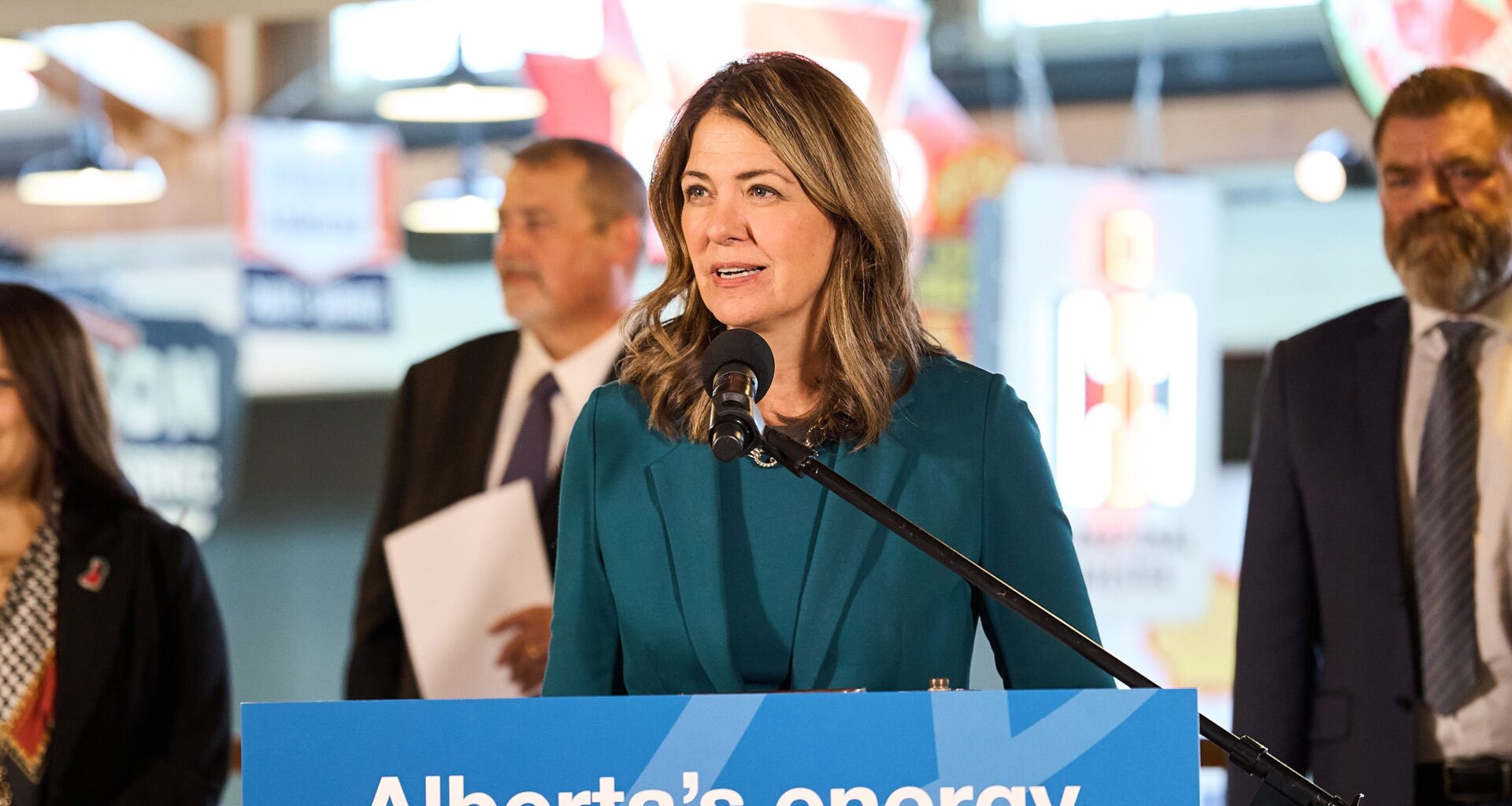
At long last, Danielle Smith’s government has found a proponent for her province’s latest pipeline dream: itself. On Wednesday, Smith announced that the province, with the “support” of a trio of pipeline companies, will draw up plans for a new pipeline that would bring Alberta’s oil to Pacific tidewater. She also effectively dared the federal government to oppose it. “This is a test of whether Canada works as a country,” Smith told reporters in Calgary.
It’s also a test of whether we’re willing to let feelings run roughshod over the facts. For all of Smith’s anti-Ottawa bluster, the absence of a private-sector proponent for her new oil pipeline here might have less to do with federal policies than the reality that — trigger warning, Conservatives — there just isn’t a strong business case for it. The US Energy Information Agency is forecasting an oil price of just $48 per barrel in 2026, one that seems to align with president Donald Trump’s stated preference for crude prices. The longer-term picture might not be much better, given the prospect of peaking demand in China and the growing adoption of electric vehicles in the developing world.
Prices notwithstanding, we might not even need that new pipeline. As energy economist Peter Tertzakian told the Globe and Mail’s Tim Shufelt recently, “an additional 1 million barrels a day could be [shipped] using existing infrastructure. That’s billions of dollars of annual revenue that could be accessed without a major capital investment.”
And while Smith talks a big game about the need for new infrastructure, she doesn’t seem to have actually done much about it. BC Premier David Eby’s dismissive reaction to her announcement suggests she hasn’t succeeded in convincing him about the merits of the project. “Smith continues to advance a project that is taxpayer-funded, has no private sector proponent, is not a real project and is incredibly alarming to British Columbians, ” Eby said.
The reaction from Indigenous leaders in British Columbia was even more negative. Marilyn Slett, the president of the Coastal First Nations-Great Bear Initiative and elected chief of the Heiltsuk First Nation, said “[w]e will use every tool in our toolbox to make sure that our coast remains tanker free.” Stewart Phillip, the Grand Chief of the Union of BC Indian Chiefs, was equally unequivocal. “Any proposal to ram a new oil pipeline through to BC’s North Coast is a direct assault on the inherent and constitutionally protected title and rights of the First Nations who steward these lands and waters,” he said in a statement.
Maybe, for all of her rhetorical crusading, she might actually prefer to see these new pipelines stay on the drawing board. Being able to blame Ottawa for the lack of progress is a useful political cudgel, one she deploys at almost every available opportunity. It distracts her voters from focusing on her own government’s failures, which range from failing healthcare and education systems and numerous corruption scandals to one of the highest unemployment rates in the country.
But if Danielle Smith actually wants to advance the prospects of a new oil pipeline, she needs to do more than just rattle her well-worn sabre at Ottawa. Instead, she needs to win over the two groups of people that are actually standing in her way: coastal British Columbians and First Nations communities that live, hunt and fish along the proposed route.
That could begin with legislation that voluntarily commits to covering all costs — fully and immediately — of any oil spill cleanup and remediation that results from the transport of Alberta oil across British Columbia. It would include compensation for impacted First Nations and nearby communities without delay, deflection or legal gamesmanship. This voluntary commitment would be without condition or qualification, and it would be in place until the last barrel of Alberta oil crosses through British Columbia.
Danielle Smith is daring Mark Carney to rubber-stamp another pipeline to the west coast. If she actually wants it to get built, she’ll need to put more on the negotiating table than just threats and political rhetoric.
This effort on Smith’s part should also include a meaningful increase in funding for the province’s Indigenous Opportunities Corporation, one that would go towards supporting ownership stakes in any new pipeline for BC First Nations. Theirs should be a majority position, not a minority, and the bulk of the economic benefits associated with operating and building the project must accrue to their people.
Oh, and the province should increase its offer to the Pathways Alliance for its proposed carbon capture and storage projects. As it stands, the federal government is offering a 50 per cent tax credit on eligible costs, while Alberta is chipping in a comparatively measly 12 per cent in grants. If it truly wants the support of Ottawa, British Columbia, and climate-concerned Canadians for its apparent ambitions, it needs to do much better than that.
I doubt it will, though. Behind the bluster and bravado is a premier who is determined to remain in power and understands the political value of playing the victim.