
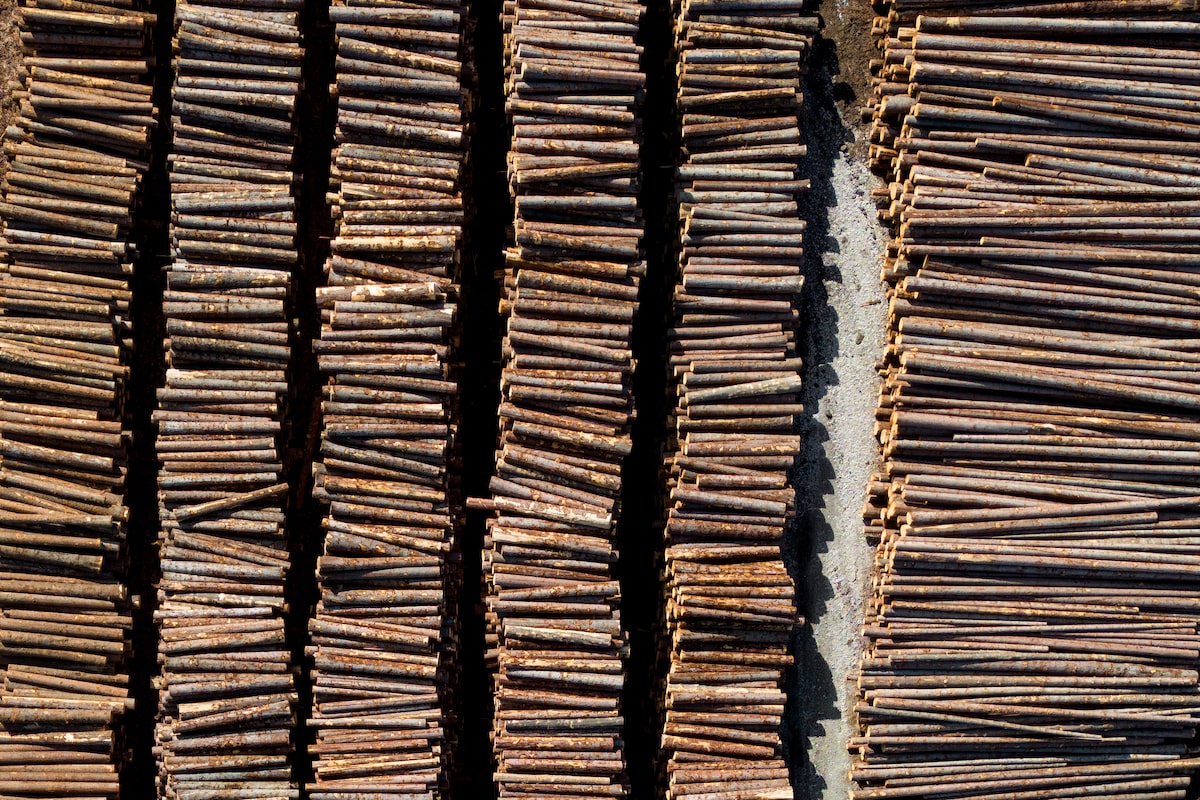
U.S. President Donald Trump on Monday announced an additional 10-per-cent tariff on Canadian softwood lumber shipments into the country.DARRYL DYCK/The Canadian Press
It’s hard to find anything good to say about Canadian forestry stocks right now. That may be their best quality.
Some of the biggest names in the sector have been on a downward slide for the past three years, as low lumber prices and weak U.S. homebuilding activity weighed on share prices.
This week, U.S. President Donald Trump added another reason to think again before investing in the sector.
On Monday, he announced an additional 10-per-cent tariff on Canadian softwood lumber shipments into the United States, effective Oct. 14, citing national security concerns.
The increase will bring the total levy on imports to about 45 per cent, on average. It follows a statement from Mr. Trump earlier in the year that U.S. forestry resources “are more than adequate to meet our domestic timber production needs.”
The share prices of British Columbia-based forestry companies West Fraser Timber Co. Ltd. WFG-T and Canfor Corp. CFP-T are down about 28 per cent each over the past year. That marks a stark contrast to the S&P/TSX Composite Index, which has gained 25 per cent over the same period and hit a record high this week.
But the onslaught of grim news has an upside: It has highlighted some bargains within the forestry sector. Heavyweight West Fraser is looking particularly attractive given that the stock is trading near five-year lows.
Okay, the definition of attractive rests on an assumption that risk-averse investors might not want to embrace just yet: Despite Mr. Trump’s bluster, the U.S. still needs Canadian lumber in a big way to feed its lumber-intensive home construction industry.
Says who? The National Association of Home Builders, for one.
The Washington-based advocacy group, which counts D.R. Horton Inc., Lennar Corp. and PulteGroup Inc. among its members – collectively valued at US$110-billion, based on the three companies’ outstanding shares – opposes tariffs on softwood imports and other building materials because they raise the cost of homes.
“To bring stability to the housing market, the administration needs to seek fair, equitable deals with America’s trading partners that quickly roll back tariffs on building materials,” Buddy Hughes, the Association’s chairman, said in an e-mailed statement this week.
Analysis: Can Canada finally sell more of its lumber overseas?
In any case, some analysts believe that U.S. forestry companies will struggle to replace Canadian softwood.
Ben Isaacson, an analyst at Bank of Nova Scotia, estimates that U.S. producers would have to build 50 new mills to become fully independent of Canadian annual lumber imports, based on normal demand.
That’s unlikely to happen, for a number of reasons.
Just two companies build the specialized equipment required in mills. They would struggle to supply even two mills a year, according to Mr. Isaacson.
U.S. forestry companies would also need 10 new – and expensive – pulp mills to handle the sawdust, chips and shavings that are byproducts of lumber production.
New lumber mills would only be economically viable with soaring commodity prices. Though the price of lumber futures gained some ground in September, they are still down about 10 per cent since August, forcing some producers to curtail output.
Even when lumber prices were soaring to record highs several years ago, providing a financial incentive for U.S. mills to ramp up production, Canadian imports to the U.S. did not budge, Mr. Isaacson added.
Admittedly, the conditions necessary for a sustained turnaround in Canadian forestry stocks are noticeably absent.
On Commodities: Lumber prices haven’t bottomed yet. Here’s when they will
U.S. single-family homebuilding activity, which is an important source of lumber demand, is in the dumps: Housing starts declined 7 per cent in August to a two-and-a-half-year low.
As well, builder sentiment – reflected in the monthly NAHB/Wells Fargo Housing Market Index – remains well below the historical average, suggesting that the immediate outlook from the pros is downbeat.
But West Fraser’s low valuation is probably reflecting much of this bad news already.
In one encouraging sign, its share price gained about 2 per cent between Monday and Thursday, suggesting that investors took Mr. Trump’s tariff news in stride.
Any sign of improvement in conditions for the Canadian forestry sector – say, from resilient Canadian exports to the United States, a slow uptake in U.S. lumber production or a rebound in U.S. homebuilding activity – could reward investors who take a chance on beaten-up stocks like West Fraser.
The U.S. President is determined to wipe out Canadian lumber imports. The Canadian forestry sector, though, may be well beyond Mr. Trump’s control.