
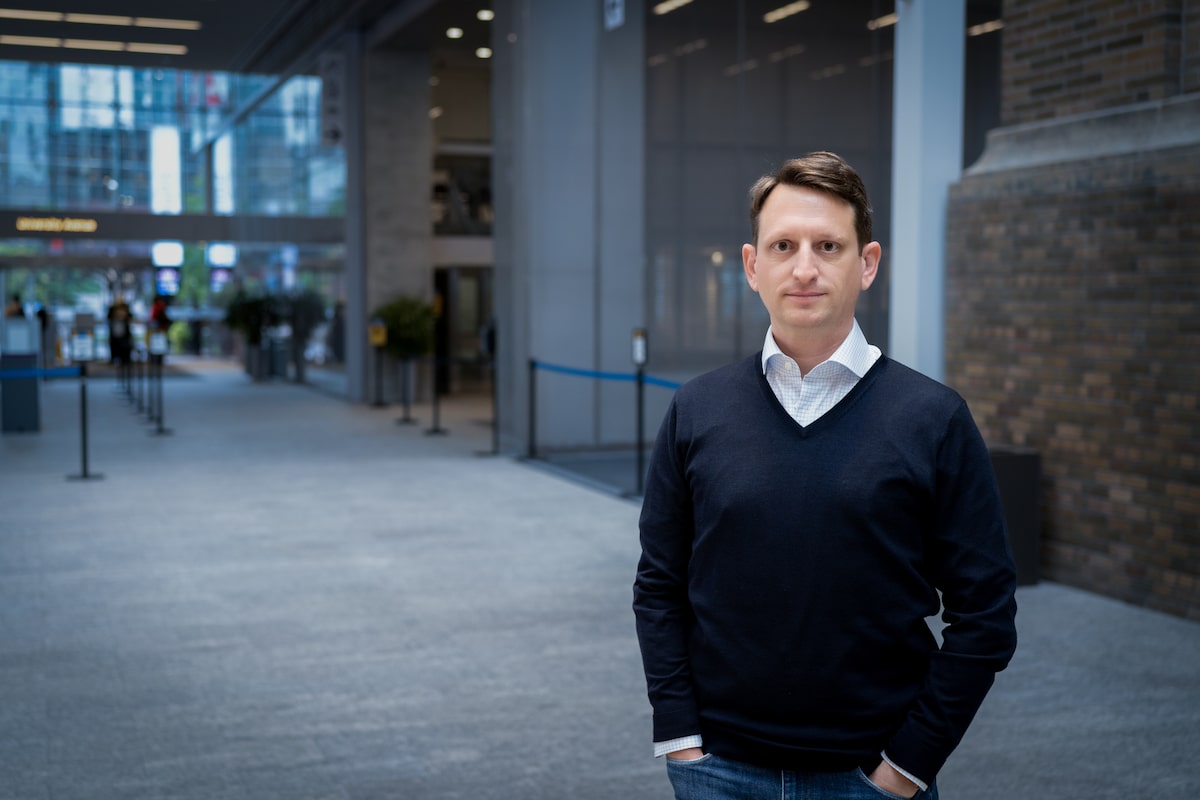
Radical Ventures co-founder and managing partner Jordan Jacobs. Its new fund will target nascent AI companies.Supplied
Toronto-based Radical Ventures has closed a new US$650-million fund to invest in early-stage artificial intelligence companies, even as the AI market looks increasingly frothy and warnings of a bubble mount.
The venture capital company, founded in 2017, began investing in AI startups when the category was far more niche and the technology had yet to have much of a commercial impact. The situation is very different today. AI startups accounted for more than two-thirds of global venture capital funding last year, totalling about US$135-billion.
“Everyone who was a crypto specialist is now an AI specialist,” said Radical co-founder and managing partner Jordan Jacobs in an interview Friday. “The money flowing into AI is enormous, which means there’s just more competition.”
The new fund will target nascent AI companies, which is a specialty of Radical’s. It cut the first cheque to Cohere Inc., which is now worth about US$7-billion. It’s also an early backer of Toronto-based autonomous driving company Waabi Innovation Inc.
Hopper leans into AI with virtual customer service agent it says is as good as humans
Variational AI inks drug discovery deal with Merck worth up to $349-million
The Canada Pension Plan Investment Board put US$75-million into Radical’s latest fund. CPP Investments has made several commitments to Radical over the years, starting with its first institutional fund in 2019, and totalling US$280-million as of July.
“We had a clear strategy to acknowledge that AI was going to be a huge trend,” said Afsaneh Lebel, head of funds at CPP Investments. “Investing in, effectively, first-time institutional funds is not something that we do with a degree of frequency, so it really did take a lot of relationship building and conviction in Radical’s plans.”
She added that the performance of Radical’s investments has “translated into top tier absolute and relative returns.”
But the boom in AI has created new challenges when scouting for investments. More competition means Radical has to work harder to find promising startups before others, and turn the founders it has already worked with into evangelists for the fund. “I can tell a founder all day long why we’re the best investors. If one of our portfolio companies says it, it’s way more compelling,” Mr. Jacobs said.
In the past couple of years, Radical has backed World Labs, which is co-founded by AI pioneer Fei-Fei Li and aims to generate 3D worlds to imbue AI with spatial awareness. More recently, it invested in Periodic Labs, a company staffed with former researchers from OpenAI and Google to achieve scientific breakthroughs, including by building autonomous laboratories.
With so much money flowing into AI, Radical is exceptionally picky. Mr. Jacobs said the company has met with thousands of AI startups in the past six years; it has invested in about 60 of them. “The important thing is to invest in the highest potential founders,” he said, “and then you can ride through any up or down of the market cycle.”
The AI market has done nothing but go up recently. While concerns of an AI bubble emerged not long after the release of OpenAI’s ChatGPT in late 2022, those worries are only getting stronger. U.S. tech giants are spending upward of US$490-billion by the end of 2026 to build the data centres to power AI, while the returns are less clear.
The massive data centre construction spree is reminiscent of the fibre optic buildout in the dot-com era, where supply far outpaced demand, and boom soon turned to bust. But there are differences, according to Mr. Jacobs. The fibre rollout was largely financed by debt, whereas the tech firms are funding data centres from their own balance sheets.
Moreover, AI companies are generating revenue quickly, he said. “That’s not to say there won’t be a correction. There will. Every cycle you have a lot of money lost. But more money is made than lost,” he said.
Since 2023, Radical has made a smaller number of investments in Canadian AI companies than in American ones. Recent research has raised alarms about an increase in Canadian founders choosing to start their companies abroad instead of at home, which is a threat to the country’s economic future.
“San Francisco is a 60-year-old ecosystem,” Mr. Jacobs said. “The size and density is extraordinary. We’re a much, much younger ecosystem.” Canada needs time for the first wave of AI entrepreneurs to exit or put money back into the ecosystem. “It’s natural that it takes longer to build the flywheel at the beginning,” he said.