
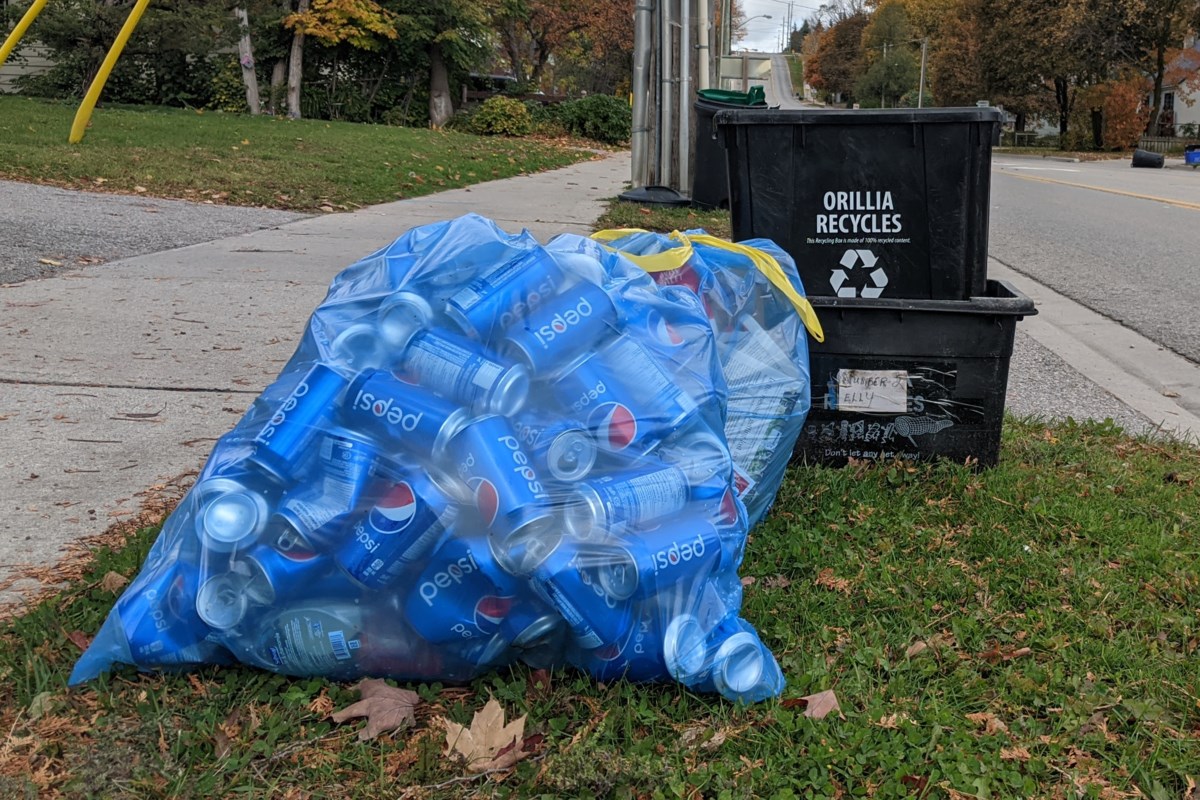
‘It doesn’t make sense,’ Coun. Ralph Cipolla says of move to shift cost to business owners as part of provincewide transition of blue box program
The landscape is changing when it comes to recycling in Ontario as the province moves to shift responsibility from municipalities to the private sector.
Coun. Ralph Cipolla says the move “doesn’t make any sense” when it comes to small businesses that could be forced to ante up funds to pay for collection of their recycling.
At Monday’s council meeting, council was asked to determine how best to move forward as of Jan. 1: to eliminate curbside recycling pickup for all industrial, commercial and institutional (ICI) businesses in Orillia or develop an online registration for businesses in Orillia that want to continue receiving curbside collection service for recycling box materials at a cost of about $275,000.
Greg Preston, the city’s director of environmental services, says staff recommend the city stop collecting recyclables for the ICI sector.
It’s a direction some councillors don’t agree with.
“As we know, businesses pay higher taxes than most residential taxpayers,” said Cipolla, an owner of a downtown business.
He fears stopping collection would “create a lot more stuff on the street” and warned of the “extra expense up and above (other taxes)” for already strapped business owners.
“It doesn’t make sense,” said the Ward 2 councillor.
Preston says it’s all about economies of scale. Currently, there are more than 15,000 collection stops in Orillia between residential and ICI customers. When the residential component is removed Jan. 1, 2026, there will be about 300 ICI customers, making collection for those customers onerous financially.
Preston said fixed costs (such as truck and staff costs) would continue but be spread out over dramatically fewer customers.
He said the city and others have lobbied the province to put pressure on manufacturers and the private sector to step up — particularly for smaller ICI customers.
“But we don’t see any resolution at this point,” said Preston.
Coun. David Campbell said the concept, in general, has merit.
“Full producer responsibility: what a great concept,” Campbell said. “When I first heard that, I was so excited.”
He said he hoped the shift to manufacturer responsibility would help reduce “disgusting” overpackaging.
That’s why he thinks not including ICI customers “makes no sense whatsoever.”
He said he thinks the city would be wise to use the $275,000 from the expected $1.8 million in savings (from taking collection responsibility away from the city) to fund recycling services for local businesses.
Preston warned council that if it took that approach and the province changed its mind on the issue, the city could be left on the financial hook.
“If we sign a long-term collection contract to collect ICI and the province changes legislation, we could potentially face a claim from the service provider for cancelling service early,” he said.
He also explained the city, traditionally, recovers only 50 per cent of the net cost of collecting residential materials.
“ICI has never been included as a refundable service through the prior blue box program,” he explained. “Now, the residential collection program is being fully covered by producers and not covered by taxpayers. Businesses pay their taxes, but the cost of operating the service is certainly higher than taxes, so it is in fact being subsidized by residential taxpayers.”
Mayor Don McIsaac asked why residential taxpayers should subsidize local businesses by paying for ICI collection, to which Cipolla suggested increasing taxes to business owners by one per cent to cover the costs.
Campbell said he’s worried about unintended consequences.
“My biggest concern is … we have an industry that has got into the habit of recycling — which we absolutely want — (that) will look at the cost and just throw everything in the dumpster,” he said.
“If this means we’re going to get a tremendous amount of recycling just going to our diversion site, that is a serious concern.”
Preston noted businesses would have to pay to bring recyclables to the waste diversion site, but he stressed the city could not control what private companies might do with recyclables they collect.
Council deferred a decision until the Oct. 20 meeting. Between now and then, city staff will canvas Downtown Orillia Business Improvement Area stakeholders on the matter.