
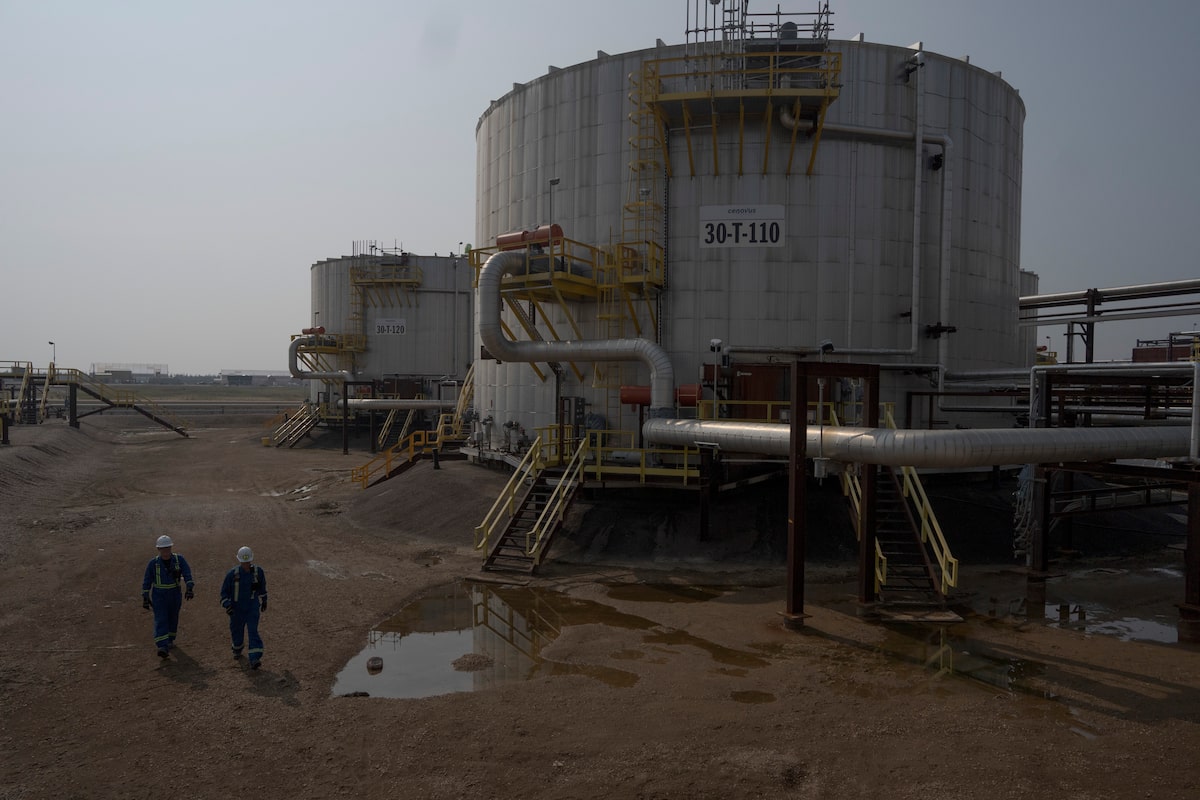
Crude oil tanks at Cenovus’ Sunrise oil facility northeast of Fort McMurray in 2023. Cenovus sweetened its rival takeover bid for MEG to roughly $8.6-billion on Wednesday.Victor R. Caivano/The Associated Press
Adam Waterous is abandoning his quest to acquire MEG Energy Corp. MEG-T.
In a statement released late Friday, the executive chairman of Strathcona Resources Ltd. SCR-T said the company was terminating its hostile takeover bid for MEG. The decision effectively puts an end to a dramatic bidding war over the last of Canada’s pure-play oil sands producers that saw the price on the table for MEG rise by roughly $2.7-billion over less than five months.
Strathcona, which is owned by a private equity firm headed by Mr. Waterous, first offered to buy MEG in May for roughly $5.9-billion. The MEG board of directors urged shareholders to reject that deal in June and two months later, on Aug. 22, the MEG board unanimously endorsed a $7-billion takeover proposal from Cenovus Energy Inc. CVE-T that was composed of 25 per cent stock and 75 per cent cash.
Earlier: Cenovus sweetens takeover bid for MEG Energy to $8.6-billion
Two weeks later, on Sept. 8, Strathcona countered with a revised bid composed entirely of stock, offering 0.8 Strathcona shares per MEG share, which at the time valued the company at roughly $7.85-billion. Cenovus chief executive officer Jon McKenzie said shortly after Strathcona raised its offer that his company would not be baited into a bidding war for MEG.
However, two days after The Globe reported that several large MEG shareholders planned to vote against the Cenovus deal alongside Strathcona – which owns 14.2 per cent of MEG – Cenovus sweetened its bid to roughly $8.6-billion. The latest Cenovus bid includes a higher stock component than its original offer, being equally divided between cash and shares.
“While Strathcona is disappointed with this outcome, it is pleased that its actions, along with those of its fellow MEG shareholders, delivered something which the MEG Board could not, namely a more equitable transaction with Cenovus which allows MEG shareholders to participate more meaningfully in future upside,” the Strathcona statement said.
At least two-thirds of votes cast at a meeting of MEG shareholders set for Oct. 22 must be in favour of the Cenovus offer for the transaction to proceed. That meeting was originally scheduled for Oct. 9 but was delayed after Cenovus announced it was increasing its offer.
Strathcona said the MEG board’s decision to allow Cenovus to acquire more MEG shares to vote in favour of its own transaction “is without precedent in the Canadian public markets and the latest in a series of anti-competitive actions taken by the MEG board.”
Cenovus did not respond to a request for comment on the Strathcona statement.
Mr. Waterous had previously accused the MEG board of adopting an “anybody but Strathcona” view. He said Cenovus was “preying on a weak board” and that negotiating with MEG “was like taking candy from a baby.”
Mr. McKenzie responded that, in reality, MEG ran a traditional strategic review process. More than a dozen companies participated in that process, he said, which resulted in multiple bids.
Strathcona has promised to pay out a special dividend in the fourth quarter of $5.22 per share if its quest to acquire MEG was successful, rising to $10 per share if not. In its statement late Friday, the company said anyone who holds Strathcona stock as of Oct. 17 should expect to receive the $10-per-share dividend payment in December.
MEG and Cenovus have neighbouring operations in the Christina Lake region of northeast Alberta. They are so close to each other that, Mr. McKenzie said, “you can really throw a rock from our plant to their plant.”