
The soybean rarely rises to any level of public interest in the United States. It is invisible to most consumers, used primarily as animal feed and, increasingly, as the raw material for biodiesel.
But soy has long been a lynchpin of the U.S. agricultural economy and now, in the first harvest since Donald Trump returned to the White House, the crop has become a crucible for his bid to remake the U.S. economy by reversing decades of effort to achieve freer trade. As hundreds of millions of bushels move off American fields with no obvious buyer, will the U.S. President change course on policies that have damaged free trade – and, with it, an important agricultural product?
Soy’s rise as a profitable crop for the country’s farmers came alongside decades of effort to liberate trade across the world. For many of those farmers, the best years in generations arrived with China’s emergence as the largest importer of U.S.-grown beans.
Now, China is no longer buying, purchasing instead from South America in the midst of its trade dispute with the White House. Farmers in the U.S., meanwhile, are staggering beneath new increases in the costs of goods they use to work the land and grow crops, some of them elevated by tariffs.
It is putting to the test the viability of Mr. Trump’s fondness for tariffs, said Michael Langemeier, director of the Center For Commercial Agriculture at Purdue University.
“There’s always winners and losers with these policies. And it just seems to me that soybeans is a loser.”
Scott Gaffner, farmer and director with the U.S. Soybean Export Council, the Illinois Soybean Association, and the USA Poultry and Egg Export Council, works the land his family has farmed for nearly 130 years near Greenville, Ill.Nathan VanderKlippe/The Globe and Mail
That balance had already grown uneven in the wake of COVID-19 and global inflation. Tariffs have made it worse, lifting the cost of aluminum and steel used to make equipment in the U.S. and adding cost to chemicals imported from China.
“For those of us that have supported this administration – that probably helped put them in the White House – it’s very frustrating,” said Scott Gaffner, who is a director with the U.S. Soybean Export Council, the Illinois Soybean Association, and the USA Poultry and Egg Export Council.
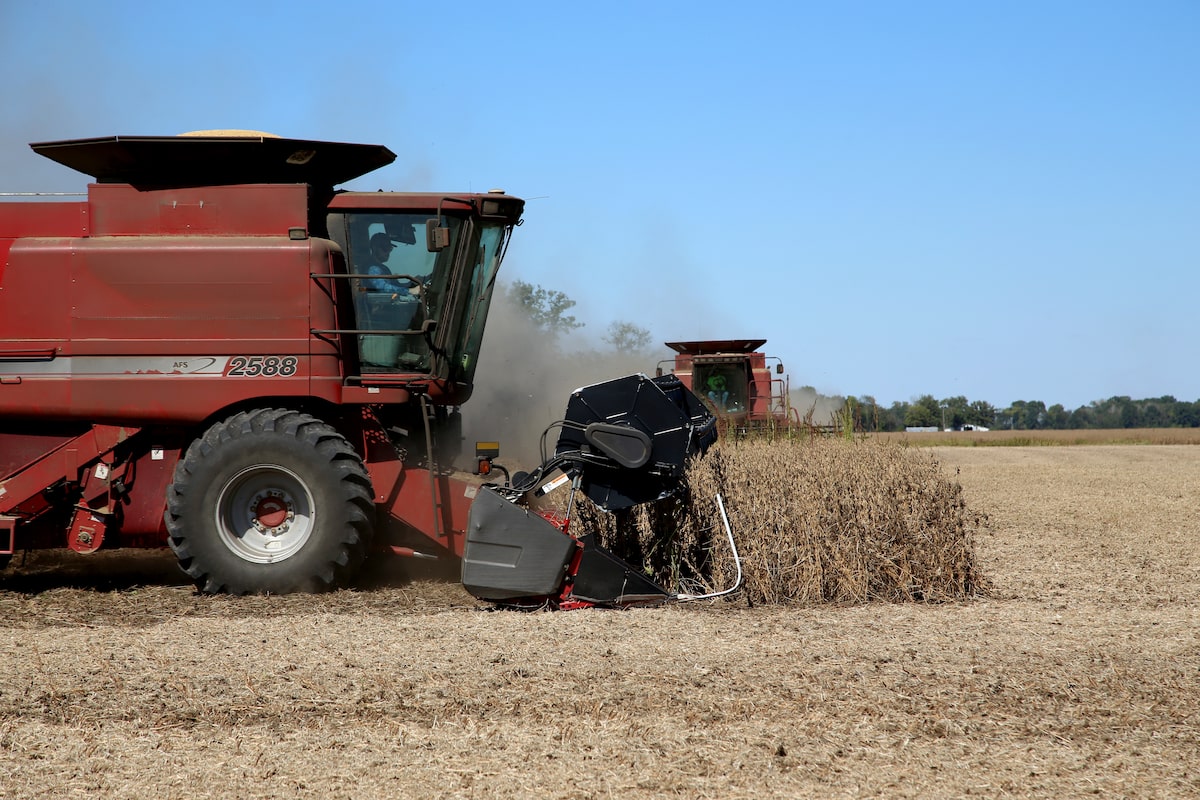
He spoke from the cab of a tractor, as he worked alongside a pair of combines, extracting beans through clouds of dust, on a farm worked by Gaffners for nearly 130 years.
“We have to have that free, fair trade. We have to have that ability to do that without these encumbrances upon us that are really manufactured, because of retaliatory tariffs and our tariffs,” he said.
Soybeans are harvested and processed at a farm in in Dwight, Ill., in August. Illinois harvests more soy than any other state, and for many years China was the largest importer of U.S.-grown beans.
Scott Olson/Getty Images
Illinois harvests more soy than any other state, and the Gaffner family has been at the forefront of what has been a lucrative trans-Pacific soybean relationship for decades. Mr. Gaffner’s mother travelled to China to promote trade in 1998, in the midst of a half-decade in which Beijing virtually eliminated its barriers to soybean imports, an important element of its accession to the World Trade Organization, which itself was a pivotal moment in liberalizing global trade.
For farmers, it marked a major shift from the 1980s when anyone considering a future on the fields faced dismal prospects, recalled Jerry Gaffner, Scott’s brother.
China’s enormous appetite for soybeans turned that on its head. In 1994, China was still a net exporter of soymeal. By 2003, it was the world’s largest importer of beans, surpassing the European Union. In the decade that followed, Chinese buyers took possession of more than 60 per cent of U.S. soy exports.
Being a producer in that era was like being “the Vanderbilts and the Rockefellers in the turn of the century,” Jerry Gaffner said.
Then came 2018, when China engineered a major disruption to soybean purchases during its trade confrontation with Mr. Trump during his first presidential term. Chinese buying subsequently returned, but never in the same numbers. China instead began to direct its attention south, to farmers in Brazil who transformed pastureland into fields of soy.
Since 2018, Brazil’s soy harvest has swelled by 40 per cent.
A worker harvests soybeans near the town of Campos Lindos, Brazil in February, 2018. Since 2018, during Trump’s first term, Brazil’s soy harvest has grown by 40 per cent due largely to to China’s business.Ueslei Marcelino/Reuters
Countries in South America are capturing “our market at the direct expense of U.S. farmers,” said American Soybean Association president Caleb Ragland in a statement in late September. “The frustration is overwhelming,”
This is what many farmers voted for. Just over 77 per cent of ballots cast in U.S. agricultural counties were marked for Mr. Trump last year. Many continue to hold fast.
Soybeans may be “part of the bargaining chip” in a broader bid by the Trump administration to strengthen the U.S. economy, said Steve Pitstick, who has a farm just west of Chicago.
“I’m okay with that.”
Besides, he said, tension with China is only part of a much broader problem. Since 2019, many costs are up 50 per cent. Crop prices haven’t kept pace.
“While everybody wants to make this a soybeans story, it’s a general story about the ag economy.”
China is no longer the biggest customer for U.S.-grown soybeans, purchasing instead from South America in the midst of its trade dispute with the White House.
Nathan VanderKlippe/The Globe and Mail
But that economy has been built, in part, around exports – a complex structure of logistics, economics and agronomics with free trade as its foundation.
Part of the natural advantage for U.S. soy lies in the proximity of its growing areas to the Mississippi River, a superhighway for barges that are then loaded onto ships bound for export markets. No other country can match it – not Brazil, with its rutted roads; not Canada, with its inland prairies far from water.
Soybeans and corn have also formed a productive dance. Corn grows better when it’s planted in a field that has previously grown soybeans.
“It’s hard to think of a crop that could replace what soybeans provide rotationally to U.S. farmers,” said Joe Janzen, an agricultural economist at the University of Illinois.
Exporting soy to China, he said, “makes too much sense for it not to happen at some point in the future.”
If tariffs remain – and if China does not return as a buyer – farmers are entering a moment so unlike what they have known for generations that it is hard to imagine.
Central Illinois soybean farmer Elliott Uphoff is among those affected by the Trump administration’s ongoing trade war with China.Nathan VanderKlippe/The Globe and Mail
Some are paying new attention to how they can cut costs. Central Illinois farmer Elliot Uphoff did the math on a new disc ripper, and figured he could save some money by buying used and refitting that older equipment with new parts.
“When times are tough, you don’t just take the easy route,” he said.
But many are simply rolling the dice, harvesting this year’s beans with no idea when they will sell them, or for how much. In normal years, farmers secure forward contracts to sell considerable quantities of their crop before it has been taken off the fields.
This year, Scott Gaffner’s soy is mostly harvested, but “I haven’t sold a single bushel yet.”
He is holding out hope that a deal with China will still materialize – that the current standoff is temporary.
“I don’t want this story to be over, because if it’s over now, we’re in trouble. We have soybeans in our bins, and we’re not going to have any place we can move them fully,” he said.
Farmers are optimists. Mr. Gaffner believes Mr. Trump is moving economic levers to restore free trade, even as the White House raises tariffs on countries around the world.
Still, he acknowledges that the future has grown less certain.
“This is one of those endeavours,” he said, “that we are taking a great risk – that we will not recoup our trading partner.”