
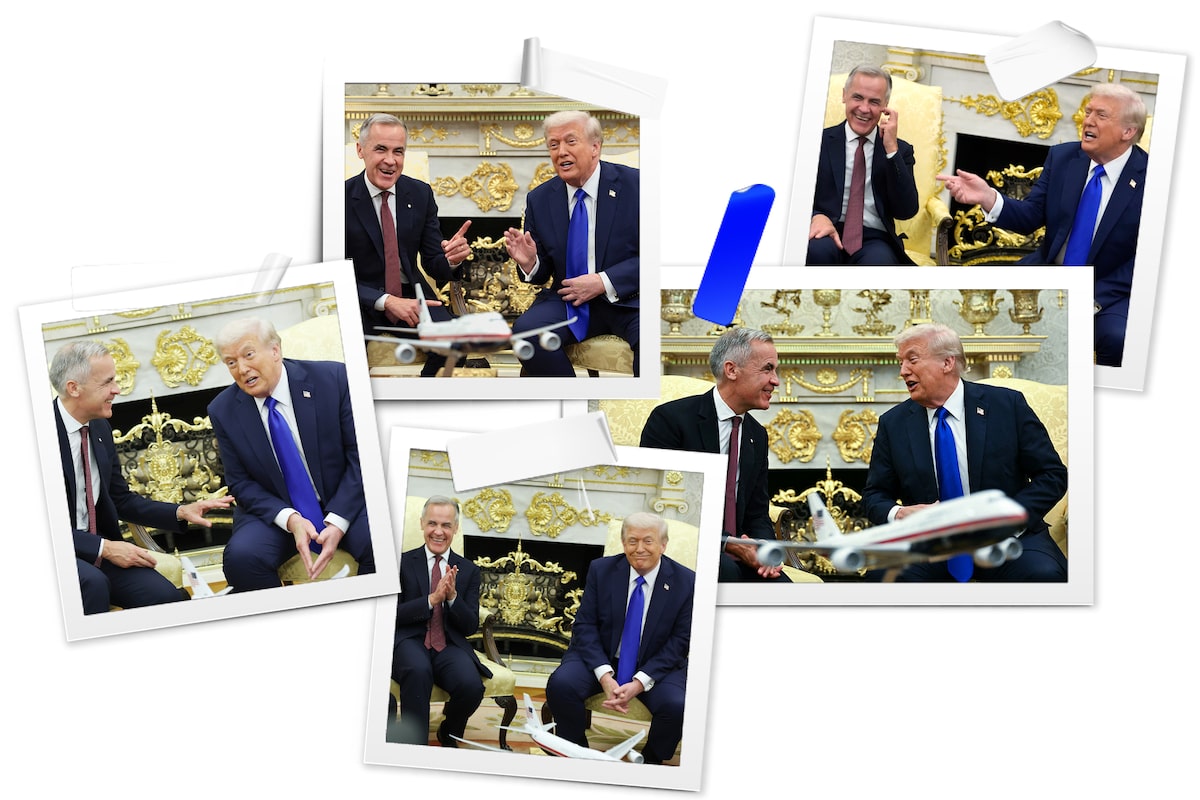
During his second visit to the White House, Prime Minister Mark Carney called Donald Trump ‘a transformative president’ as he sought relief from punishing U.S. tariffs.The Globe and Mail
If anyone doubts that sycophancy is having a defining moment in the history of Western civilization, get a load of this: even lowly writers are being falsely flattered. Scammers are flooding inboxes with AI-generated notes of praise from so-called readers in an effort to lure the scribblers into identity-theft scams. “You weren’t just writing about history,” one note claimed: “you were in the room where history happened.” It’s a measure of the dilapidated state of the average writer’s ego that the ruse has been successful.
Then there was the spectacle last week of Mark Carney seated at the right hand of the President in the freshly gilded Oval Office, squirming like a teenager trying to get a word in edgewise with his chatty date. When Mr. Carney finally got to speak – for about 90 seconds in the course of a half-hour Trumpologue – two-thirds of what the Prime Minister said was dutiful spit-polishing: Donald Trump was once again “a transformative president.”
Shannon Proudfoot: What Keir Starmer figured out about Donald Trump before the rest of us
By today’s standards, Mr. Carney’s praise was downright reserved. Sycophancy is as old as human nature, but has lately taken centre stage in negotiations all over the world. The word of the year is transactional. After last month’s display of British obsequity toward the President – a parade! A trip around Windsor Castle in a carriage! – African leaders followed with salaams and hosannas of their own. Brendan Carr, the FCC chairman, buttered the wishes of the White House and forced comedian Jimmy Kimmel off the airwaves, only to have Mr. Kimmel, who refused to apologize to Mr. Trump, nevertheless kiss the ring of ABC and Disney for having him back. Qatar “gifted” the U.S. President a $400-million jet. The tech-bro billionaires helped pay for Mr. Trump’s inauguration, and have enjoyed a largely unregulated AI marketplace ever since.
And let’s not forget the three-hour-and-15-minute televised sycofest the President staged before Labour Day, demanding steaming heaps of humiliating praise from his cabinet. The ball seems to have been set rolling last January when Anna Paulina Luna, a Republican Congresswoman from Florida, proposed legislation to have Mr. Trump’s head added to Mount Rushmore. Competitive sycophancy demands ever more craven sacrifices.
The Prime Minister came bearing praise for the President, who returned the favour, calling Carney a ‘world-class leader.’Evelyn Hockstein/Reuters
I was so astonished by the dripping spectacles that I called Joe Shlesinger, a former managing director and now senior adviser at Clearspring Capital Partners, a Toronto private equity shop. Mr. Shlesinger ran the Canadian arm of another one, Bain and Company, for 17 years, which meant pleasing a lot of bosses and customers, sometimes sycophantically. His reply to my e-mail asking about sycophancy was “THAT IS THE GREATEST QUESTION AND TOPIC I’VE EVER HEARD.”
He was joking, of course, except about how fundamental sycophancy is to contemporary business and political life. What Mr. Trump is demanding, Mr. Shlesinger said over the phone, “is just an exaggerated version of something that goes on pretty much all the time in the course of making a living.” He added that politicians are even more sycophantic than business executives. “Because who’s more sycophantic than a politician when he’s campaigning?” Similarly, “in the corporate world, everyone’s in a customer service environment. We’re all doing that. Bosses use an employee’s agreeableness to assess his or her ability to build relationships with clients. So I don’t know that sycophancy is always a terrible thing.”
Sucking up and lying down to do the master’s bidding is a core practice of a capitalist democracy? Interesting, terrifying thought.
Sycophancy has been around since human beings figured out how to take advantage of one another. It’s most notable in populist eras, when a leader’s need to be loved by the mob becomes an addiction. The word sycophant got its start in ancient Greece, where it identified an extortionist: someone who brought false accusations against someone else in hope of being paid off to go away. By the time the word shows up in Shakespeare’s nascently commercializing England (see Iago in Othello), its original connotation (false-speaking parasite) has softened to mean an insincere flatterer trying to get ahead. Smithers, Mr. Burns’s assistant on The Simpsons, is the classic sycophant. They go by a range of names: apple-polisher, bootlicker, brown-noser, lickspittle and many more vulgar than that. None are terms of endearment. As much as we all suck up now and then, we reserve some of our harshest scorn for sycophants: their hypocrisy somehow offends our longing for the trustworthy, for our idealized version of ourselves.
John Rapley: Carney must remember: Trump’s sound and fury signify nothing
Machiavelli explicitly warns aspiring tyrants against sycophants, in Chapter 23 of The Prince: “He who does otherwise is either overthrown by flatterers, or is so often changed by varying opinions that he falls into contempt.” Botticelli depicts sycophants in Dante’s Inferno writhing in a river of (their own) excrement in the second pit of the eighth circle of Hell. Nice! The thin and unctuous Uriah Heep was Dickens’s memorable contribution to the category. They are all slithering snakes and resemble their counterparts in the real world. Roberto Farinacci, Mussolini’s pre-eminent booster, insisted party members make a pilgrimage to Benito’s birthplace. In China under Mao, the smart move was to repeat Mao’s name incessantly: it wasn’t unusual for a single speech to mention him 100 times.
Joseph Goebbels, left.The Associated Press
But the master sycophant was Joseph Goebbels, Adolf Hitler’s minister of propaganda. Goebbels reinvented sycophancy using radio and film, technologies as new to his day as social media is to ours. It was Goebbels who invented the slogan “Heil Hitler!” and promoted its attendant one-armed salute, Goebbels who insisted everyone call the boss der Führer. He venerated Hitler to create a demi-god who could then “decontaminate” German life – attacking universities and writers while singling out Jews and immigrants as “un-German.”
Goebbels was the sycophant’s sycophant, the original model and source for every aspiring quisling who followed. He and his wife, Magda, gave each of their six children a name that began with the letter H, to honour Hitler. They later poisoned all six to death before taking their own lives the day after Hitler killed himself in his bunker. Peter Longerich, Goebbels’s biographer, notes that Goebbels needed constant praise from an idol to whom he completely subordinated himself. We assume sycophants behave the way they do to get ahead. But a pathological sycophant’s biggest thrill isn’t gaining power or reaping rewards. It’s something more atavistic and instinctual: the transcendent release that comes from surrendering one’s will and personal judgment to that of an autocratic leader.
In businesses across North America, everyday sycophancy is known as “managing up” – cultivating “mutually beneficial relationships with your manager,” as a recent Harvard Business School description put it. “Managing up is not political game playing. Rather it is a conscious approach to working with your supervisor toward goals that are important to both of you.” (Journalists are quite familiar with the concept, from worming their way into the confidence of interview subjects.) A modicum of subservience is the price of admission to making a living and joining the club.
But how much is too much? I called David Zweig, a professor of organizational behaviour at the University of Toronto Scarborough and the Rotman School of Management. His first observation was that sycophancy is not well studied. Maybe it too readily evokes the compromises we all face, at some point, in the course of a career or a working life. Sycophancy is the shameful secret of success, the taint of meritocracy.
Nevertheless, Mr. Zweig makes a sharp distinction between ordinary managing up, on the one hand, and craven pandering to the ego of an insincere narcissist. “You’re gonna see sycophancy in any environment where there is a power hierarchy,” he said, meaning every workplace on earth. He had a very deep voice on the telephone. “Most of us know we have smoke blowing up our asses, but generally we can discern if it’s too much or too far. We all like to be flattered, and flattery can get you very far.”
Carney appeals to Trump’s love of the puffed-up investment deal
Only in certain conditions does this practice turn toxic. “You need the combination of someone who’s very narcissistic, with a deep sense of insecurity, who will surround themselves with people who are very good at being sycophantic – kissing up to gain power and at the same time keeping others down.” Even honourable supplicants fall prey to this double-whammy: witness Ukraine’s Volodymyr Zelensky on his second visit to Mr. Trump, suddenly “wearing a suit and showing deference to the king, right? And he had no choice because the stakes were so high.”
Standard-issue sycophancy can produce disastrous results. At the most prosaic level, it undermines merit – the hope that skill and hard work will get you ahead. “But sycophancy is not about merit,” Mr. Zweig said. “It’s about gameplay and gaining power and influence. Pointing out what’s wrong will only harm your ability to get ahead.”
Pathological sycophancy foments another order of chaos. Capitalism is strewn with the corpses of companies that foundered on fawning, ruined by executives who were unwilling to tell the truth to bosses who didn’t want to hear it: Eaton’s, Bre-X, Enron, Boeing, the list is endless. By the mid-1920s, Henry Ford, the founder and majority shareholder of the Ford Motor Company, was surrounded by yes men and a submissive board. For nearly 20 years, no one challenged Henry’s conviction that the original Model T, the so-called Universal Car, was the only model the company needed to sell. Eventually his son Edsel convinced him otherwise, by which time General Motors’ new models were on their way to dominating the car industry for the next 80 years.
That doesn’t mean the car industry has freed itself from sycophancy. Dimitry Anastakis, a colleague of Zweig’s at the Rotman School who specializes in automotive history, pointed out that the Edsel, the 1957 car named after Ford’s son, is no longer the industry’s most famous flop. That honour now belongs to Elon Musk’s Cybertruck, another product of a sycophantic corporate culture where no one was willing to pay the price of standing up to the (then) richest man on earth. “The Cybertruck is now the new Edsel,” Mr. Anastakis said. He estimates Mr. Musk has spent $4-billion to build 500,000 chunky trucks annually. Tesla will be lucky to sell 40,000 this year.
A Tesla Cybertruck on display in a California showroom.Richard Vogel/The Associated Press
Anastakis thinks the same smarmy dynamic sustains Washington’s love of tariffs. “When Trump imposed tariffs on ‘Liberation Day,’ people like [Treasury Secretary] Scott Bessent and all the others reacted as if it was the greatest thing ever. That can lead to despair, because it erodes our capacity to connect to the real world.” At its worst, sycophancy is a form of corruption.
That’s not just an opinion. A 2025 study in the American Journal of Political Science analyzed 1,000 speeches by Russian governors in the lead-up to their boss Vladimir Putin’s decision to invade Ukraine. The mechanics of sycophancy were on full display: the less experienced and educated and economically robust the apparatchiks were, the more they toadied to the boss. The more they toadied, the worse their advice was. “Sycophantic behaviour among authoritarian officials is … the recipe for ill-prepared and less-thought-through policy decisions with potentially disastrous consequences,” the study concludes. But “truckling to the autocrat pays off. When the weak start overbidding each other and the ruler systematically rewards them for doing so” – hello, Trump’s cabinet! – “cults become self-reinforcing.” Mass veneration is the result, a throwback to the idea that the king embodied not just a flesh-and-blood person, but the state itself.
And for the boss? What value does sycophancy have, beyond refilling his or her bottomless ego? It’s a loyalty test. The secretary of labour who is willing to publicly debase herself by hanging her leader’s giant portrait, Reich-style, outside her Washington, D.C., headquarters is more likely to accede to draconian restrictions on workers down the road. The attorney-general who supports your completely false claim that the 2020 election was stolen is more likely to let you cancel the next midterm election. Proven and reliable sycophants have no pride left to lose.
Not everyone wants to be a sycophant. Eighty per cent of the talks Toronto management psychologist Rafael Chiuzi delivers all over North America are to companies trying to avoid a “fear-based culture.” But it’s tricky, because the yes-sir culture we publicly deride is so, so similar to the go-get-’em culture we claim to admire. “When you tell your team, ‘don’t bring me problems, bring me solutions,’ the intent might look good, at first glance,” Mr. Chiuzi says. “But what you’re really saying is, ‘if you have a problem you can’t solve, don’t even bother talking to me.’”
I was coming to the end of my stroll through Vacuumland when I got an unexpected phone call from Mr. X, which I am calling him for reasons you will soon understand. Mr. X started an extremely successful company that he sold a few years ago for a great deal of money to a much bigger company in the U.S. Let’s say it’s a consulting company: that’s close enough. Mr. X still works as an adviser to the Canadian branch.
He is a very smart, very thoughtful, very funny guy – and I say that sincerely, without hope of favour. He was full of scorn for the sycophantic modus of the Trump administration, but he saw similar behaviour on Bay Street and in Ottawa. It is not good enough to do your job at a very high level, he explained. You also have to show praise to the leader – and in Mr. Trump’s case, without that behaviour, you’re out. That’s just a simple fact of survival for those guys, he said. He sneered at the Marco Rubios of the world who prostitute themselves on national television to stay on Mr. Trump’s good side, but admitted Marco Rubio was playing a long game. He wondered whether the craven sycophancy we see today in Washington is a precursor to dictatorship, but assured himself that this too shall pass.
U.S. Secretary of State Marco Rubio speaks to Trump during a meeting at the White House.Evan Vucci/The Associated Press
Why don’t more people refuse to perform such compliant anilinction? His American colleagues are anti-Trump, Mr. X said matter-of-factly, but they put on a different face as business executives. “Because at the end of the day, every American I’ve ever worked with is a fundamentally hardcore, capital-C capitalist. And they will bend their ethics and their self-esteem in order to make sure their business doesn’t get crushed.”
“That’s fabulous,” I said greasily. “Can I quote you?”
“Uh, sure,” he said. Then: “Well, whoa. Wait a minute.”
It turns out Mr. X had been an adviser on a pro-Canada (and anti-Trump) political campaign. He got a call from his U.S. CEO to cease and desist because the company could not be seen to be anti-government. Why? Because tens of millions of dollars of the parent company’s revenues derive from federal contracts in Washington. And until you confront what it is you fear, the fear tells you what you can say and what you can do.