
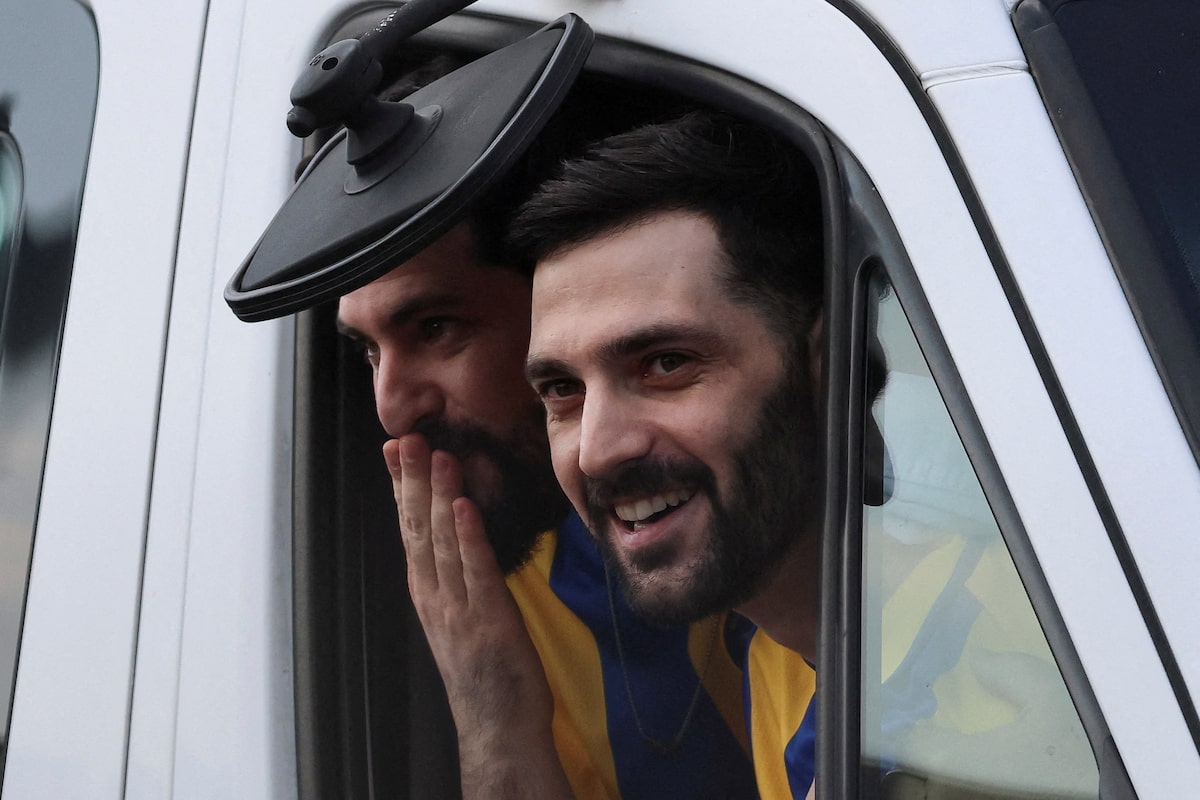
Released Israeli hostages Gali and Ziv Berman arrive at Sheba Medical Center Monday.Hannah McKay/Reuters
First came seven men, re-emerging from Gaza after 738 days of captivity.
Then came the remaining 13, their release inaugurating a momentous day for the Middle East more than two years after a Hamas-led attack on Israel sparked a war that killed tens of thousands.
“All of our living hostages have come back to us. What wonder,” Israel Prime Minister Benjamin Netanyahu said Monday.
In Tel Aviv, thousands gathered to watch and cheer the return of the remaining living hostages, some wiping away tears as speakers swelled with the sounds of a song, “They’re Coming Home.”
“It’s the first time I’m crying. I didn’t cry for two years,” said Gila Sharabani, a retired lawyer who spent hundreds of days at Hostage Square, bringing hot tea to the families of people taken captive in Gaza and then returning, again and again, as a show of hope.
“Happy is not the word. It’s too small,” she said.
“Unbelievable. Unbelievable.”
The remains of another 28 deceased hostages are also expected to be released, in exchange for 1,950 Palestinian prisoners, who began to be delivered by bus.
The U.S. president came to greet released hostages and speak to the Israeli Knesset, before planning a departure for Egypt for a peace conference intended to chart a new course for the war-torn region. Mr. Netanyahu and Palestinian President Mahmoud Abbas were both expected to attend that conference alongside numerous foreign leaders, including Canadian Prime Minister Mark Carney. But Mr. Netanyahu has declined the invitation, his office said in a statement Monday, citing a conflict with a Jewish holiday.
“The release of hostages must be a turning point toward lasting peace,” Mr. Carney said in a statement, in which he paid tribute to Canadians killed in the Hamas-led attacks two years ago: Canadians Vivian Silver, Netta Epstein, Alexandre Look, Judih Weinstein, Shir Georgy, Ben Mizrachi, and Adi Vital-Kaploun.
Many in Israel mixed gratitude to the Israel Defense Forces with thanks to Mr. Trump, including some Knesset members who wore red ballcaps with the words: TRUMP THE PEACE PRESIDENT.
“As far as I’m concerned, the war is over,” Mr. Trump said as he arrived at the Knesset, where Speaker Amir Ohana called him the best friend Israel has ever had. The U.S. President smiled as Knesset members chanted: “Thank you, Trump.”
Israeli Prime Minister Benjamin Netanyahu addresses the Israeli Knesset. U.S. President Donald Trump is visiting the country before planning to attend a peace conference in Egypt.Pool/Getty Images
The White House released excerpts from a speech he was scheduled to deliver, in which he described “the historic dawn of a new Middle East.”
“Israel has won all that can be won by force of arms,” Mr. Trump’s prepared remarks said. “Now, it is time to translate these victories against terrorists on the battlefield into the ultimate prize of peace and prosperity for the entire Middle East.”
He held out a hand to Tehran as well. “Even to Iran, whose regime has inflicted so much death on the Middle East, the hand of friendship and cooperation is always open.”
For Gazans, his remarks said, the focus “must be on restoring the fundamentals of stability, safety, dignity, and economic development, so they can finally have the better life their children deserve.”
Much remains uncertain, including how long a fragile ceasefire can hold, and what role Hamas will accept in Gaza, where its armed militants immediately returned to streets as hostilities with Israel ceased.
”The return of the hostages is one thing, but the end of the war, that’s very important,” said Alex Grab, an Israeli-born retired history professor. In that, he said, “I’m not confident at all.” He trusts neither Hamas to keep its bargain, nor in Israel’s prime minister to hold to his commitments to peace: “I don’t think that Netanyahu is interested. He was forced to do this by Trump.”
The war, too, has left deep scars.
”Gaza was flattened, destroyed,” Mr. Grab said. “Israel is in crisis. Despite their success now, the euphoria now, I think Israel has got a lot of issues.”
Family and friends of Israeli hostage Eitan Horn react to the news of his release.GIL COHEN-MAGEN/AFP/Getty Images
But In Israel, the release of hostages marks the conclusion of a lengthy national agony. At the country’s main airport, volunteers handed Israeli flags to arriving passengers. News footage of hostages moving in Red Cross vehicles was broadcast live in cafes, on phones and in countless living rooms across the country. Those pictures showed one hostage pumping his fist in celebration as he arrived in a hospital, while images distributed by the government showed young men embracing their families in emotional reunions.
”For a few days, we were very nervous, because we didn’t know anyone’s condition,” said Auneg Rahamim, whose husband’s cousin is Matan Angrest, an Israeli soldier who was among those released Monday.
“When we were told that he’s walking on his feet and he’s smiling and he’s okay — nothing else matters.”
She patted a pregnant belly. “All we wanted was Matan to be back home to meet his future cousin,” she said.
She spoke to the Globe and Mail at Ichilov Medical Center, where staff placed an enormous “Welcome” sign on the concrete outside the hospital, visible from the rooftop helipad where several hostages were expected to arrive early in the afternoon.
In a brief video call distributed on social media, Mr. Angrest said he had persevered “out of love for the country and the flag.”
The return of hostages is ”a hole in the heart that’s getting filled now, and it’s going to have to get healed,” said Camelia Mendelovich, who has helped to support the family of Elkana Bohbot, who had helped to plan a music festival that was attacked by militants on Oct. 7, 2023.
The length of his captivity was evident in a sign Ms. Mendelovich carried, imprinted with 34, his age when he was taken hostage, a number scratched out and replaced with a 36, his age now.
”Israeli resilience won,” said Yoseph Haddad, an influential social media personality with nearly a million followers on Instagram.
”We’ve been in the last two years, fighting on seven fronts — Yemen, the Houthis; Lebanon, Hezbollah; Ansar Allah in Iraq; we have Syria; we have Hamas; the West Bank; the [Iranian Revolutionary Guards],” he said.
“And we’re still standing. Standing tall.”