
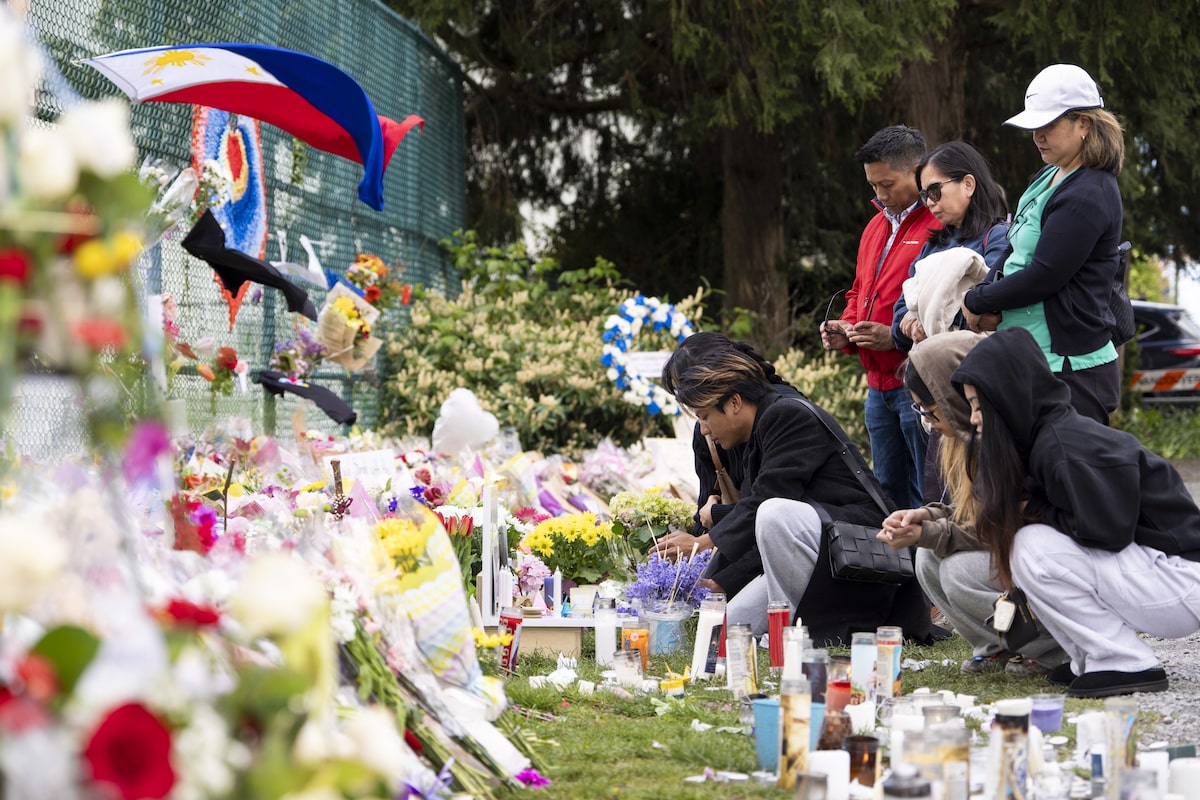
People attend a vigil near the site of the April 26 Lapu-Lapu festival car-ramming in Vancouver, B.C., that killed 11 and injured more than two dozen.Jimmy Jeong/The Globe and Mail
The man accused of driving an SUV through a crowded street festival in Vancouver this spring, killing 11, should have been hospitalized by his mental-health team in the days before the attack, say four past and present members of a tribunal that oversees involuntary hospital detentions.
These members of the Mental Health Review Board of British Columbia say Kai-Ji Adam Lo’s behaviour before the April 26 attack on the Lapu-Lapu Day Festival should have raised multiple red flags for members of his health team, who are trained to recognize them.
More than two dozen people – including a 22-month-old – were also injured in the car-ramming, with one remaining hospitalized in stable condition this week. Mr. Lo appeared in Provincial Court this summer, where a judge ruled he was fit to stand trial on 11 charges of second-degree murder and 31 counts of attempted murder.
Although Mr. Lo had been held in hospital for mental-health issues at least twice in the two years leading to the attack, at the time of his alleged crimes he was out and being cared for by a community mental-health team, under a form of medical supervision known as “extended leave.”
Questions have been raised about the actions of health officials and police in response to signs that Mr. Lo’s condition had significantly deteriorated before the attack. And a larger debate is echoing across Canada about how to treat patients with severe mental illness, and how to determine when they should be detained.
The B.C. government has promised a public inquiry into gaps within the mental-health system if Mr. Lo’s trial does not answer questions about if and how he was failed by his care providers. A publication ban on details of his fitness hearing has so far prevented some aspects of the case from being revealed publicly.
“Extended leave” – the kind of supervision that Mr. Lo was under – requires patients to follow a treatment plan that comes with certain conditions, which may include taking medications and having consistent visits with mental-health professionals. Care teams have the discretion to do check-ins with the patient, including through unannounced house calls.
Mental Health Review Board members, who work in panels of three, assess decisions to keep patients detained in hospital against their will.
The Globe and Mail spoke with three former members of the independent tribunal, one current member who had never dealt with the accused and a forensic psychiatrist with direct knowledge of Mr. Lo’s care. All have worked closely within the systems B.C. has in place to monitor and care for the extremely mentally ill.
The Globe is not identifying the five sources. The review board members have been advised not to speak to the media about the case. The forensic psychiatrist is not authorized to speak to media.
All the sources said details of Mr. Lo’s condition and medical treatment, which were reported by The Globe, raised issues of concern.
The review board sources did not have direct access to Mr. Lo’s health records but rather were commenting on revelations of his deteriorating mental health as reported by The Globe.
In the days and weeks leading to the attack, The Globe wrote, Mr. Lo was showing signs of acute paranoia, was reporting delusions to his medical team and had made multiple police complaints of imagined threats. The day before the attack he complained to Mounties in a suburb south of Vancouver that chemicals had been spilled in his SUV and that a virus had been installed on his dash cam. Three months prior to the attack, Mr. Lo purchased a US$1,159 instrument used to identify chemical warfare agents and toxic chemicals.
The three former review board members and the one current member were critical of the decision by Mr. Lo’s health team not to detain him again. They said his condition and treatment in the weeks and months leading up to the attack, as reported in The Globe, were concerning – including his mounting paranoia, frequent calls to police and his objection to his medication.
Mr. Lo had been released from hospital last year on an extended leave after his most recent detention in April of 2024. But the four board members noted there are conditions attached to such a leave and Mr. Lo appeared to no longer be meeting these requirements.
Documents reviewed by The Globe note that Mr. Lo had complained about the side effects of his medication, and that if he did not take it as prescribed he would be at a “high risk” of becoming mentally unstable, and of having his psychosis and delusions return.
Three of the sources said Mr. Lo’s health team should have alerted Vancouver Police to ask for an officer to return Mr. Lo to hospital on April 11 of this year, the day of his last visit to a community clinic in South Vancouver to meet his psychiatrist, who determined his mental health appeared to be deteriorating, and his delusions increasing.
A fourth source, the current member of the tribunal, said they would have leaned toward sending Mr. Lo back to hospital after the psychiatrist’s meeting, which was two weeks prior to the attack, but first would have liked to hear the psychiatrist explain why Mr. Lo wasn’t immediately recalled.
The board members all said Mr. Lo should have been receiving his medication by injection to ensure compliance, a standard requirement for people on extended leave.
At the very least, the current board member said, someone should have visited Mr. Lo at his family home to assess his deterioration.
The Globe was unable to uncover any evidence that such a house call was ever made to Mr. Lo during the two weeks between his last psychiatrist appointment and the attack.
After The Globe’s initial reporting on the attack, the Vancouver Coastal Health Authority, which oversaw Mr. Lo’s community health team, released a statement saying his care team was following him closely. The health authority also said there was no indication Mr. Lo was violent and that “there was no recent change in his condition or non-compliance with his treatment plan that would’ve warranted him needing to be hospitalized involuntarily.”
How the horror of the deadly Lapu-Lapu vehicle attack unfolded
In the months since, the health authority has declined to confirm what – if any – follow-up care or supervision was ordered after Mr. Lo’s April 11 psychiatrist appointment, where his doctor noted concerns about Mr. Lo’s efforts to have his anti-psychotic medication reduced, and worries about his condition deteriorating.
Both Vancouver Coastal Health and the College of Physicians and Surgeons of B.C., the self-regulating body that oversees all doctors in the province, including psychiatrists, recently declined to say whether they have begun internal audits of Mr. Lo’s care in the wake of reporting on his mental decline in the leadup to his arrest.
One of the former board members, a psychiatrist, said the increasing paranoia exhibited by Mr. Lo earlier this year is an important risk factor for violence, and his case worker should have considered this another red flag warranting action.
Mr. Lo was detained at Vancouver General Hospital for 11 days in March of 2023. On leaving, he was subject to a witnessed monthly injection of an anti-psychotic, the source with knowledge of his care told The Globe.
By the time of his arrest, his prescription had been changed to an oral anti-psychotic that he was supposed to be taking on his own. It is not clear when his prescription – which was a condition of his extended leave – was switched from injection to oral or whether he was taking his medicine at the time of his alleged attack.
The Globe has previously reported that roughly two weeks before the Lapu-Lapu Day block party, his psychiatrist suggested his dosage may have been insufficient to be considered therapeutic.
Two of The Globe’s sources – both psychiatrists – said they would not have allowed Mr. Lo to be taking oral medications on his own because of his refusal to accept his diagnosis and because he was at a high risk to deteriorate if he wasn’t taking a proper dose of medication.
Alejandro Samper, an engineer, small-business owner and artist whose mother, father and sister were killed in the attack, said he is pained and disappointed to learn that B.C.’s medical system may have “failed” him and his family. But he is not surprised.
“I love Canada; it has given me so many opportunities,” said Mr. Samper, who moved from Colombia to Canada as a child with his parents. “But in B.C., mentally ill people are not given adequate care – so many end up on the street.”
“I am destroyed. I feel like I have no heart any more. I have nothing. I have no one left. I saw my sister die in front of my eyes.”