
Now that the Women’s National Basketball Association (WNBA) season is over, with the Las Vegas Aces winning the championship, all of the attention has moved towards negotiations for a new collective bargaining agreement (CBA) for the league’s players. The current 2020 CBA expires on Oct 31. Like other CBA talks between the workers and the bosses, the workers usually fight for their “fair” share of the profits that they produce for the bosses with their labor – in the form of salaries and benefits. In Marxist terms, the share of workers’ labor that the capitalist keeps as profit is referred to as surplus value. Under capitalism, the working class is never fully compensated for the work it performs.
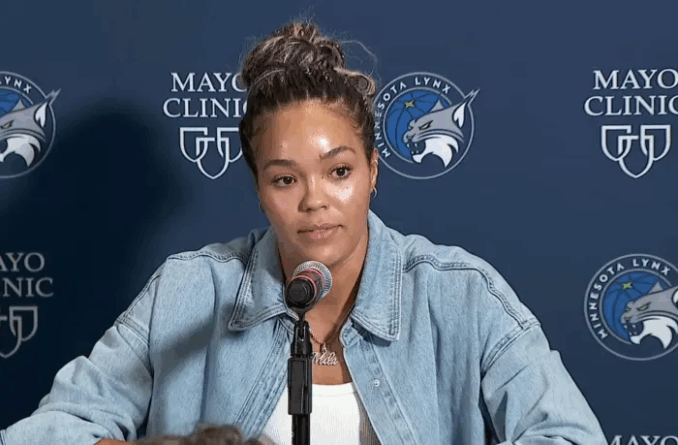
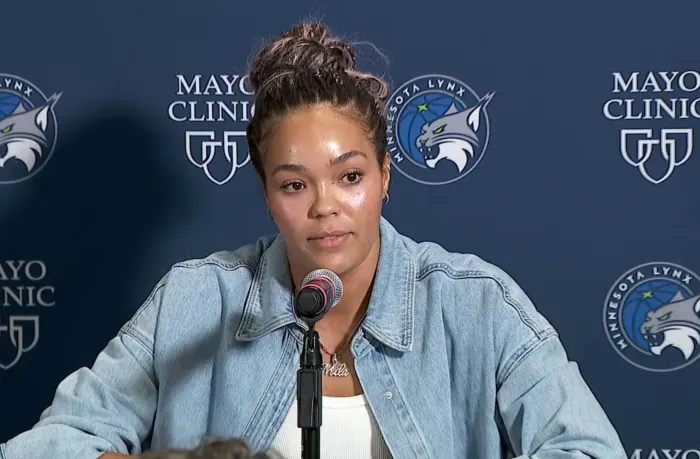
Napheesa Collier speaks at Sept. 30 press conference in Minneapolis, Minnesota.
In the case of the WNBA, the players are the workers, represented by their union, the Women’s National Basketball Players Association and the bosses are the multimillionaire team owners represented by Commissioner Cathy Engelbert. The president of the WNBPA is Nneka Ogwumike, a player with the Seattle Storm.
What are the priority issues for the players with a new CBA? An increase in salaries is paramount, but the biggest issue is revenue-sharing and whether the percentage of this sharing for the players will be allowed to grow. For the men’s National Basketball Association, salary caps for teams are set based on a percentage of what the CBA describes as “basketball-related income”. By contrast, the WNBA’s current CBA defined the salary cap for each season ahead of time with modest 3% annual raises that are non-negotiable.
As Ogwumike stated in early August, “The players are still adamant that we get a percentage of revenue that grows with the business, which perhaps includes team revenue, and that’s just a part of the conversation.” (ESPN)
In 2024, the popularity of the WNBA exploded, reflected in packed arenas and more televised games. More expansion teams are being added. As a result of this growth, the WNBA signed an 11-year deal for 2026 with Disney, Amazon Prime Video and new rights holder NBCUniversal, valued at about $2.2 billion.
Future agreements with additional partners could bring the league’s overall media deals closer to $3 billion. The players are fighting to see that a share of this astronomical revenue be included in their salaries going forward.
Front Office Sports reports that the league is proposing a supermax salary estimated at $850,000 with the veteran minimum around $300,000. (Oct. 10) Supermax salaries are usually reserved for “elite” players either on a rookie extension or with at least five years of experience and also remain with their current team. Under the current CBA, the supermax salary is a little over $249,000.
Many WNBA players, who are majority Black – a large number of them queer and several are mothers – have been forced to play in overseas leagues during their offseason to help supplement their regular salaries. These players are justified in demanding higher salaries to reflect the growing revenue that their skills, talents and popularity have generated.
Lost trust in WNBA leadership
Complicating the CBA talks is the growing rift in relations between the players and the league. Right before the WNBA Finals, Minnesota Lynx star player, Napheesa Collier, who is also vice-president of the WNBPA, issued a four–minute statement at a Sept. 30 press conference. She accused the WNBA of having the “worst leadership in the world” and Engelbert of being “negligent” in her duties as a commissioner.
Collier went on to say: “The real threat to our league isn’t money, it isn’t ratings, or even missed calls, or even physical play. It’s the lack of accountability from the league office.” (The St. Louis American, Oct. 11)
Many of the most prominent WNBA players voiced solidarity with Collier’s assessment.
These accusations center around questionable officiating, especially during the recent playoffs and also what is to be perceived by the players as Engelbert’s general lack of communication and coordination with them. This first started during the fall of 2020 when the predominantly Black NBA and WNBA took part in countrywide protests against police brutality sparked by the recorded lynching of George Floyd in May.
Engelbert’s feigned support for the WNBA’s participation in these protests proved to be off-putting to a number of the players at the time.
Many of the players stated that relations with Engelbert, who is white, are now beyond repair. How this rift impacts the outcome of the negotiations, no one knows. The players have not ruled out organizing a work stoppage if their demands for more income-sharing are not met by or after Oct. 31.