
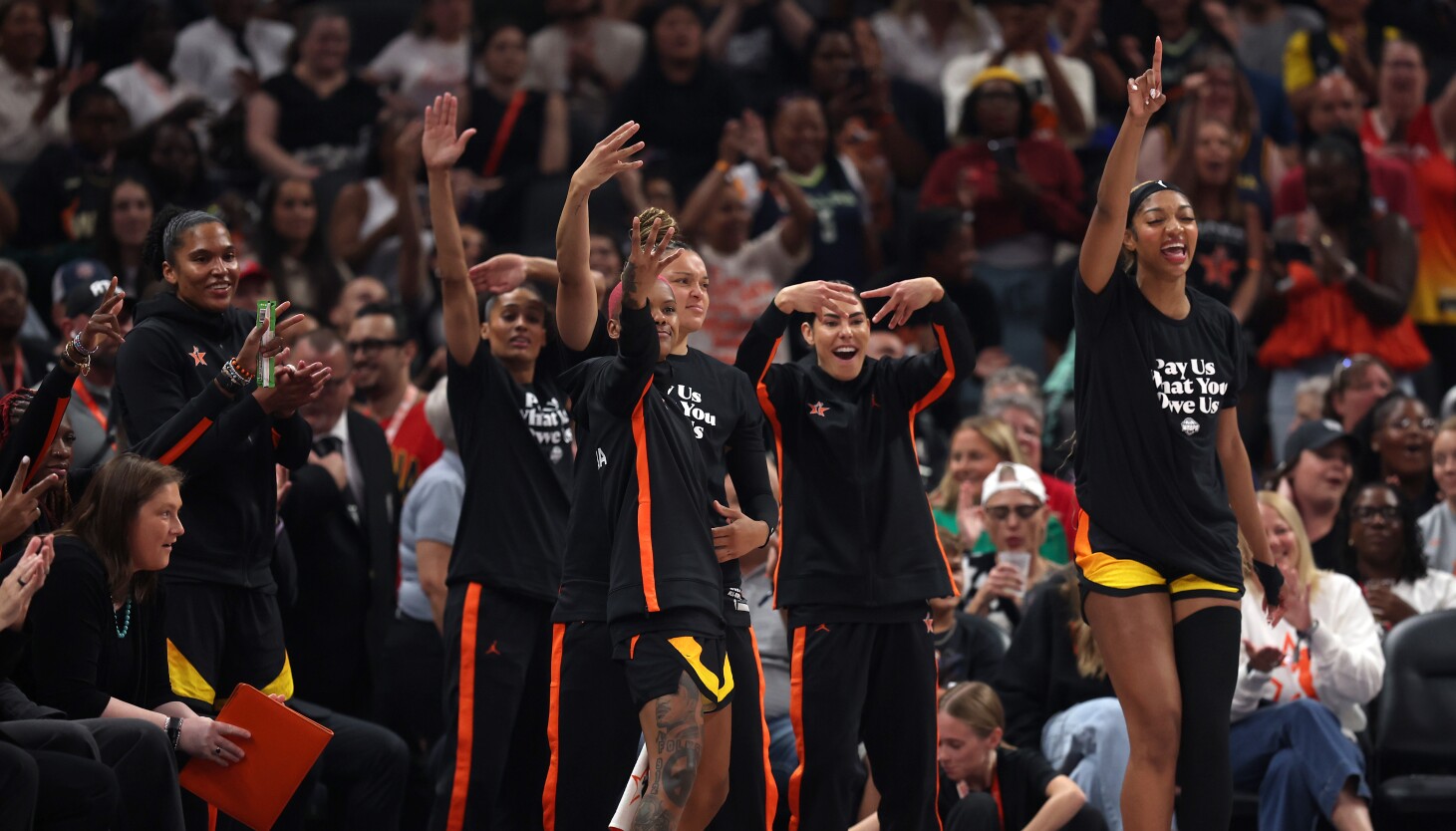
In the latest round of negotiations, WNBA players have made it clear they want more money. ‘‘Pay Us What You Owe Us,’’ their shirts at All-Star weekend read, and fans threw their support behind them.
The owners have shared less about what they want, but commissioner Cathy Engelbert gave us a clue in her Finals address.
‘‘We want owners to have a viable business,’’ she said. ‘‘It’s important that [expansion-team owners] coming in have a shot at a viable economic model for the future.’’
‘‘Give Us a Viable Economic Model for the Future’’ wouldn’t have been a cool T-shirt to wear courtside, but it is necessary, and the owners deserve some spoils from the recent boom.
What are the spoils, exactly? They can be difficult to quantify. The WNBA often feels like a numberless abyss, where basic financials require 45 minutes of frustrated Googling.
One key number has been publicized, though: the recurring revenue stream from the WNBA’s new TV deals, which are bigger and better now that the league is more popular.
Starting in 2026, the deals should add around $220 million of annual revenue to the league. Because of the WNBA’s ownership structure, that number is both a game-changer and also not that much.
After the NBA and outside investors take their cut, each WNBA team will be left with an increase of $6 million annually through 2037. That’s not exactly Kawhi Leonard money, but it’s meaningful in a league in which the current salary cap is $1.5 million.
So what do WNBA owners want with that $6 million?
On one end of the spectrum, an owner could say: ‘‘Give me the whole thing. I’ve mostly lost money in my 20 years of ownership. Now I want payback, and I also still need to hire analytics personnel and a PR team and invest in a practice facility.’’
Such an attitude would mean no season in 2026, though. Players won’t agree to any deal in which their salaries increase by $0.
On the other end of the spectrum, an owner could say: ‘‘Let’s give the full $6 million to the players. It will ensure we have a season, help attract the top foreign players and elevate the product. And though it’ll put me further into the red now, in 20 years, I’ll be able to sell this team for 50 times what I paid.’’
How utopian the second attitude sounds! It even could inspire an impulse to exile those WNBA owners who actually need revenues to fund expenses and leave the league in the hands of ultra-wealthy groups who don’t care about annual profits and own the team
because it’s fun and maybe will be worth more in the future.
Surely nothing could go wrong from billionaires exclusively owning a social justice-oriented league!
In all seriousness, though, these two attitudes reflect potentially viable economic models for a growing sports league.
Model #1: The business is viable as long as it generates annual profits.
Model #2: To hell with profits and losses, the business is viable as long as team valuations are going up.
Whether owners prefer Model #1, #2 or somewhere in between likely depends on their capacity to absorb losses and their beliefs about how big this boom really is.
Anyway, the world of women’s basketball got some new numbers last week, courtesy of Annie Costabile at Front Office Sports. She reported the league is offering players a raise of 3.8 times current salaries at the low end ($300k) and 3.4 times at the high end ($850k).
A bit of algebra reveals that, in this proposal, the total increase to the player salary cap is $3.9 million, leaving owners with $2.1 million. In other words: a 65/35 split of the incremental media revenue.
Is that a fair split? At the very least, it doesn’t sound egregious.
But the fact that the players weren’t offered the full $6 million confirms we’re not yet living in a Model #2 utopia.
Notes on calculations
About the $220 million of incremental TV revenue: TV deals are expected to generate around $250 million of annual revenue for the WNBA through 2037. Subtract annual revenue from the TV deal in place during the 2020 negotiations — $33 million — to get $217 million, then round up to $220 million to make it easier on the eyes.
• Incremental TV revenue of $6 million per team: Multiply $220 million by the WNBA’s ownership stake of 42%. Divide by 15 teams in the league to get $6 million.
• A 65/35 split of TV revenue: Multiply the current salary cap of $1.5 million by the midpoint between $3.4 million and $3.8 million to get $5.4 million, the pro forma salary cap. Subtract the current salary cap of $1.5 million from the pro forma salary cap to get the incremental addition of $3.9 million. Divide $3.9 million by $6 million to get the player share of 65% and owner share of 35%.