
A Red Deer County councillor remains concerned that a $32 million broadband investment is not reaching its intended customers.
Coun. Christine Moore has voiced misgivings over the years about the project that began in 2019 to improve internet connections across the county, where 20,000 residents are spread across 4,000 square kilometres.
Moore submitted a series of detailed questions to administration in February and the answers came back in a report to council on Tuesday.
That update shows $31.7 million, including $8.1 million through a joint federal and provincial grant, had been invested in the broadband project to the end of 2024. As of the end of June, 1,500 businesses and residences had been connected with about 600 county subscribers and 240 in the Village of Delburne.
Moore said on Wednesday that the project does not seem to be meeting its goal.
“The premise of all this was rural and remote and it seems to me that the people who have the internet are people who live in subdivisions and not the real rural residents,” said Moore, who is running for mayor along with fellow councillors Brent Ramsay and Lonny Kennett.
“To me, the ones who really need it are not the ones who have it right now.”
Moore said many ratepayers have reached out to her with their concerns – which she shares – about the cost of the project that several years ago was pegged at about $22 million.
“We’ve invested that much money and I’m not sure what it’s going to take to get a good return on our investment.”
County chief administrative officer Curtis Herzberg said the project was based on a five-year construction schedule and the soaring inflation of recent years was not anticipated.
“At the time council approved (the project) they did not necessarily outline exactly to what extent they would build and when they would build. So, the project became flexible upon council’s wish to have a five-year period to build it.”
During that period, changes such as adding additional fibre optic cable and increasing connections, changed costs.
The only way the project could have stayed at $22 million is if it had been tendered at the beginning, but the project evolved over time.
Moore asked county administration how many customers were needed to break even.
Herzberg said it depended on how many residential versus commercial customers – which provide more revenue – are signed up and other factors, such as leasing opportunities.
It was always anticipated it would take several years to break even, he said.
A recently completed forensic audit looked into the broadband project and determined that council had not exceeded the council-approved budget on the project, with the exception of $23,266 in 2022, which led to a budget adjustment approved by council.
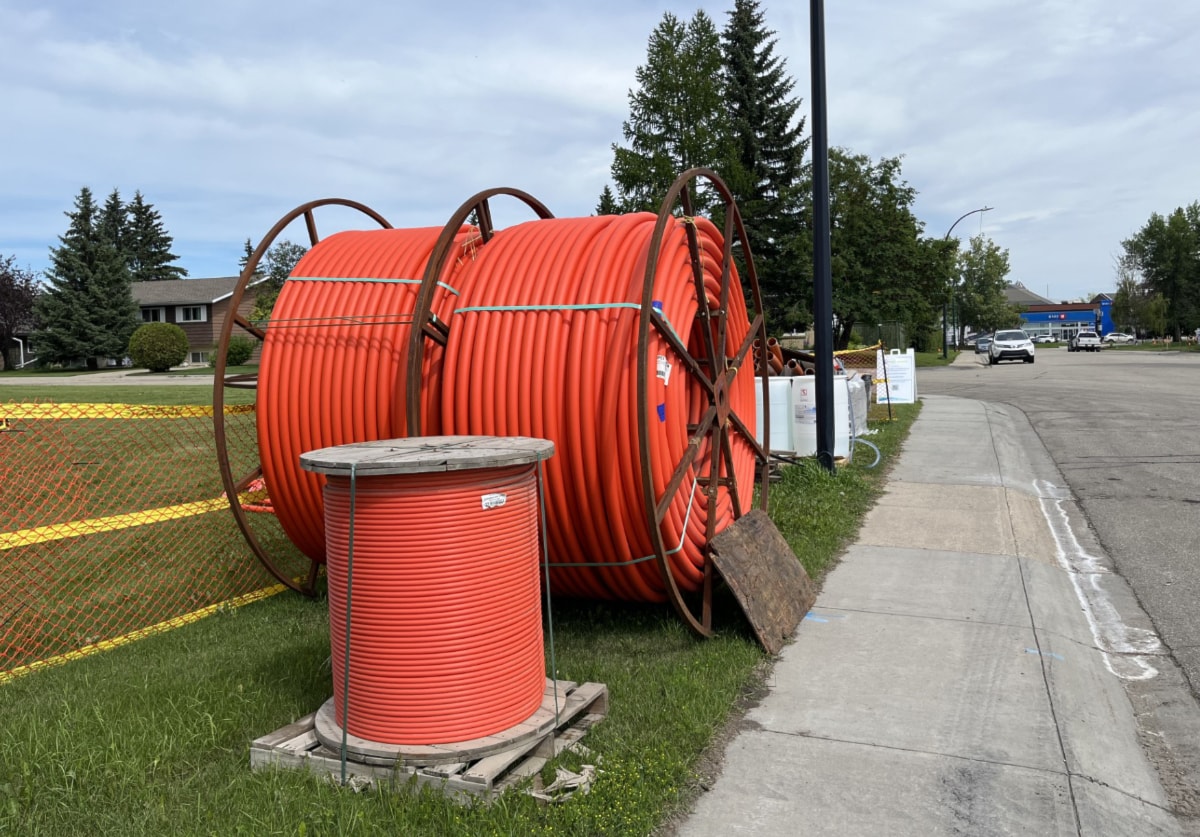
The report to council says that about 240 kilometres of backhaul (the infrastructure that connects local networks, like cell towers to a larger network) and 73 kilometres of dark fibre (fibre optic cables that can be “lit” later) will be completed by the end of August. Three new communication towers in Benalto, Bowden and Red Deer will be lit, extending service to 7,000 potential customers, who will be contacted in the coming months.
A municipally controlled corporation (MCC) was created with the Village of Delburne and Paintearth County to oversee the broadband system, which will be built and operated by Rural Connect Ltd. Another partner is EQUS REA Ltd., an Alberta-based member-owned electricity provider, which provided $2 million in start-up capital.
A second phase of construction is planned to bring more customers online and the MCC will fund it through a $10.5 million loan guaranteed by Red Deer County.
Coun. Philip Massier said he believes council made wise broadband decisions and hopes to see the county receive dividends as the project expands.
Coun. Connie Huelsman said she believes the broadband initiative will prove a big benefit for county residents and new customers should be pursued.
The prospect of the broadband MCC eventually proving a money-maker is encouraging, suggested Coun. Lonny Kennett.
“The whole point of the MCC is one day it may be paying the county a dividend. I’m glad to see EQUS sees the value in this as well because I think this is a partnership that will really help this broadband out.”
Coun. Ramsay said the MCC was the right move, and he hopes that as the new towers come online, Rural Connect will be able to build the customer base and make the network sustainable.