

As modern AI/ML computing advances at a breakneck pace, the industry urgently needs cooling solutions that support hyperscale adoption of thermal-intensive workloads. A key trend is the move toward independent, per chip cooling, leading to an overhaul in system architecture. New AI server designs, for example, are shifting from large, multi-chip cold plates to dedicated cooling plates for each chip, which drastically increases the number of quick disconnects (QDs) required. A single system with 18 compute trays now uses more than 500 QDs, more than double that in previous designs.
The new architecture delivers superior thermal management efficiency and inherent modularity for future upgrades, but it also requires support for higher UQD counts and introduces greater system complexity. Expertise in liquid connection system design and implementation is needed for the success of next-generation computing.
From Components to Critical Standards
The industry now recognizes quick disconnects (QDs) as critical components for system reliability. Ultimately, the ability of QDs from different manufacturers to interoperate reliably will determine whether liquid cooling can be deployed successfully at the scales required today.
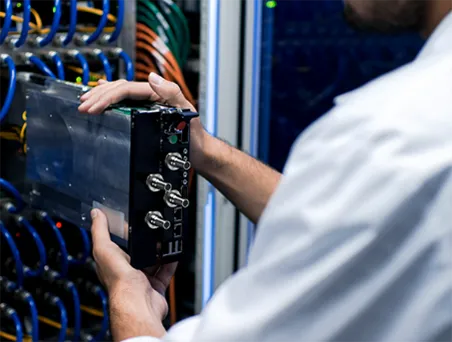
Surging computational density could bring an overhaul to the current liquid-cooling architecture.
Colder Products Company (CPC), with nearly half a century of experience in liquid connection technology, has been instrumental in the efforts to enable interoperability. CPC led technical dialogues that uncovered complexities and solutions in seemingly simple components and techniques, such as mechanical cycling to accommodate misalignment, tube attachment methods, and reliability modeling of long-term seal efficacy, all of which need to be tailored for modern data centers.
The stakes of component failures are high. Seemingly negligible flaws from small-scale testing can cause major system breakdowns that put critical hardware at risk. The valuable lessons and experiences shared through shaping industry best practices highlight the need to address technical gaps and a lack of testable requirements in liquid connection technology.
Engineering Reliability at Scale
Design and testing at the system level lay the foundation for large-scale liquid cooling success, with material science being the core expertise. Starting from the design phase, a mature supplier would already begin to anticipate how every material in the system might interface, and how each fluid pathway might behave when operating.
This compatibility is mission-critical due to risks like electrolysis and galvanic corrosion unique to liquid cooling. Expert know-how and customization in materials categories such as elastomers (particularly O-ring formulations and curing processes), thermoplastics and metal alloys (corrosion resistance and galvanic compatibility) create opportunities for higher performance and customer value.
Material expertise also allows forensic analysis where QDs act as early indicators of issues such as coolant contamination or particulate buildup. For large QD orders, automation, statistical process control, and serialization are crucial investments that ensure reliability and traceability from material sourcing to final delivery.
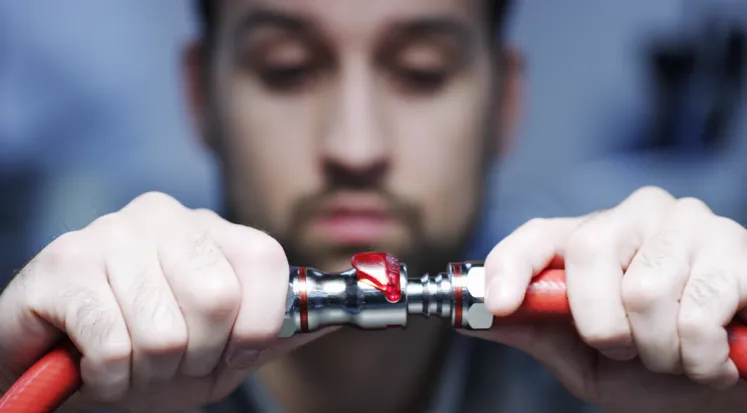
CPC’s material expertise and rigorous testing at both unit- and system-level ensure reliability in critical components.
Futureproofing in Hyperscale Environments
In hyperscale data centers, managing total cost of ownership depends on the ability to deploy modular, serviceable infrastructure. Quick Disconnects are key to enabling this modularity, facilitating efficient component replacement and system reconfiguration without necessitating full disassembly or extended downtime. This plug-and-play capability is essential not only for scalability but also for futureproofing as thermal design power requirements approach 1.2–2kW per chip and beyond. The challenge is to translate these thermal requirements into quantifiable flow parameters for next-generation connectors. Other critical frontiers include a deeper focus on reliability at scale, advancements in direct-to-chip and two-phase cooling, as well as increasing connection sizes for manifold and CDU interfaces.
This future is “liquid everywhere”. While GPUs currently dominate the liquid cooling conversation, significant opportunities exist to expand this technology to memory modules and networking components. As demand for AI and hyperscale computing surges, liquid connection technology will no longer be an afterthought but a defining factor.