
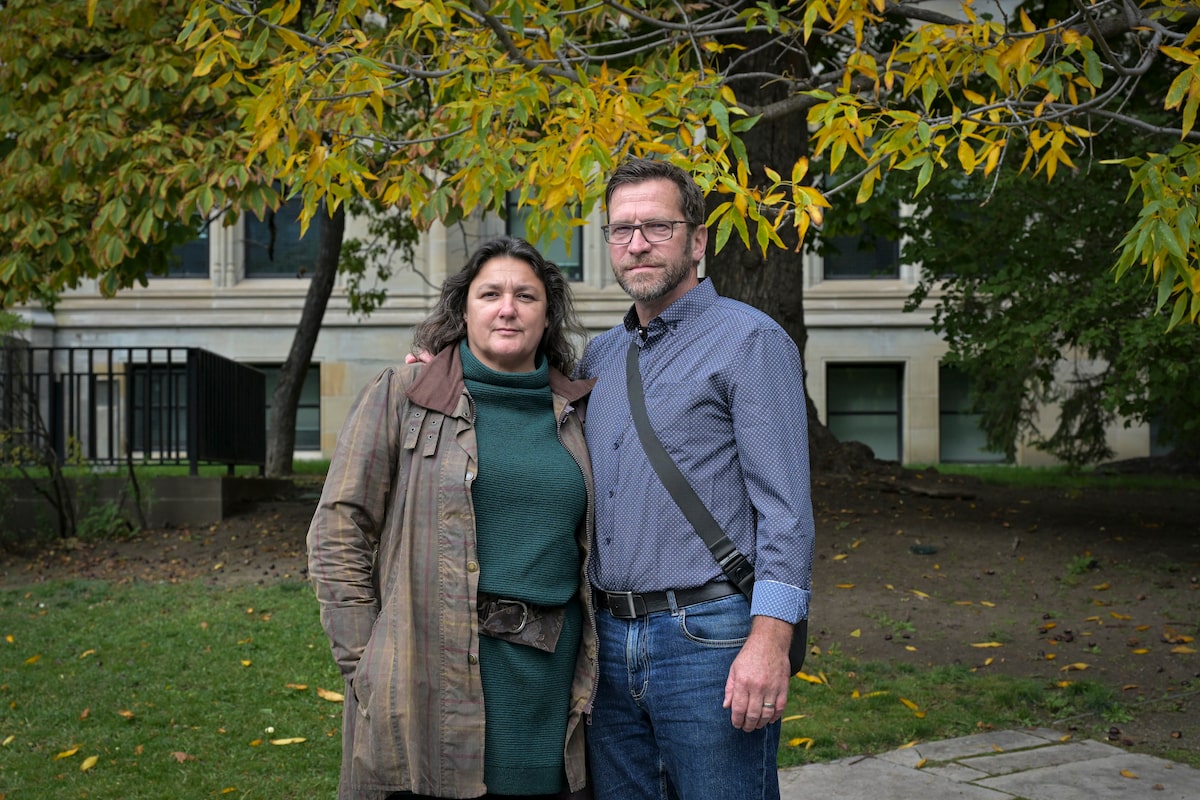
GJ and Hazel van der Werken, of Burlington, Ont., outside Queen’s Park in Toronto on Thursday. They came to the city to meet with Ontario Health Minister Sylvia Jones.EDUARDO LIMA/The Globe and Mail
The family of an Ontario teen who died after waiting hours to receive care at a hospital say a Thursday meeting with the province’s Health Minister is a good step in their push for legislative change that includes standardized maximum ER wait times for vulnerable pediatric patients.
Hazel and GJ van der Werken, the parents of 16-year-old Finlay van der Werken who died in 2024 of sepsis and pneumonia after he waited for care at an Oakville, Ont., hospital, said they felt heard by Health Minister Sylvia Jones when they discussed their call for legislation entitled “Finlay’s Law.”
They want a bill to be tabled that would include legal limits on how long pediatric patients should be sitting in an emergency room before they are seen by a doctor. They have not specified what the set times should be but say patients need to be seen faster than they are now.
An Ontario woman died of an infection after an abortion. Her sister says doctors failed her
The family is also calling for changes to the ratio of nurses and doctors to patients, saying the status quo is not sustainable. They also say an independent body should audit hospitals and that general hospitals need to receive additional funding to serve pediatric patients.
“The truth of the matter is we have to keep fighting; we have to keep this up,” Ms. van der Werken said in an interview after the meeting with Ms. Jones. “It doesn’t stop now.”
The van der Werkens are also calling for others to support their advocacy work. Since their son’s death, the van der Werkens have launched a campaign called “Finlay’s Voice,” designed to promote their calls for ER reform.
Meghan Walker, the lawyer representing the van der Werkens, said Thursday that Ms. Jones should also commit to the principles behind Finlay’s Voice, including accountability, transparency and independent oversight. Thursday’s meeting must bring about “systemic change and not just sympathy,” she said.
Nova Scotia’s approach to sepsis treatment offers life-saving lessons, advocates say
Jackson Jacobs, the director of communications for Ms. Jones, confirmed the minister met privately with the van der Werkens Thursday but declined to offer further comment on the meeting.
“We recognize the interest in this meeting; however, out of respect for its confidential and sensitive nature we won’t be able to say any more,” he said in an e-mail.
The van der Werkens have also previously spoken with Ontario NDP Leader Marit Stiles, who supports staffing ratios for hospitals. She has also pushed to ensure ER wait times do not endanger lives.
When Ms. van der Werken rushed her son to the Oakville Trafalgar Memorial Hospital in February, 2024, he was classified as “Level 2″ on the Canadian Triage and Acuity Scale. This system is used by emergency departments to prioritize patients based on the type and severity of their symptoms. At “Level 2,″ a patient should ideally be seen in 15 minutes, 95 per cent of the time.
Opinion: Too many Canadians are leaving ERs before getting assessed
Hospital records show, however, that instead of seeing a doctor right away, he waited more than eight hours to see a physician on the morning of Feb. 8.
Finlay, who was eventually diagnosed with pneumonia, sepsis and hypoxia, suffered cardiac arrest that afternoon. He was transferred to Toronto’s Hospital for Sick Children and, at 1:35 a.m. on Feb. 9, was taken off life support because the family was told he could wake up in tremendous pain.
The family has also filed a lawsuit against the Halton Healthcare Services Corp., a network of hospitals that includes Oakville Trafalgar Memorial, and medical staff, alleging Finlay’s pain, suffering, emotional distress and death were caused solely by negligence. The allegations have not been proven in court.
A statement of defence filed in September by the health-services corporation and several nurses denied the allegations of negligence. It said at all times, hospital defendants provided “reasonable hospital and nursing care” to Finlay.
The family has also requested a discretionary inquest be called to examine the circumstances of their son’s death. While inquests are automatic in the province under certain criteria, they are not when a child dies at a hospital. The van der Werkens say inquests should be mandatory in this circumstance.
The Office of the Chief Coroner of Ontario confirmed Thursday it is still in the process of reviewing the request for the inquest.