
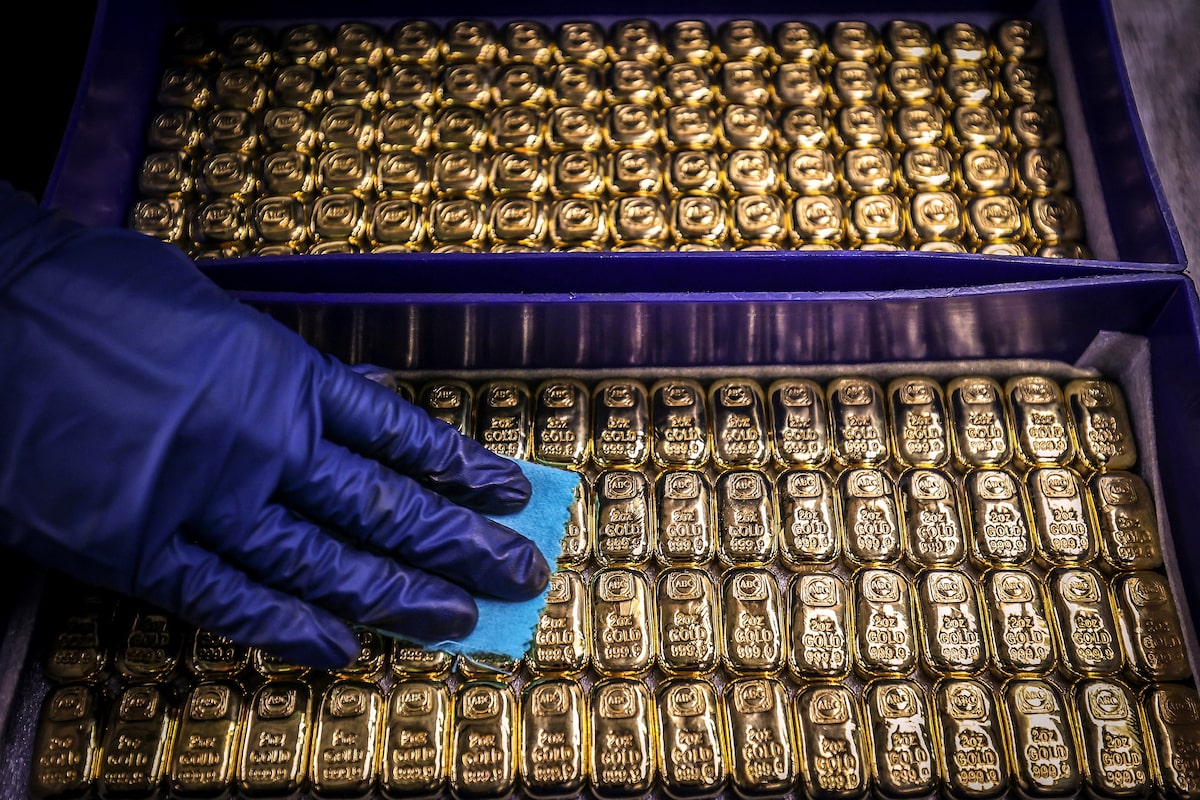
Of the top 20 performers in the S&P/TSX Composite Index this year, 18 of them are gold miners.DAVID GRAY/AFP/Getty Images
We’re capable of inflating our own asset bubbles, thank you very much.
The artificial intelligence bubble that so consumes the financial world is more of an American thing. The fate of the TSX is increasingly intertwined with a different investing craze.
We’ve all marvelled at the resilience of Canadian stocks this year. Even as the country’s economic future has crumbled before our eyes, the Toronto Stock Exchange is on pace for its best showing in 15 years.
At the heart of this disconnect is gold. The monster run in gold prices this year has electrified the TSX and helped erase a huge discount on Canadian stocks. Without gold, the S&P/TSX Composite Index would be trailing the S&P 500 index on the year.
But with great gains comes great vulnerability. At any moment, gold mania could vanish. Yes, you could say that about any hot asset, but it’s more true of gold, which is notoriously difficult to put a value on.
You don’t need to be a gold bug to be exposed. Since so much of investor sentiment toward Canadian stocks seems to be tied up in gold, a free fall in the commodity would weigh heavily on the TSX in general.
“Because the gains have been so aggressive, you would imagine that the flip side would be pretty aggressive too,” said Craig Basinger, chief market strategist at Purpose Investments Inc. in Toronto.
Canada is the only G7 country to sell off all its gold reserves. Why?
We’ve recently caught a couple of glimpses of exactly that. This past Tuesday, gold bullion had its worst day in more than 12 years when it fell by as much as 6.3 per cent.
The cause of the turbulence was unclear. U.S. President Donald Trump said some nice things about China, which was interpreted as a sign of progress in trade talks. And since gold is said to thrive on turmoil, down it went.
By way of explanations, it was thin gruel. The important part is what happened to Canadian stocks. The benchmark index dropped by 1.7 per cent, making it the worst day since Mr. Trump’s “Liberation Day” debacle in April. This was on a day when stocks globally were calm.
Same thing last Friday. Some vague talk on tariffs, gold drops and the TSX follows suit.
Those are but blips on what has been an otherwise upward trajectory. Gold is still trading at well above US$4,000 an ounce. But would anybody be shocked if one of these blips marks the beginning of a nosedive?
It’s hard to be confident in gold’s endurance when we struggle to explain why it’s gone up so much in the first place.
Lots of investors consider gold to be an inflation hedge. That could explain it. Or it’s a crisis trade that pays off when chaos reigns. But really it’s a play on bond yields, gaining strength when fixed-income payouts decline. Then again, it sure looks like a function of declining faith in the U.S. dollar and concern over burgeoning public debt. Mind you, there are lots of investors chasing real assets these days. Maybe it’s all those things.
Perhaps you’re not looking this gift horse in the mouth if you hold gold stocks right now. Of the top 20 performers in the S&P/TSX Composite Index this year, 18 of them are gold miners. Their average return is 170 per cent.
No other sector has contributed more to Canadian returns this year. Materials, which is a sector dominated by gold names, has generated more than one-third of the index’s 23-per-cent gain.
As a result, the Canadian stock market is much more heavily tilted to gold today than it has been in recent years.
Look at where Canadian earnings growth – a critical fuel driving stock markets higher over time – is coming from. Gold stocks are expected to generate $11.6-billion in earnings growth over the next year, according to Purpose Investments. The entire rest of the market: $12.9-billion.
Those numbers echo the concerns about concentration in the U.S. market, where AI stocks have accounted for 80 per cent of earnings growth over the past three years, according to a recent JP Morgan report.
Gold can also take credit for helping lift TSX valuations out of the basement. The price-to-earnings ratio when factoring in profit estimates for the year ahead sits at 16.5. That isn’t exactly bubble territory, but it’s not cheap either.
A few years ago, that trading multiple was closer to 10 times, when the TSX was unloved and underowned. The silver lining of having a dirt-cheap stock market is that it doesn’t tend to be super volatile. As the U.S. market rode the whims of Big Tech up and down over the past few years, Canada’s market was relatively stable. That’s changing fast.
As goes AI, so goes the U.S. stock market. The TSX, on the other hand, has cast its lot with gold, for better or worse.