
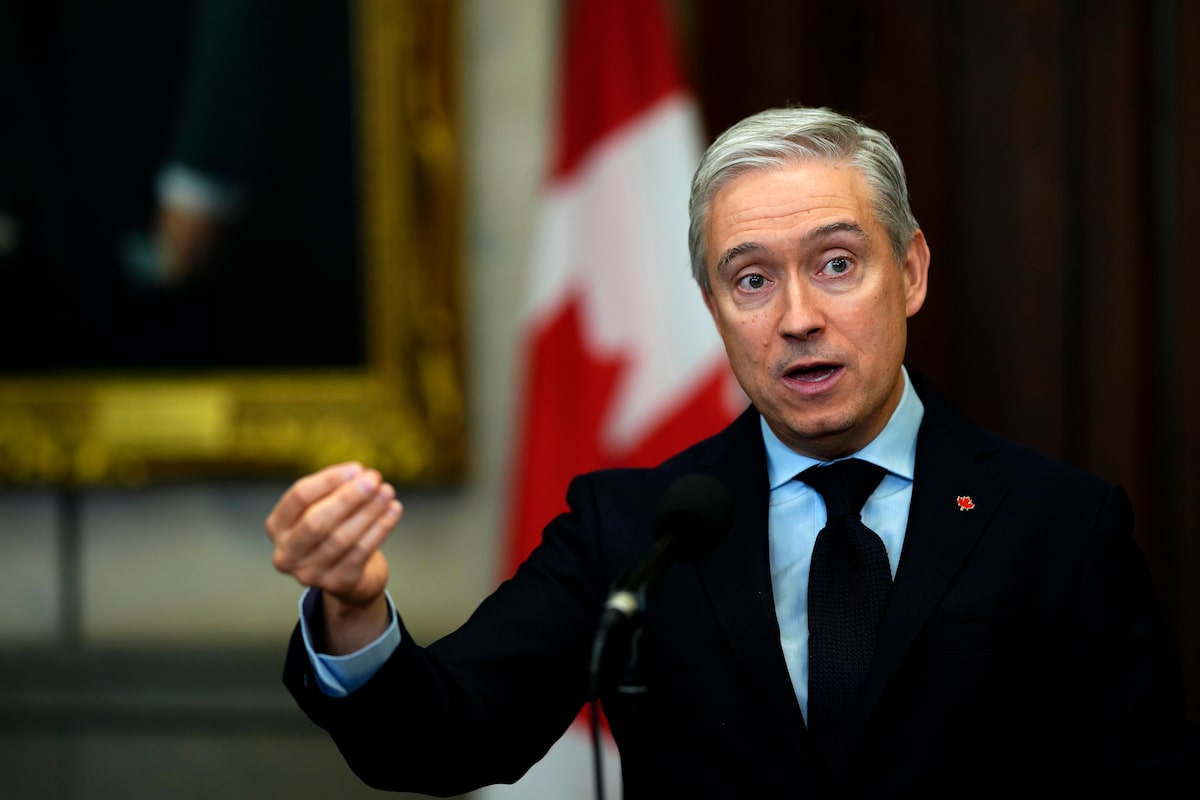
Finance Minister Francois-Philippe Champagne in Ottawa on Oct. 6. Mr. Champagne has avoided repeating Prime Minister Mark Carney’s campaign pledge that government debt relative to GDP will decline.Justin Tang/The Canadian Press
In the run-up to what is expected to be a big-spending federal budget, a growing number of economists are predicting that the Liberals won’t live up to a once central promise of shrinking the debt relative to the size of the economy.
A report released this week by RBC assistant chief economist Cynthia Leach is the latest to reach that conclusion, adding to similar projections by economists at Desjardins, the C.D. Howe Institute and the Office of the Parliamentary Budget Officer.
In an interview, Ms. Leach said the budget is unlikely to show a declining debt-to-GDP ratio, at least over the short term.
“That looks pretty difficult and probably an overly rigid anchor in light of what the government is facing,” Ms. Leach said. “We think a good chunk of this spending is probably warranted if it’s in the right areas to help the economy with structural challenges and finding new and expanding growth drivers.”
Ottawa’s budget to include more for retraining, tax credit for personal support workers
Federal budget to include new agency to tackle money laundering, online fraud
Federal budgets typically set a target known as a fiscal anchor, which is meant to show the direction of public finances over time.
Historically, a common fiscal anchor was to focus on a timeline for balancing the budget.
Past Liberal governments under former prime minister Justin Trudeau, who defended deficit spending, frequently cited the goal of lowering the net debt-to-GDP ratio instead.
That general lowering trend was thrown off-track during the pandemic, with the ratio jumping to 47.2 per cent from 31.2 per cent in a single year. The ratio then improved for two years until a slight uptick to 42.1 per cent was posted for the 2023-24 fiscal year, the most recent figure available.
Under Prime Minister Mark Carney, the Liberal Party referenced the target again in its April election platform, pledging that a re-elected government would “ensure that government debt to GDP declines over the budget horizon.”
Since then, however, Finance Minister François-Philippe Champagne has avoided repeating that pledge when directly asked.
During a recent appearance before the House of Commons finance committee, he instead focused on two other targets when Conservative MPs asked him to state the government’s fiscal anchors.
Mr. Champagne said the government will balance the operating budget in the next three years.
“That is a fiscal anchor that we have been talking about and have put in the platform,” he said, adding that the government has also said the deficit-to-GDP ratio will decline.
The deficit is the annual shortfall between revenues and expenses. An annual deficit is added to the federal debt, which is also called the accumulated deficit.
In dollar terms, the debt climbed above the $1-trillion mark during the pandemic. It was more than $1.2-trillion in 2023-24.
Balancing the operating budget refers to Mr. Carney’s pledge that within three years, revenues and day-to-day operational expenditures will be in balance, while all deficit spending will be devoted to capital spending that creates long-term benefits.
That approach has prompted debate over how the government will define capital spending.
Conservative finance critic Jasraj Hallan dismissed the concept as an “accounting trick” during his back and forth with the minister at committee.
“At the end of the day, the bottom line is still the bottom line,” he said.
Last month, interim Parliamentary Budget Officer Jason Jacques released a report projecting that the debt-to-GDP ratio would rise above 43 per cent over the medium term. A prebudget report from Desjardins reached a similar conclusion this month.
The Business Council of Canada recently released a budget-focused report based on interviews with more than 50 CEOs and nearly 20 economists, investors and senior officials.
The report found near unanimity across all groups that fiscal anchors matter. It said the debt-to-GDP ratio is the most frequently cited anchor, with many advocating a stable or declining path over the medium term.
Theo Argitis, the Business Council of Canada’s senior vice-president of policy, said in an interview that debt-to-GDP targets provide helpful guidance to markets, the public and decision-makers in government departments about where federal spending is headed.
“There is some tolerance for deficit financing of an investment agenda, as long as it’s not out of control, and as long as the investments are real,” he said.
“People are willing to give them a little bit of latitude, I would say, given the moment that we’re in, with the caveat that over the medium term, they have to show kind of a respectable fiscal track.”
The Globe asked Mr. Champagne’s office Tuesday to list its current fiscal anchors and whether the government remains committed to a declining debt-to-GDP ratio.
“We will outline our fiscal anchors in the budget on November 4,” spokesperson John Fragos replied in an e-mail.