
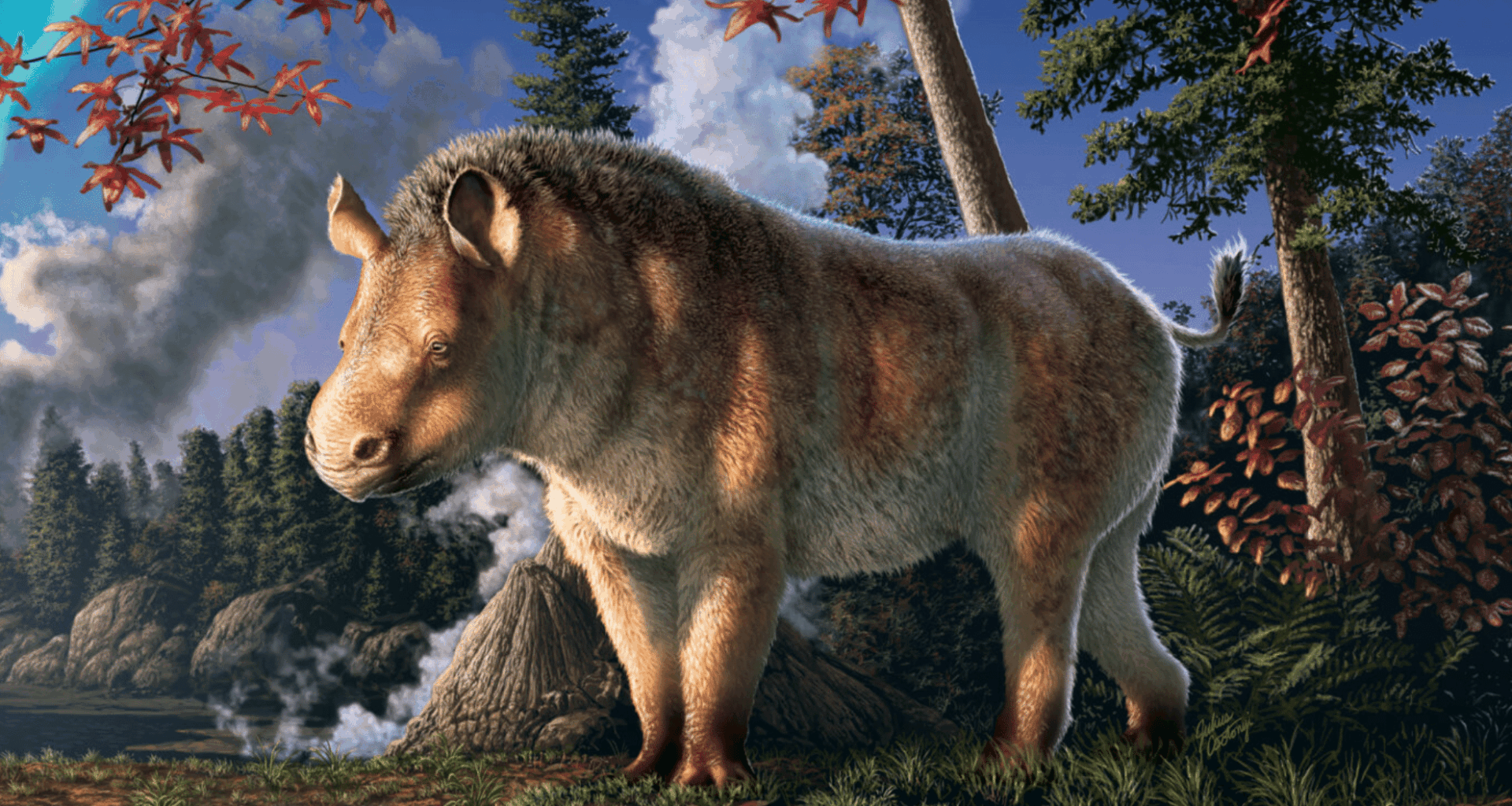
Scientists have recently uncovered an astonishing discovery in Canada’s High Arctic—a new extinct rhinoceros species. Found in the remote Haughton Crater on Devon Island, this remarkable fossil offers insights into rhino evolution and ancient animal migrations. The nearly complete skeleton of Epiaceratherium itjilik opens a new chapter in the study of prehistoric mammals, shedding light on species that once roamed much farther north than previously believed.
The Arctic Rhinos: An Ancient Enigma
The fossilized remains of Epiaceratherium itjilik have revolutionized our understanding of rhino evolution. This ancient rhino species, which lived around 23 million years ago during the Early Miocene, was discovered in one of the most unlikely places—a site in the High Arctic. The fossil’s exceptional preservation has captured the imagination of scientists, allowing them to reconstruct not just the physical characteristics of the animal but also its place in the larger ecological and evolutionary context.
The name Epiaceratherium itjilik was chosen to honor the rhino’s frigid Arctic home, with “itjilik” meaning “frost” in Inuktitut, the language of the indigenous Inuit people. Researchers, including Dr. Danielle Fraser from the Canadian Museum of Nature (CMN), are particularly excited by the fact that the new species expands the rhino family tree.
“Today there are only five species of rhinos in Africa and Asia, but in the past they were found in Europe and North America, with more than 50 species known from the fossil record,” Dr. Fraser noted.
The discovery offers a rare glimpse into the ancient ecosystems of the Arctic and its diverse megafauna.
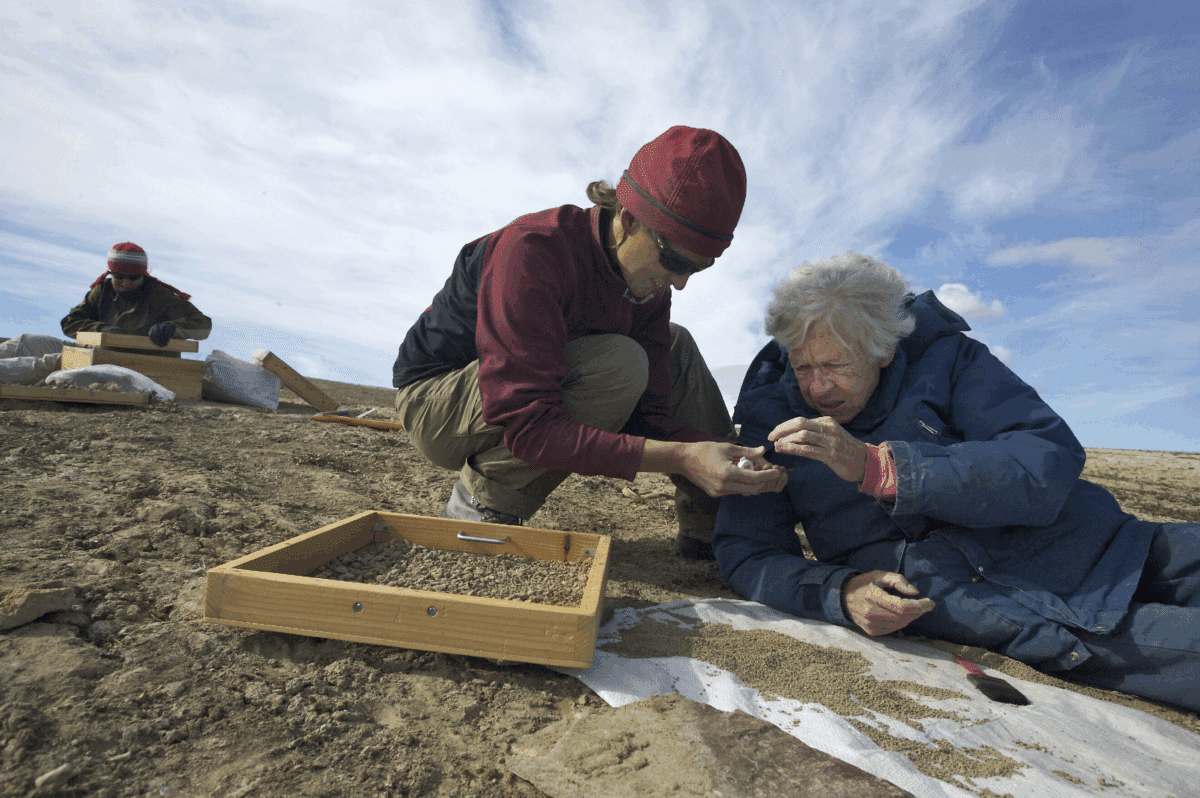 Dr. Natalia Rybczynski (foreground, left) and Dr. Mary Dawson sift for fossils at the Haughton Crater site during a field expedition in 2007. Credit: Martin Lipman Canadian Museum of Nature
Preserved in Time: A Remarkable Fossil Find
The state of preservation of the Epiaceratherium itjilik remains is nothing short of extraordinary. Fossils typically undergo a long, complex process of mineralization, but the bones of this ancient rhino were found in almost pristine condition. Dr. Marisa Gilbert, a co-author of the study and senior research assistant at CMN, emphasized this aspect:
“What’s remarkable about the Arctic rhino is that the fossil bones are in excellent condition. They are three-dimensionally preserved and have only been partially replaced by minerals. About 75% of the skeleton was discovered, which is incredibly complete for a fossil.”
This level of preservation has enabled researchers to piece together an accurate representation of what the creature might have looked like in life. With a size comparable to the modern Indian rhinoceros but without a horn, Epiaceratherium itjilik was a relatively small rhino by today’s standards. The completeness of the fossil has not only helped in physical reconstruction but has also provided essential clues to its evolutionary relationships and migration patterns.
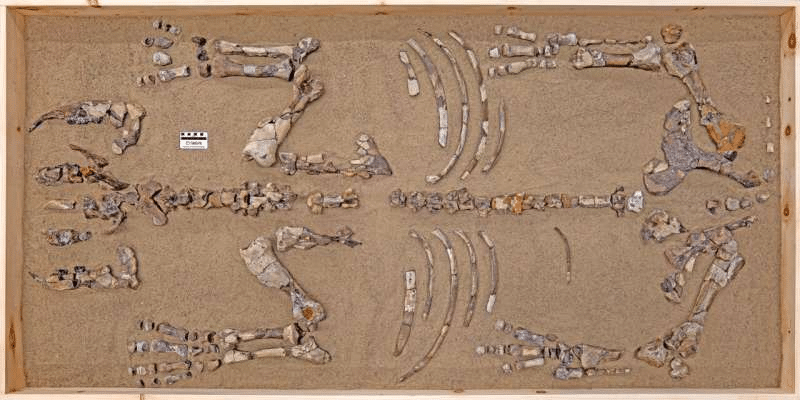 Overhead view of the fossil of Epiaceratherium itjilik with its bones laid out on a sandy base. About 75% of the animal’s bones were recovered, including diagnostic parts such as the teeth, mandibles and pieces of the cranium. Credit: Pierre Poirier Canadian Museum of Nature
The Role of the North Atlantic in Rhinos’ Evolution
The discovery of Epiaceratherium itjilik has broader implications for the study of mammalian evolution, particularly in understanding the role of the North Atlantic during prehistoric migrations. The research team’s findings, published in Nature Ecology & Evolution, suggest that the North Atlantic was an important conduit for the dispersal of rhinos and other mammals between Europe and North America much later than previously thought.
Fraser and her team’s analysis challenges earlier models of animal migration, which assumed that land bridges between continents only functioned as passageways during specific time frames.
“It’s always exciting and informative to describe a new species. But there is more that comes from the identification of Epiaceratherium itjilik, as our reconstructions of rhino evolution show that the North Atlantic played a much more important role in their evolution than previously thought,” Fraser commented.
The study not only extends our knowledge of prehistoric migration routes but also reshapes our understanding of how environmental factors influenced species diversification over time.
A New Era in Arctic Paleontology
The discovery of Epiaceratherium itjilik is particularly significant in the context of Arctic paleontology. For years, the High Arctic has remained a mystery to paleontologists, with few fossil sites yielding substantial evidence of ancient life. However, the Haughton Crater, with its rich deposits, has emerged as a treasure trove for prehistoric discoveries. This new species of rhino is only one of the many discoveries that have helped to reshape our view of Arctic ecosystems in the distant past.
Dr. Natalia Rybczynski, a research associate at CMN and co-author of the study, highlighted the broader implications of this research:
“More broadly, this study reinforces that the Arctic continues to offer up new knowledge and discoveries that expand on our understanding of mammal diversification over time.”
The fossil’s preservation and the site’s ongoing potential for new discoveries suggest that the Arctic could hold even more secrets of Earth’s ancient past.
The Legacy of Arctic Fossils: A Look into the Past
The discovery of Epiaceratherium itjilik is not just a scientific milestone for paleontologists; it also holds significant cultural value. The researchers worked closely with Jarloo Kiguktak, an Inuit Elder, to name the species in honor of its Arctic origins. This collaboration underscores the importance of integrating indigenous knowledge with scientific inquiry, fostering a deeper connection between contemporary communities and ancient ecosystems.
The fossil’s ongoing study will likely open new avenues for understanding the region’s biodiversity during the Miocene. As more research is conducted, we may learn about the broader ecosystem that Epiaceratherium itjilik inhabited, including the plants, animals, and environmental conditions that allowed such creatures to survive in a once-temperate Arctic.