
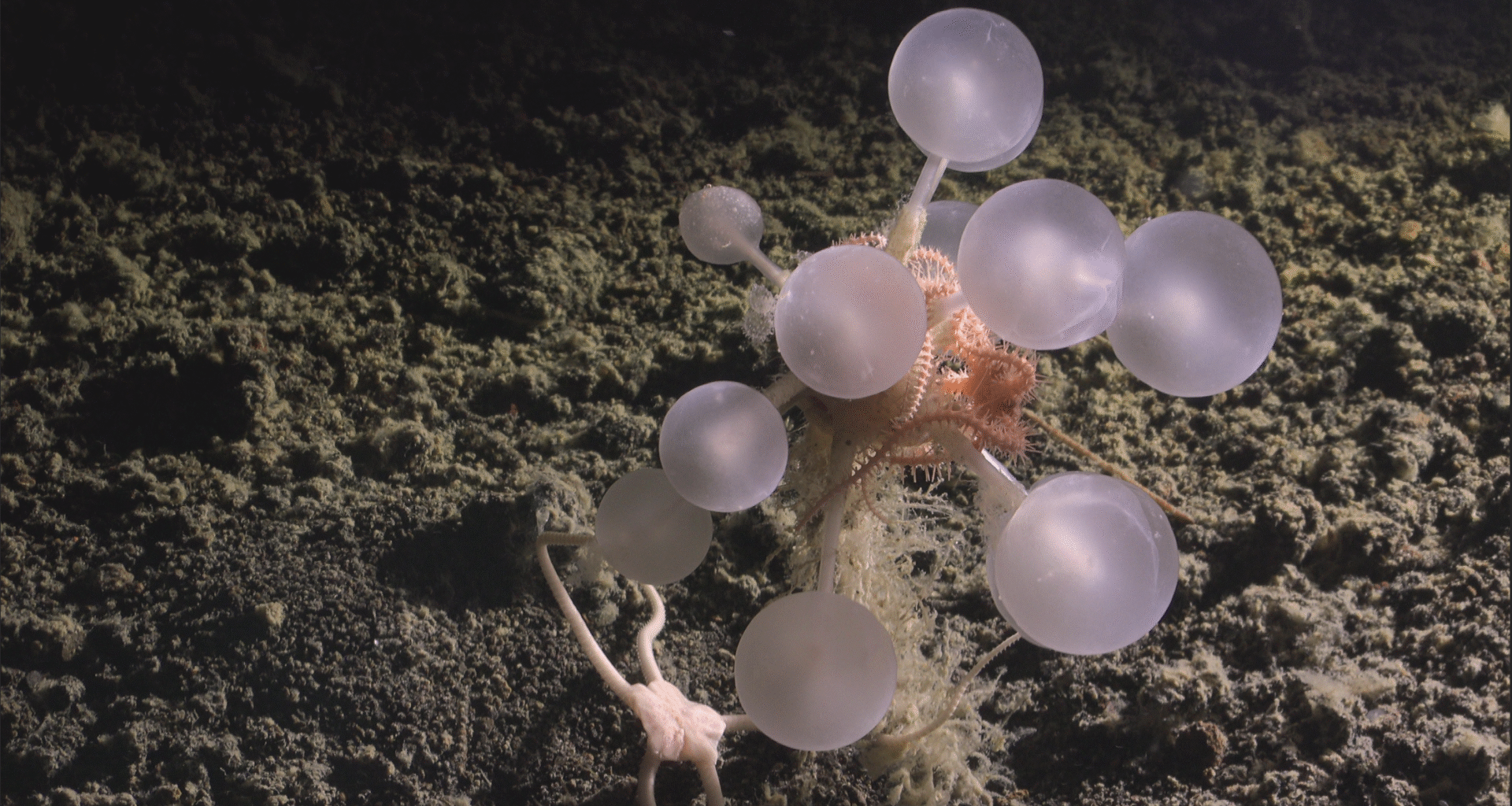
Further south, an Ocean Census Science Network team joined another R/V Falkor (too) expedition in the Bellingshausen Sea. When iceberg A-84 – measuring roughly 510 km² – calved from the George VI Ice Shelf in January 2025, researchers seized the rare opportunity to explore the newly exposed seabed, sealed under ~150 metres of ice for centuries.
“The Southern Ocean remains profoundly under-sampled,” said Dr Michelle Taylor, Head of Science at Ocean Census. “We’ve only assessed 30% of the samples from this expedition so far, and already confirmed 30 new species. That shows how much biodiversity is still waiting to be documented.”
By pairing expeditions with rapid species discovery workshops, Ocean Census compresses what can take a decade of taxonomic work into months—without compromising scientific rigour.
Other confirmed or likely new species include:
Armoured and iridescent scale worms (Eulagisca sp. nov.).
New sea stars from Brisingidae, Benthopectinidae, and Paxillosidae families.
Unidentified crustaceans, including isopods and amphipods, one of which may represent an entirely new amphipod family.
Rare gastropods, bivalves, and black corals thriving in volcanic and hydrothermal-influenced habitats.
A potentially new sea-pen genus now under expert review.
“Advanced tools – from precision seafloor mapping to HD ROV imagery – let us explore places no human has ever seen,” said Dr Jyotika Virmani, Executive Director of Schmidt Ocean Institute. “This collaboration has yielded the first juvenile colossal squid sighting and an array of new species, demonstrating what becomes possible when technology and science unite.”
At the Southern Ocean Species Discovery Workshop, taxonomists from around the world fast-tracked verification using a triage system – imaging, comparing, and DNA-barcoding specimens in real time. This “ocean-to-lab” approach aims to tackle a chronic issue in taxonomy, that of samples languishing unprocessed for years due to limited resources.
“This is exactly why Ocean Census exists,” added Dr Taylor, who also lectures at the University of Essex. “Accelerating discovery and making biodiversity data openly available ensures every species we confirm becomes a cornerstone for conservation and future science.”
Polar deep-sea ecosystems remain among Earth’s most mysterious and least studied environments, vital for understanding evolution, biogeography, and resilience amid a changing climate.
All confirmed species meeting Ocean Census’ ‘Discovered’ criteria will be catalogued in the Ocean Census Biodiversity Data Platform – an open-access database designed to empower global research, conservation planning, and policy.
From death-ball sponges to colossal squid, the Southern Ocean continues to remind us how much of our planet’s life still lies hidden in the cold, dark depths—waiting to be revealed.