
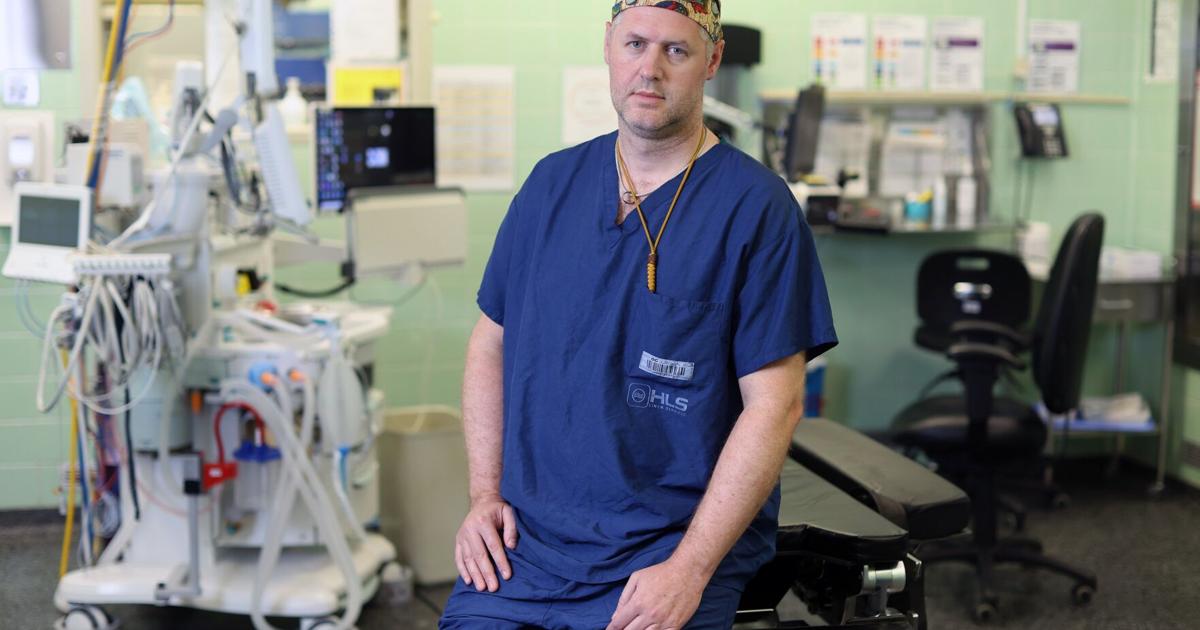
Dr. Braden Gammon remembers the surge of adrenaline he felt when he rushed to an operating room three years ago to see a patient whose hand had been crushed in a piece of farm equipment.
The young farmer had lost four fingers, but Gammon, an Ottawa surgeon who specializes in hand and wrist surgery, wanted to take a shot at putting the mangled hand back together.
Working through the night, Gammon slowly reattached each finger, carefully setting bones, connecting tendons and sewing together blood vessels no wider than a strand of spaghetti.
The 15-hour operation was a success. But it took two-and-a-half years before Gammon said the provincial government reimbursed him for his work. Until then, the only payment he had received since the November 2022 surgery was a jug of maple syrup from the grateful farmer.
“It’s ridiculous,” said Gammon, an orthopedic surgeon at The Ottawa Hospital. “Those fingers didn’t magically reattach themselves.”
The case is a dramatic but increasingly common example of how long-standing OHIP billing problems are affecting doctors across the province, the Ontario Medical Association says.
It’s warning that Ontario’s outdated OHIP billing system is forcing doctors to wait months for delayed payments, and that hours spent dealing with rejected or unresolved claims is leading to physician burnout and taking time away from patient care.
The challenges have become so widespread in recent years, the OMA says the issue is now a top concern for its members. On Monday, the physician advocacy organization called on the provincial government to make a revamp of the OHIP billing system a top health-care priority.
While billing problems affect a range of doctors — a 2025 OMA survey found 90 per cent of respondents said they had claims rejected the previous year — the challenges are particularly acute for surgical specialists. The OMA says the billing system has not kept pace with surgical innovation and often doesn’t account for newer or more complex surgeries. This has led to some doctors no longer offering procedures to patients over fear of not getting paid, while others choose to leave the province.
“It worries me that physicians are so frustrated … that some of them are getting to the point where they just don’t want to do (complex surgeries) anymore,” said the OMA’s CEO, Kimberly Moran. “We don’t want that for our health-care system.”
How Ontario doctors are reimbursed
Ontario doctors are reimbursed for the insured services they provide according to the OHIP schedule of benefits. They submit claims using specific fee-for-service codes; there are about 6,000 codes in the schedule for physician services.
When a billing is deemed to be in error, or when a doctor is asked for further information about a patient encounter, it can lead to rejections, or delays or decreases in payment. There is an appeal process, but doctors say it is time-consuming and that not all appeals will be granted or quickly resolved.
Gammon is one of a handful of surgeons willing to speak out about unpaid or delayed OHIP claims. He said many of his surgical colleagues have similar experiences, but few want to speak publicly because they fear their OHIP billings will face more scrutiny, causing further delays.
In the case of the farmer, Gammon said his OHIP reimbursement was held up because he billed for multiple surgical procedures at one time, under one anesthetic; the patient needed four fingers reattached, not just one, for example. That triggered the manual review process, meaning the claim could not be fully processed through OHIP’s automated system and was instead sent to the Health Ministry for assessment.
For a manual review, doctors are required to provide detailed documentation of the procedure as proof they provided the services, which can lead to numerous back-and-forths between the physician and the ministry. If a doctor submits a claim or response outside the prescribed timeline, that billing can be delayed, reduced or denied. Doctors can appeal decisions through a multi-step process, which includes requesting an independent audit through the Health Services Appeal and Review Board.
Gammon said he understands the need for checks and balances to ensure claims are accurate and that doctors are complying with the schedule of benefits. For surgeons, he said, the problem is that OHIP billing codes don’t fully capture the complexity of many procedures, which means these claims go straight to the manual review process, creating administrative burdens and leading to delayed or reduced compensation.
“I would say the more complex things get, the more likely there is to be a discrepancy between the service that was provided and the payment that was received,” said Gammon, an associate professor at the University of Ottawa. He noted that in his practice, in general, OHIP claims face a delay of at least seven to nine months before starting the manual review.
The frustration has become so great that Gammon, an expert in helping patients with arthritis, no longer offers a specific surgery.
Gammon said the procedure, a partial wrist fusion, is the best option for some patients because it offers greater mobility than a full wrist fusion, while reducing pain. But there is no OHIP billing code for it, and Gammon said he has yet to be compensated for the multiple times he has done the surgery.
“When people hear about this, they assume that we must have done something wrong,” he said. “But there’s no clerical error. The patient has a valid OHIP card. We submitted our billings on time. We’ve resubmitted and inquired repeatedly. The delays are purely on the ministry side.”

Dr. Michael Yacob, a vascular surgeon formerly at Kingston Health Sciences Centre and now at The Ottawa Hospital, said his OHIP reimbursements are often delayed by at least six months.
Jilly MacIver for the Toronto Star
Some surgeons pushed out of Ontario
Dr. Michael Yacob, a vascular surgeon, formerly at Kingston Health Sciences Centre and now at The Ottawa Hospital, said the OHIP compensation that surgeons receive is used to fund their practices, which include buying and maintaining equipment and paying office staff. When billing claims are delayed, he said, it can be hard to keep their practices afloat.
“There’s a real, tangible outcome to those of us experiencing this,” he said, noting that his OHIP reimbursements are often delayed by at least six months.
Yacob said his surgical specialty — vascular surgeons diagnose and treat diseases of the arteries and veins — is among those most affected by delayed OHIP reimbursement because the ministry’s schedule of benefits doesn’t account for complex vascular procedures or the pace at which the specialty is progressing. He said while hospitals are aware of surgeons’ challenges, they don’t have a direct stake in the payment process and it’s up to doctors to advocate to the ministry.
In recent years, Yacob said he’s seen the “snowball effect” of chronic underpayment for technically demanding procedures turn surgical trainees away from his specialty and push some experienced surgeons to leave the province. He said he knows of at least five vascular surgeons who have left Ontario in the last few years.
“They’re just done with having to deal with the headache of delivering care and not being compensated for it,” said Yacob, the OMA’s section chair of vascular surgery. With only about 135 vascular surgeons in Ontario, patient wait times will likely get longer if doctors continue to flee the province or the specialty, he said.
“We love doing the hard cases. We love delivering the best operation for the patient. But that is not compensated in the Ontario system.”
What does the Health Ministry say?
Moran of the OMA said the ministry is aware of the OHIP billing challenges and is working on solutions, but it’s not clear what those are and that doctors have yet to see any change.
A spokesperson for Health Minister Sylvia Jones said Ontario’s Medical Claims Payment System processes more than 200 million claims every year, and that 99 per cent are paid automatically as submitted, which “reflects the system’s productivity.” Ema Popovic said less than one per cent of all claims are sent for manual review, and that more than 95 per cent of those are resolved within 30 days.
She said, in general, two-thirds of these claims are labelled as Complex Surgical Claims, in which multiple procedures are performed. The ministry’s three-tier review process, used in a manual review, is fitting in these cases, Popovic said, noting nuanced cases will move up to the third tier, where a physician conducts the final review. She said outcomes include full or partial payment, or claims being returned, and that the appeal process is open to doctors.
“This reliable, structured process ensures that claims subjected to manual review comprehensively align with the payment requirements of the Schedule of Benefits,” Popovic said in a statement.
As part of its advocacy on the issue, the OMA is asking the ministry to create a fast-track process to update and modernize the schedule of benefits so it can keep pace with medical and surgical advances. The OMA also wants greater transparency and swifter timelines in the review process and is calling on the government to establish an OHIP Ombudsman with independent oversight who can intervene and quickly act on billing issues.
The Health Ministry didn’t answer questions on whether it would work with the OMA on its requests to modernize and streamline the OHIP billing system. Popovic said it was “disappointing that the OMA is choosing to focus on 0.58% of OHIP claims, rather than highlighting the real progress we’ve made together to support physicians.”
Though he was finally compensated for the 15-hour hand surgery, Gammon said it remains a striking example of what’s wrong with the billing system. After negotiating with the ministry, he said he received payment for his services, but at a reduced rate.
“Many surgeons have to do long, complicated procedures, and if we get paid a fraction of what we feel like we’re owed, that’s obviously a real disincentive for us.”
Gammon said he doesn’t want people to mistake what he and his colleagues are asking for. It’s not more money or higher salaries — they know Ontario surgeons make a good income. Instead, they want to be quickly reimbursed for work they’ve already done, or for the innovative procedures they want to do.
“We can’t be waiting multiple months or even years to figure out if we get paid or not.”