
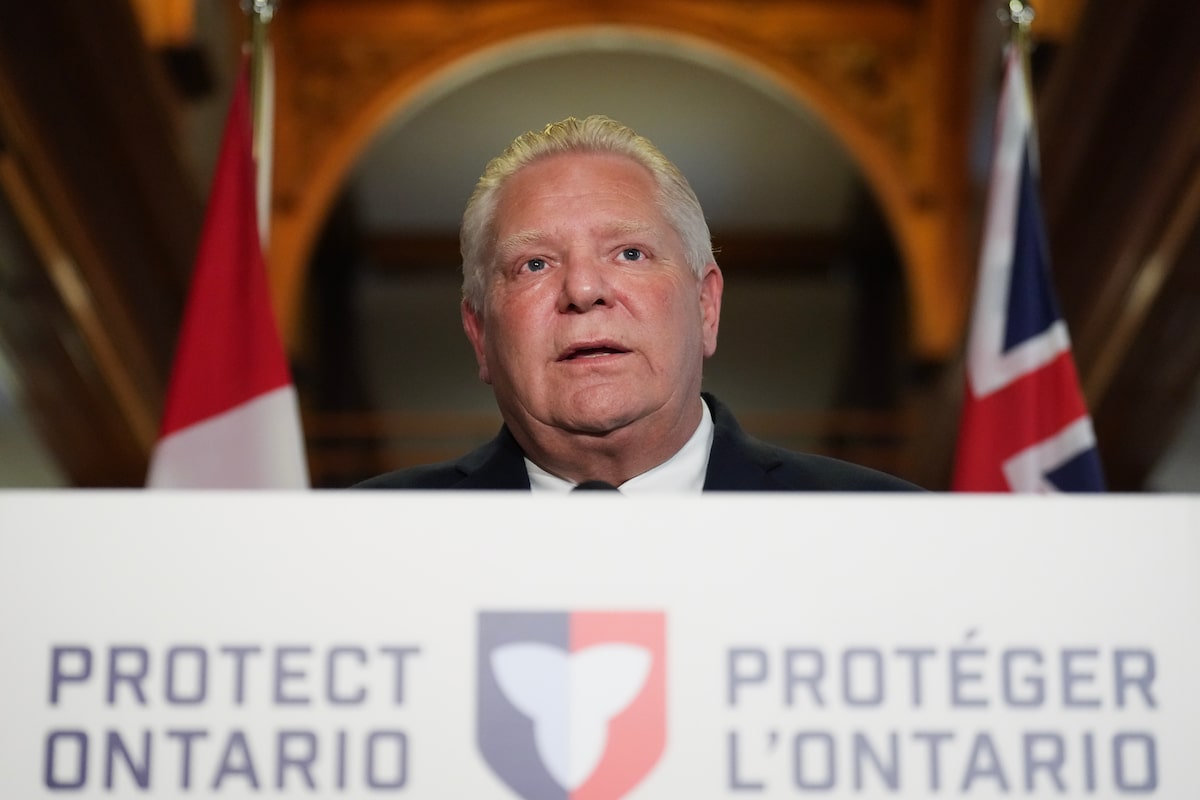
Ontario Premier Doug Ford says that the feasibility study is part of a broader plan to build a more competitive, resilient and self-reliant economy for Ontario and Canada.Nathan Denette/The Canadian Press
Ontario has launched a feasibility study of a new Canadian pipeline and energy corridor which would move oil and gas produced in Alberta and Saskatchewan eastward to refineries and new ports on James Bay, Hudson Bay and the Great Lakes.
Premier Doug Ford said in a statement Thursday that the analysis is part of a broader plan to build a more competitive, resilient and self-reliant economy for Ontario and Canada, and create jobs in the face of tariffs imposed by the United States.
It would also help to protect Ontario’s energy security by ensuring a reliable and uninterrupted supply of oil and gas from the West, the government said. Any pipeline that comes from the plan would be built entirely within Canada, using Canadian steel.
The study, to be completed next year, will include options on where the energy corridor could be built and what it would cost. It will also look at what the government called “complementary development opportunities” across Ontario, including all-season roads for the Ring of Fire region, mineral exports, grid upgrades and a strategic petroleum reserve.
The Editorial Board: An elbows-down strategy in the pipeline
“This nation-building pipeline and energy corridor will unite our country and help unlock new markets for Canada’s energy resources that will reduce our dependence on the United States,” Mr. Ford said.
Acting Ontario infrastructure minister Todd McCarthy told reporters at Queen’s Park on Thursday that he hoped the concept would make Prime Minister Mark Carney’s next list of major national projects earmarked for fast-tracking, expected next month.
“We’re not waiting. We hope the federal government will join us,” Mr. McCarthy said. Canada needs to transform, he said, to ensure it can both power itself and increase energy exports.
With both Alberta and Saskatchewan aiming to significantly boost oil production, the premiers of both provinces applauded Ontario’s plan.
Alberta Premier Danielle Smith said in a statement that “Alberta, Ontario and Saskatchewan are proving what’s possible when provinces lead and stand together to advance a shared vision of responsible development, economic freedom and common sense.”
Saskatchewan Premier Scott Moe echoed her comments, saying that access to domestic and international markets is critical for Saskatchewan’s export-oriented economy.
“New pipeline infrastructure will strengthen Canada’s energy security and help us become a global energy superpower,” he said.
Asked why Manitoba is not involved, Mr. McCarthy said the effort was in its early stages.
The Ontario government said the province would honour its duty to consult with Indigenous communities and continue to advance economic reconciliation, which includes pathways to Indigenous equity participation.
Tony Keller: Does Canada need a new oil pipeline? Maybe. More LNG? Definitely
Ontario NDP Leader Marit Stiles said big energy corporations, not taxpayers, should pay for any feasibility study, and that the cost of it should be released.
“I don’t know why we are footing the bill for these companies when they are certainly more than capable of doing it for themselves,” she told reporters.
Keith Brooks, with Environmental Defence Canada, condemned the idea of an east-west pipeline and energy corridor, calling it “ridiculous” and “absurd.”
“These pipeline fantasies ignore economic and climate realities while threatening to derail Canada’s path towards a clean, climate-competitive future. There just isn’t any demand for more Canadian oil, regardless of how it reaches tidewater,” he said in a statement.
As the world races to get off fossil fuels, he said, “it makes no sense to spend valuable public dollars studying this latest, and most fanciful, pipedream.”
With reports from Jeff Gray in Toronto