
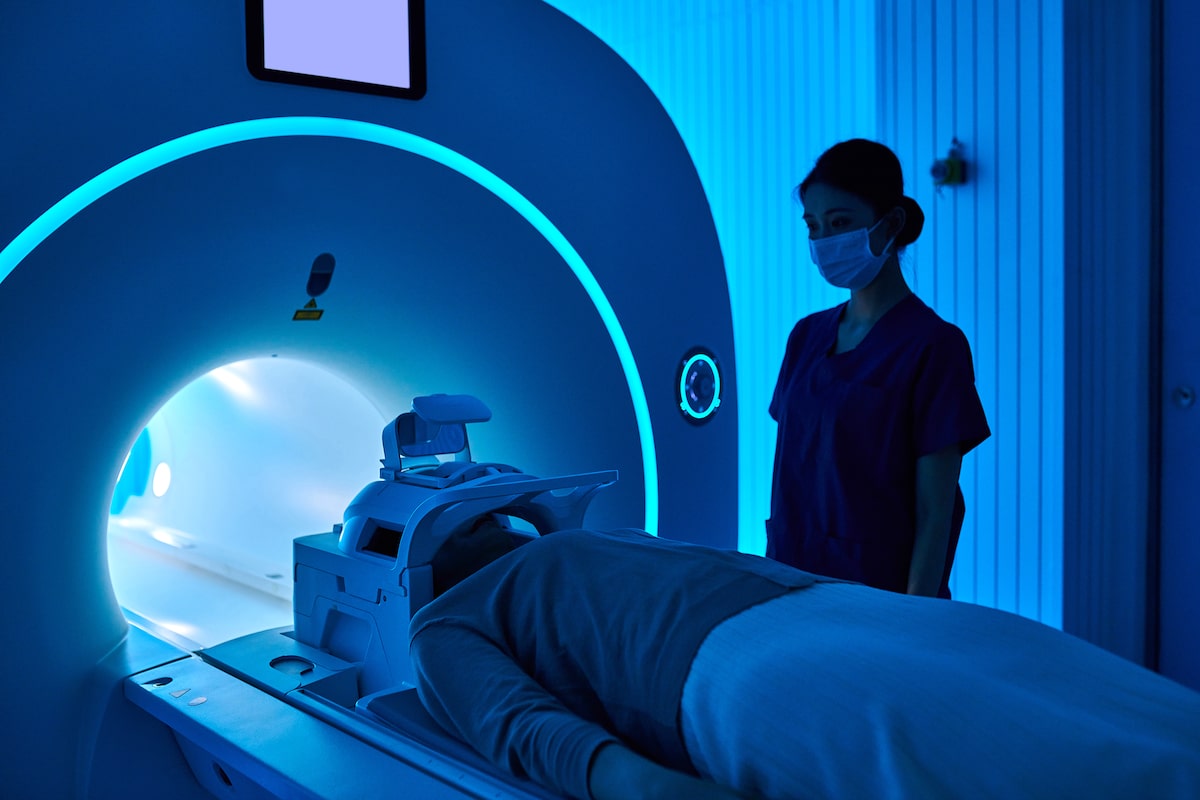
Technicians must perform many MRI scans while maintaining the exactitude.Getty Images
Anakana Schofield is a writer living in Vancouver. Her forthcoming novel, Library of Brothel, will be published in May.
Each weekday morning, for six weeks earlier this year, I made my way to UBC Hospital’s Department of Psychiatry (Non-Invasive Neurostimulation Therapies Lab), where, as part of a study, a magnetic coil delivered 600 pulses to my brain for 10 minutes at a time.
Transcranial magnetic stimulation (TMS) targets either the right or left dorsolateral prefrontal cortex area of the brain, which is responsible for mood regulation, among other things. Each zap felt like a woodpecker jabbing sharply on my head or a nail being gently hit into a wall, except my head was the wall. With each pulse, accompanied by a loud clicking sound, like a BBQ lighter, a nerve would twitch in my nose like a rabbit. It was uncomfortable and strange rather than painful, but I quickly adjusted and found the rhythm of each zapping click soothing. I would run lines of Shakespeare in my head and I found I could sing the Ave Maria perfectly in tune, until they turned the machine off.
TMS greatly improved my symptoms of depression, which had been very bad this past year. It also gave me a renewed appreciation for those who work, often behind the scenes, in our health care system.
The study in which I was a participant was called “Left Intermittent Theta Burst Stimulation vs. Right Low Frequency Repetitive Transcranial Magnetic Stimulation Effectiveness in Depression and Suicidal Ideation.” Each patient was given multiple MRIs, including one at the initial visit and one a week after the six-week treatment ends. As well I was asked if I would consider doing an additional weekly MRI which, while not required by the study, would help researchers observe if changes were detectable in my brain.
Ontario hospitals tackle doctor shortage with hefty incentives for locums
Research MRIs, while unlikely to be as fraught as for a patient in the grip of serious, life-altering illness or injury, still require commitment, because it’s 90 minutes of your time – 47 minutes spent rigid and burial-like inside a very noisy tunnel, while being asked intermittently to keep your eyes open and stare at a cross on a screen. Each visit to the brain health building, I would change into a gown and socks, place six sticky cardiac pads on my chest and ribs, and attach coloured wires to the pads based off the diagram provided. Each week, my technician, J, would ask the music I wanted – should it be Argentine tango, son cubano, rumba, Vivaldi, Doechii, drill or reggaeton? – then would set about preparing me for the scan.
There were multiple stages in the process, and J was very careful and systematic. She’d shuffle me up a bit so my head was at the top, put a bolster under my legs and pads under my shoulders. She’d wrap a belt around my waist to monitor breathing, connecting the boxy ECG thing where I’d already put the sticky pads and wires on myself to another big cable so my heart and blood pressure could be tracked, and clip a pulse monitor to my finger. Did I want a blanket? Here are the ear plugs. Did I want to put them in myself or for her to put them in? She’d tape a vitamin E pill to the side of my head, so the team would know this was the right side of my head on the scan. She’d hand me headphones to put on and an emergency squeeze ball alarm in case I wanted out of the tunnel. Finally the big helmet contraption which covered my head and face and through which I’d see the cross I was to look at.
Every time J packed me into the scanner, I thought about every person she would need to repeat this with all day long and how remarkable it was to be able to maintain this level of instruction and patience. How each patient might arrive with different levels of anxiety, claustrophobia, dread or confusion and that the technician’s ability to create trust and work with the patient was ultimately what produced the scans
J’s voice was always clear and encouraging inside the headphones just like an air-traffic controller. She would always tell me “you are doing a fantastic job” and “after this we only have one more scan” and even at the end “You are done and I am coming in now to roll you out.” Each week J would ask “so what music do you think you’ll have next week?” I found this lovely since it acknowledged I was coming back and gave me something else to think about, rather than how much my enthusiasm for lying still inside that clanky tunnel was rapidly waning.
Research MRIs, while unlikely to be as fraught as for a patient in the grip of serious, life-altering illness or injury, still require commitment.Getty Images
We tend to marvel at technology rather than the technician, yet this technology could do nothing without the capacity and precision of its technician. Forty-seven minutes supplied plenty of time to contemplate the volume of different scans I’ve had (thank you, public health care) and how lucky I have been with nearly all these experiences throughout my life. I had my first MRI in my early 20s, where the maxillofacial department at UCH London was trying to establish whether my dislocating, wonky jaw bones were still growing before they operated on them. This was in the ancient times, when more primitive machines moved uncomfortably close around your face for an hour.
My most memorable scan was a cystometrogram, to find out if my bladder was emptying properly and why my left kidney was sending me to hospital with terrible colic. Early in the procedure, the technician appeared to inquire if anyone had ever mentioned that I had an extra kidney tube and additional kidney head and eventually, after inserting a catheter with some kind of camera on it, they discovered I had mild kidney reflux. Instead of leaving the bladder, urine was going back up into my kidney.
Two years ago, after my left hip tendon inexplicably gave up, I found myself inside an MRI at 2:30 a.m., which, apart from the bockety hip, was like going out clubbing – but rather than finding a hot date, the verdict was arthritis, and a renovating steroid shot.
And then last June my uterus threw a three-month uncontrollable bleeding conniption after it, unbeknownst to me, evicted my IUD. I lost so much blood that all I could do was lie flat and watch soccer. I don’t even like soccer, but so little happens in it that it’s perfect viewing when you can’t stand up and don’t have the blood count to read or write. That experience put me under the loving wand of another ultrasound technician at Vancouver General Hospital, who, in my imagination, is already on the bullet train to heaven. I bled and bled all over the bed as she was scanning me, so that when I stood up it looked like a mobile abattoir. Women will recognize this as a feature of our condemned despair.
The ultrasound technician’s job was merely to obtain images, yet she was so reassuring as I performed a Greek Chorus of apology and demanded that the ceiling tiles tell me where was all this blood coming from. She would fetch another gown and paper underwear, and eventually found me a diaper.
Mortification aside, it ensured my return to the ER without leaving a bloody trail. To some readers, it may sound as if she’s just doing her job, but this isn’t her job, and for this hemoglobin-plummeting patient she was responding with volcanic humanity. What a miracle for me that she could muster it. How many more people might be distressed and wailing, as well as bleeding and howling, before her shift was over? How much pressure was she under to move to the next patient waiting on a stretcher with some much worse bursting or injured appendage?
Unfortunately, the medical profession or the disconnected suits who make funding decisions seem very comfortable with women bleeding uncontrollably, so three days later I was back again at the same ER, still bleeding atrociously. At one point I landed up in X-ray for a surreal-seeming chest X-ray. This time a millennial male radiographer, with tattoos and nail polish, listened to my diatribe on the absurd treatment of bleeding women by grumpy old male doctors, along with some version of perhaps someone could shoot me because maybe then finally this bleeding would stop.
The more distressed I became, the more sympathetic he was, the more I cried, the more he handed me tissues and consoled me until I was both laughing and crying and admiring his nail polish and hailing his oft-derided generation for their compassion and tolerance. The X-ray became an afterthought to us becoming best pals because this random 30-year-old was the only person who understood my plight, even though his job was solely to snap a picture of my lungs.
Later, as he was passing by on his break at 3 a.m., he came to check on me. I was planted in a plastic chair, in a corridor, infusing iron into my arm for the next six hours, alongside a 90-year-old who forgot to take his blood pressure medication and was raising mine by watching a Spanish soap opera with no headphones. I was able to apologize to the saintly radiographer for being a complete flump and tell him how good he is at his job.
During those six hours, I had plenty of time to observe how it’s often the more incidental-seeming encounters and much lower-paid workers who help us survive these all-night medical ordeals, which gave way to daytime questions like: How do they stay awake in those dark rooms? How many repetitive injuries are sustained from doing these jobs? How on earth can a mammogram tech scan six women an hour? Or what about an ultrasound technician on the 13th set of ovaries hunting for cysts or fifth torn hamstring on some hiking biking kayaker or worse, whose wand discovers a baby has no heartbeat or recognizes something truly detrimental on the screen but must keep their composure as they disappear out the back to consult with the radiologist. Personally, I would be dreadful at this job.
For us, it’s one scan, but that’s 6, 12, 36 or more that technicians must perform while maintaining the exactitude they execute ours with. Of course, it only takes one scan for a person’s life to be changed irreversibly and strangely the person who is holding that wand or putting you in the tunnel will be the last person that you engaged with before that life-altering information becomes known.
On the day of my final MRI, J wasn’t there, so I couldn’t properly thank her, but I mentioned to her colleague as she packed me into the machine that J was the reason why I’d agreed to do all these additional scans. Oh, she said, J mentioned we have a very interesting study patient. It was a relief to learn it was a mutual appreciation society rather than just me endlessly badgering them with my wonderings.