
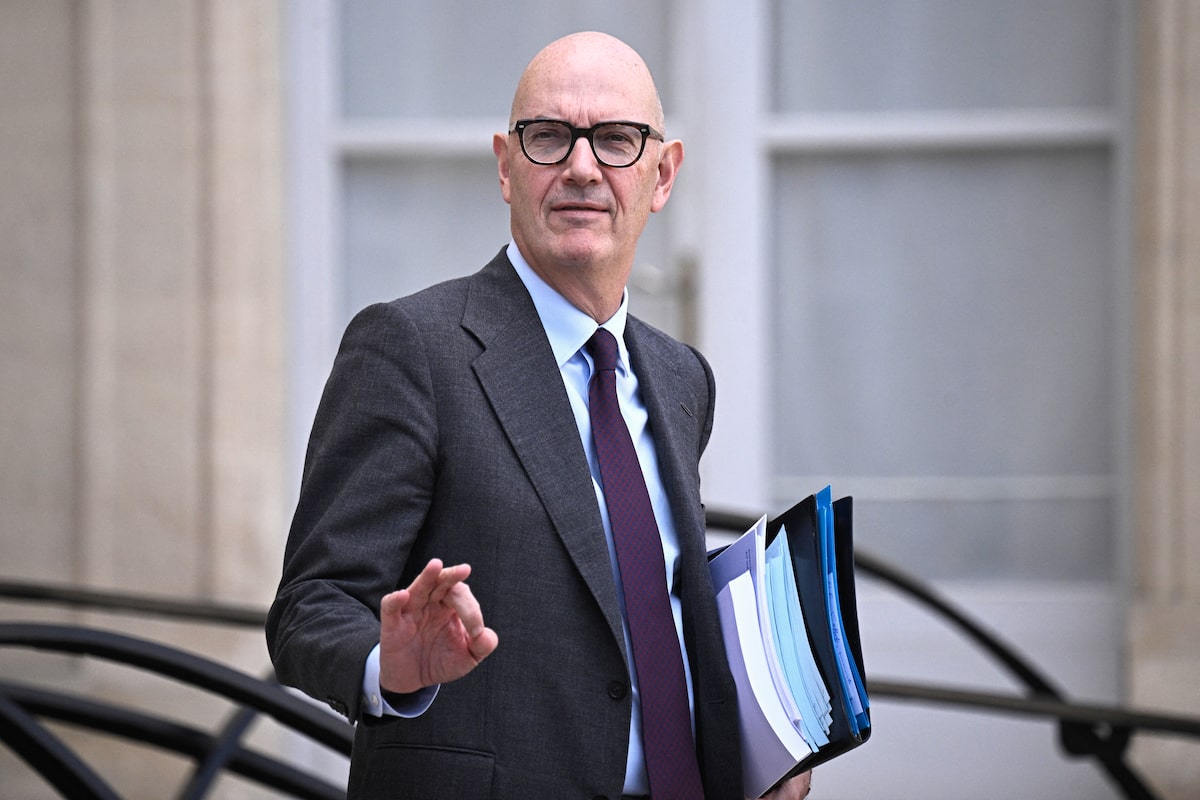
France’s Minister of the Economy, Finance, and Industrial, Energy and Digital Sovereignty, Roland Lescure leaves the weekly meeting of the new cabinet at the Elysee presidential Palace in Paris on Oct. 14.JULIEN DE ROSA/AFP/Getty Images
As Canada readies for a federal budget that could be tough by this country’s standards, France’s Finance Minister has reason to look on with envy.
Roland Lescure, appointed to the role last month, is tasked with advancing a fiscal plan to tackle soaring deficits and a 114-per-cent debt-to-GDP ratio that is among the highest of any advanced economy. And he must do so amid a political crisis, involving conflicts around spending plans between left- and right-wing members of France’s minority parliament, that has led to five changes in governments in less than two years.
The former finance executive, who spent years in this country as chief investment officer for the Caisse de dépôt et placement du Québec, sat down with The Globe and Mail while in Toronto for last week’s G7 energy and environment summit.
Mr. Lescure talked about how he’s trying to get France back on stabler ground, inspiration he’s drawing from Canada’s past austerity efforts, and about how the two countries could jointly pursue industrial and investment opportunities amid geopolitical upheaval. And he made his pitch for Canadian investors to put more dollars into France despite its current turmoil.
You’re probably already tired of being asked about the budget situation.
I’m not. Having a budget is the mother of all other public policies. And as you know, we have had a very hung parliament.
We’re getting closer to the presidential election, so that brings an interesting political situation. Two of the 11 parties in parliament want the mess. They want an early presidential election, so they don’t want any discussion about the budget. The other nine are learning the hard way how to build consensus.
Every day we bring forward another subject that, brick by brick, is building a budget. And I’m responsible for that house that we’re building, brick by brick, to not look like some kind of Addams Family house, completely broken to pieces.
I’m not saying it’s a done deal, but I think the importance of the moment will hopefully help us converge toward passing the budget before the end of the year, and then we can start working on other things.
We need to launch big tenders for offshore wind. We need to build our nuclear power stations. We need to work on fiscal fraud. We need to simplify and streamline industrial policy to make sure we have more factories on the ground.
Whoever wants to be our next President, they can convince France that they’re the right person for that. But in the meantime, we will have cleaned the runway. France will be in order.
A theme we’re hearing in the run-up to Canada’s budget is the need for some public sacrifice. But France, where for instance the government dropped plans to raise the retirement age, is an example of how hard it can be.
When I gave a speech in parliament at the beginning of the budget, I gave Canada’s example of the 1990s. There were efforts made. But it was nothing compared with what Portugal, Spain or Greece had to do more recently.
I think we have a budget that’s asking efforts from a lot of people, but not dramatic effort. We’re not talking about cutting wages or pensions, or about getting rid of half our civil service.
It’s hard to find the right balance. But I’m convinced that if we do it now, it won’t be as hard as if we wait.
We can still borrow money at a cheap rate. I’ve got no problem issuing bonds every day. We’re in a warning zone. And we have to use that warning. Rating agencies have downgraded us the way they did Canada in the 1990s. And Canada showed that you can find your triple-A again. We have to find that path.
This geopolitical moment is ideally when you make robust investments in economic competitiveness or defence. How much can you do that while requiring austerity?
Well, that’s my job. I have to make sure we keep money aside for future investments – energy, infrastructure, defence – by making sure that we save on everyday consumption.
The other thing – and maybe that’s a message to the big Canadian pension plans, who I met with here – is we’re also willing to do it with partners. We’ve been the most attractive place in Europe for foreign direct investment for seven years in a row [according to annual reports by the consultancy EY]. We’ve announced massive deals in industry, pharmaceuticals, data centres. We want to keep going.
There’s a lot of long-term investors looking for places to put their money. Europe is pretty stable at the moment, and I can think of a few places that are not that stable.
You also had a one-on-one with Tim Hodgson, the federal Natural Resources Minister, while here. Any key take-aways?
We talked about minerals, obviously a great asset for Canada and a great opportunity to tighten its relationship with Europe and France in particular. The [Critical Minerals Production Alliance, a Canada-led G7 effort to forge investment partnerships] is part of that, but we need to deepen it further.
We also discussed the agenda of the G7 [which France is taking over as chair in 2026] – a few things we could do to build on work that’s been done by the Canadian presidency on raw materials, on nuclear.
As you know, parts of Canada are big nuclear regions. France is, too, so we also have to see if we can help each other there. There’s tonnes of synergies in rebuilding an industry that’s been stalling for years.
What are the nuclear co-operation opportunities for Canada and France, which to some extent might be competitors?
For reactors, we probably will be in competition in some markets, though building a nuclear power station can use a lot of companies. You can have stations built by Canadian, American, French or Korean companies. That doesn’t prevent small companies from working for them.
On mining, transforming, enrichment, we can find ways of working together. And then what happens after – when it’s about dealing with nuclear waste – we also have great companies that can help on that front. It’s a whole supply chain that needs to be re-dynamized.
As Canada tries to diversify trade, where else are you seeing the biggest opportunities with France and Europe more broadly?
Commodities are going to be a massive thing. But we also have great projects in industry, low carbon, aeronautics. And you guys have advantages there.
For obvious reasons, Canadian companies have been looking south for decades.
French companies have considered Canada, especially Quebec, an entry point in North America for a long time. I would say there are more French companies here in Canada, in Quebec, than the other way around. So, look east, guys. Look east.
This interview has been condensed and edited.