
‘I used to be in this club called Nine to Five Racing,’ says Graham Shrive, Factor’s director of engineering. ‘As you can imagine it was for racers who also had a normal job. With the Monza, that’s who we wanted to appeal to. Up until now we’ve been solely premium – partly because Rob Gitelis, our founder, conflates non-premium with a depreciation of the brand – but I don’t see it that way.’
‘We had a lot of doors closed to us in some territories because we didn’t have anything in that meat and potatoes range. This is us growing the base of our pyramid a bit.’
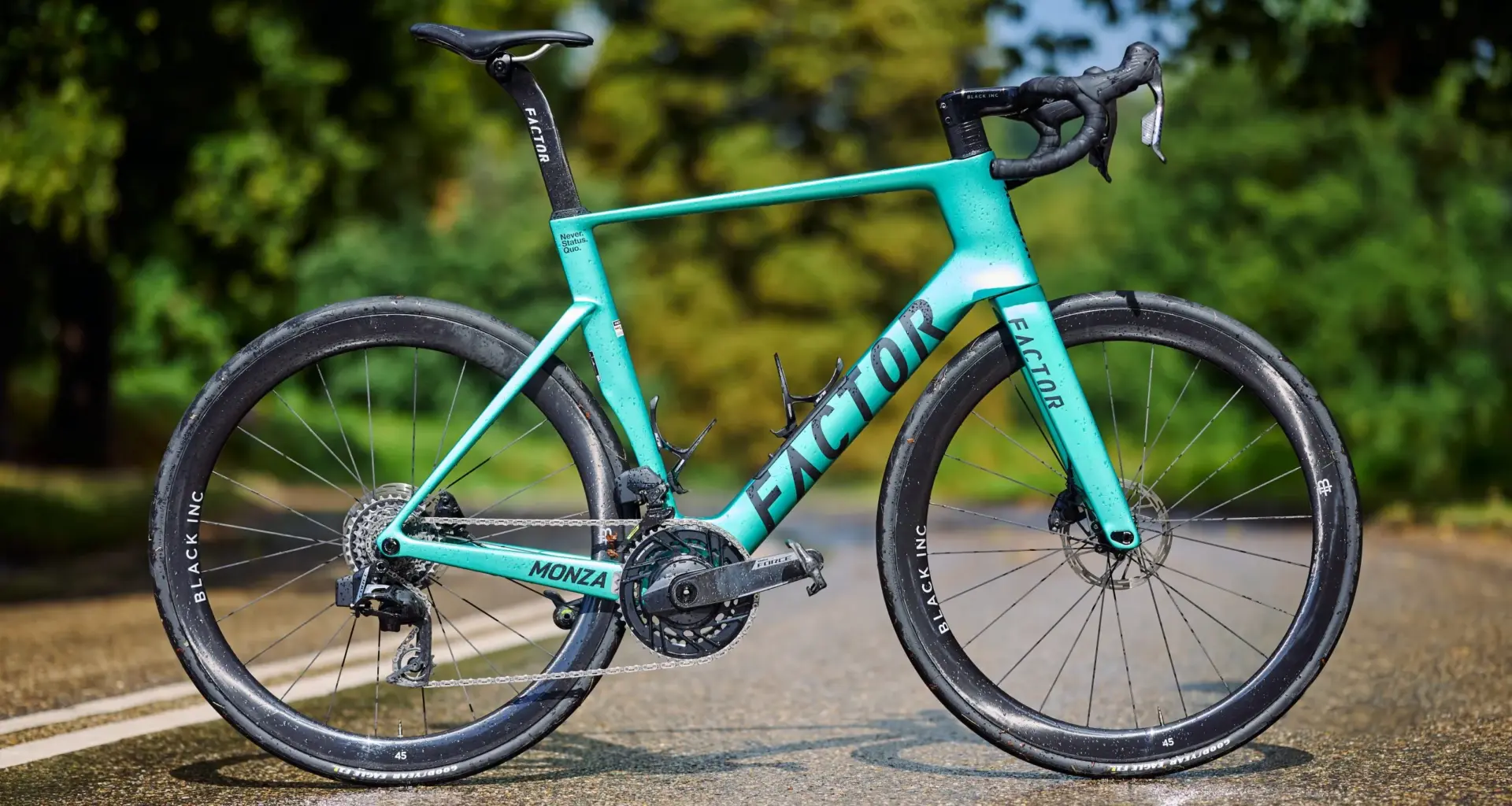
The result is the Factor Monza, an aero bike named after the famous Italian racetrack. The Monza isn’t a ground-up project by any means. Its tube shapes, aerodynamic qualities, and guiding performance mantra all overlap significantly with the Ostro VAM, the aero bike ridden by WorldTour team Israel Premier Tech. But it’s different, both in the number of zeros and in the way it’s been designed.
‘I didn’t want to just make a cheaper version of the Ostro. We wanted to make a different bike that’s easier to build, easier to live with, more practical, that rides differently with bigger tyre clearance,’ says Shrive. ‘And it’s not as simple as just using a cheaper fibre or whatever: a lot of the costs of frame making are fixed. Labour, the bladder, the tool are all the same regardless of the grade of carbon. You could always chisel your own factory for margins but since we own our own factory that’s not a particularly good strategy.’
The inclusion of down tube storage is more-or-less unique for an all-round race bike of this ilk and speaks to the Monza’s aero-in-the-front, practical-in-the-back mantra. Factor hasn’t publicly shared any aerodynamic data but Shrive showed me some internal figures that claim the Monza is faster than the old Ostro at 45 kmh, just 2.5 watts less aero than the current Ostro VAM and faster than the Cervélo S5 and Tarmac SL8.
Big claims indeed, especially when it’s not in the same price bracket.
Built with power-equipped SRAM Force, the Monza is £3,000 cheaper than the Ostro VAM while the frameset alone costs £1,600 less, putting it in the same ballpark as bikes like the Cervélo Soloist, Giant’s Propel Advanced 0 and the Canyon Aeroad CF SLX 8.
So how has Factor made the Monza around a third cheaper?
‘There are lots of unremarkable areas that, combined, have a big impact on the cost of a bike’s production,’ says Shrive. ‘It’s something people don’t realise. Increased frame complexity increases scrap rate and lowers the speed at which mechanics can build up bikes. We factored these things in when designing the Monza.’
Related questions you can explore with Ask Cyclist, our AI search engine. If you would like to ask your own question you just need to , or subscribe.
Factor Monza frameset
The overarching aim for the Monza’s frameset was simplification. This has been applied throughout the bike, starting with the materials themselves.
‘There is no exotic carbon in the Monza,’ says Shrive. ‘They’re all workman-like fibres that are easy to work with and readily available. It’s easy to cut and lay. All of which contributes to a lower price.’
Factor uses a higher proportion of woven carbon in the Monza’s layup compared to the Ostro or the O2, which provides similar properties but at a lower cost.
‘It gives you a strong layer to build on,’ says Shrive. ‘TeXtreme carbon is what we use more of on our more premium frames. It weighs about 75g psqm instead of 300g psqm. With the Monza’s layup, you’ll get similar strength and stiffness, but it’s not as bright, as electric feeling, as a totally high modulus frame, because of those thicker walls. Riders newer to the sport will tend to like that duller feeling frame. They say it feels more comfortable because they’re not feeling as much road.’
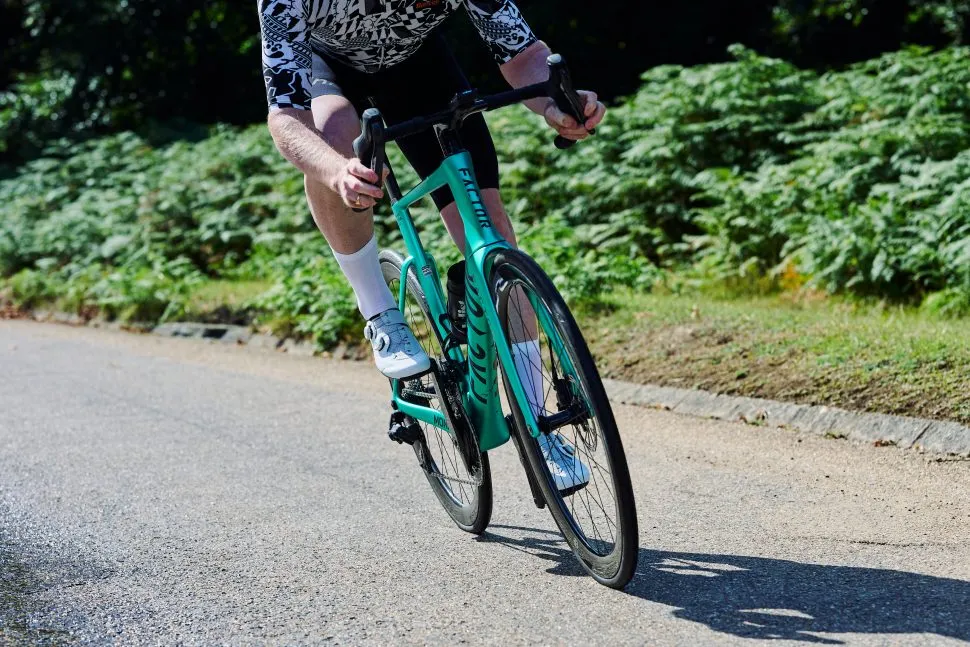
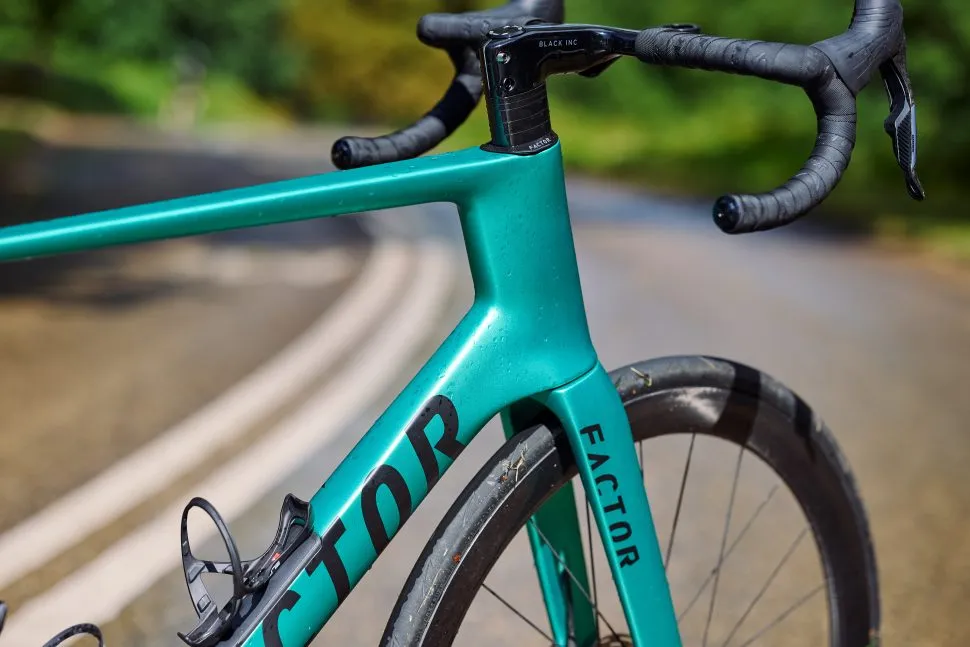
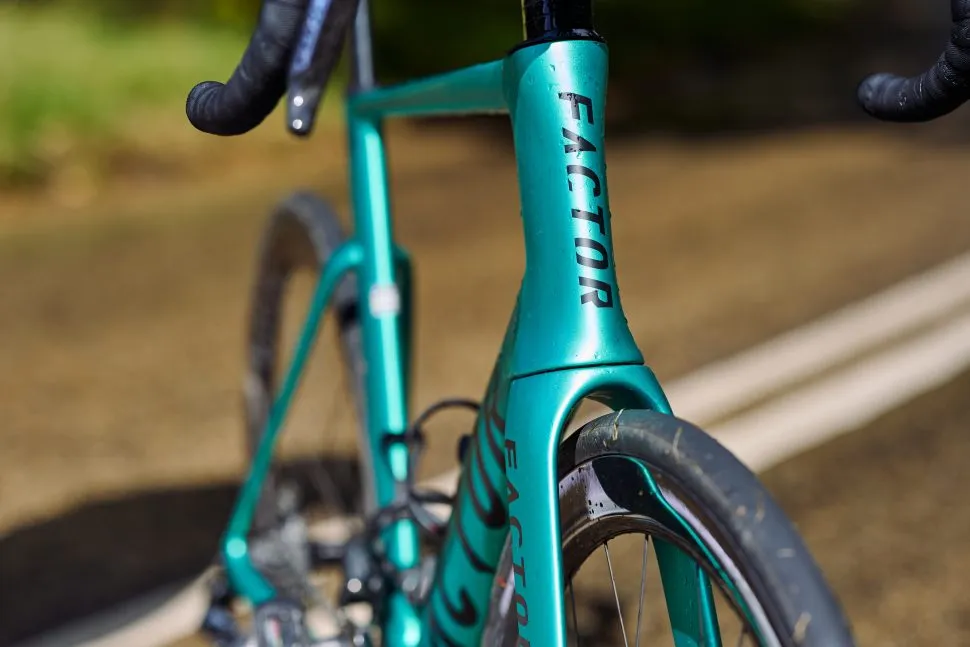
This manifests itself in the frame’s weight, which at 1,100g is significantly more than the 820g Ostro VAM, but other factors contribute to this too. The head tube is less waisted meaning the frontal profile is wider, the transition into the fork has been straightened, the seat stays are thicker and more curved than on the Ostro and the seat post – borrowed from the first Ostro – is big enough to house a Di2 battery.
‘It’s simpler to make than the Ostro in almost every way,’ says Shrive. ‘The Ostro is quite elaborate with tighter tube radii, a big head tube to fork lip and other intricate tube transitions requiring delicate tolerances. The Monza is more subtle and less things can go wrong which means scrap rates are low.’
Other practical touches are the inclusion of common industry standards like a T47 bottom bracket, a UDH mech hanger, 1.5” headset bearings and a round steerer tube. Factor says the increased space around the steerer tube in particular makes life easier for mechanics.
‘We want mechanics to be able to build these bikes up quickly and get through 20/25 a day, as it helps with volume,’ says Shrive. ‘That was why we chose a 1 ½ inch upper bearing and made the bars easier to route than on the Ostro.’
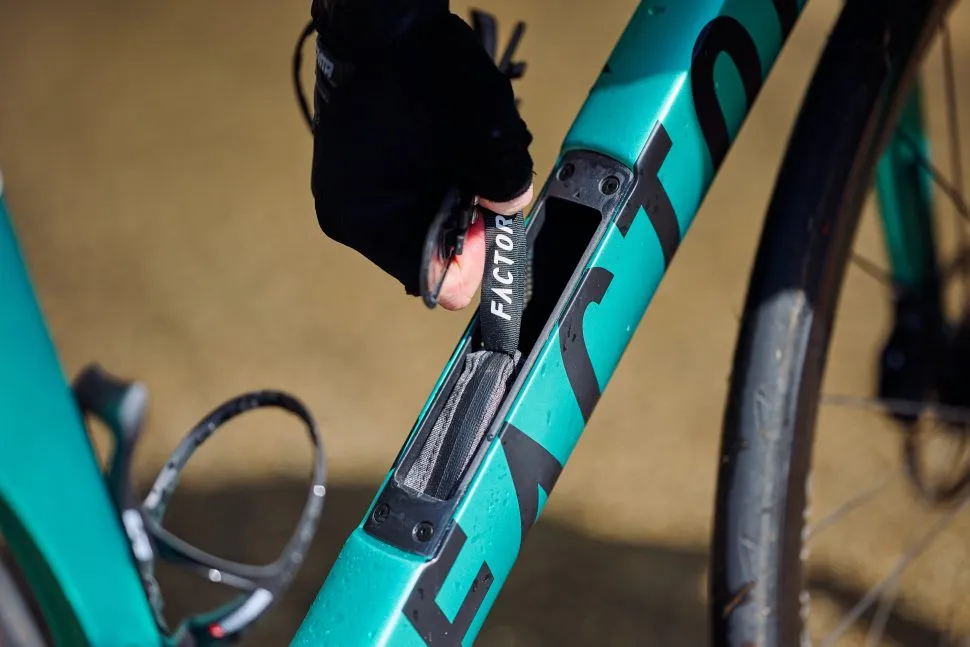
Conversely, one area where Factor has added frame complexity for the price of practicality is in the down tube, where a storage cavity has been added. Factor says this inclusion added machining costs while slightly reducing the Monza’s frame stiffness.
‘Now that was a huge pain in the ass,’ says Shrive. ‘Carbon doesn’t lend itself to precise tolerances because it likes to shrink quite a bit when it goes in and out of the mould. With that in mind we used a non tolerance-dependent fit for our down tube storage. We had an intermediary bezel that went inside the frame, otherwise it’s a load of trial and error and really careful control of the wall thicknesses.’
‘I was a little nervous about the overall frame stiffness but it’s worked out well. It’s about 10% off the Ostro, mainly in the bottom bracket, and you can only really feel that when you’re out of the saddle on a really steep climb.’
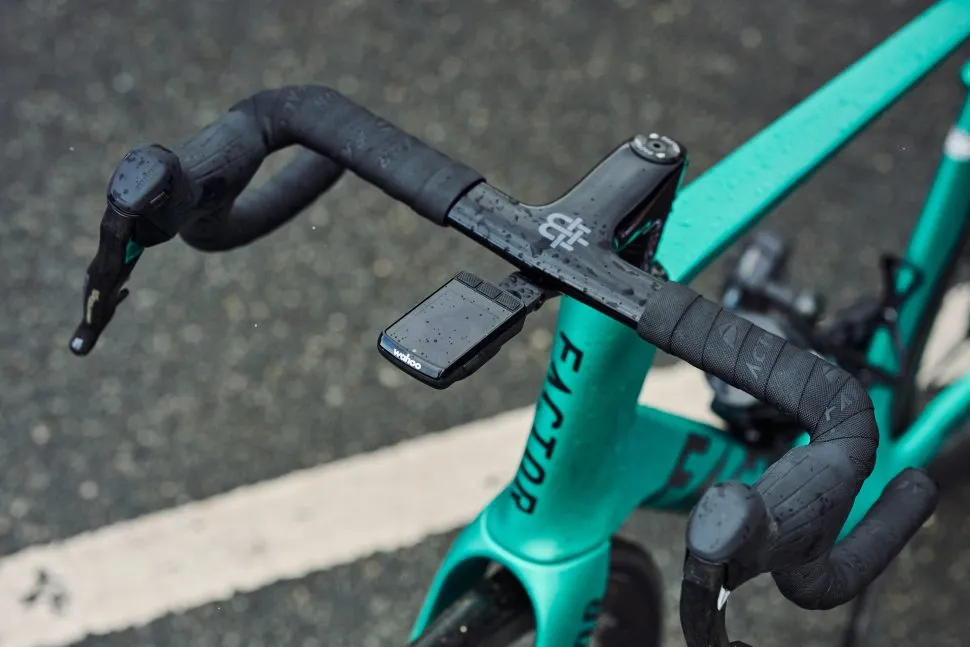
Another element that understandably deviates from the Ostro is the componentry and finishing kit. The Black Inc 45 wheelset has been chosen for its versatility, durability and all round qualities, complete with steel spokes, steel bearings and a 21mm internal rim width. The one-piece HB04 bar-stem has been designed specially. The drops feature an 8° vertical flare but are less aggressively aero than the Black Inc Integrated Aero bars on the Ostro.
‘Rob never liked the size of the tops on the Ostro,’ says Shrive. ‘The HB04 bars are slightly more traditional with smaller tops but similar aero performance. We introduced a straight section into the bar, which reduces the amount of tooling we need to get the range of fits.’
Factor has reduced the reach of the bars to 75mm in response to both SRAM and Shimano increasing the reach on their new shifters, while Shrive says Factor settled on a 115mm drop measurement to encourage riders to use them for sprints.
In keeping with the Monza’s more affordable proposition, Factor only builds it with SRAM Force AXS or Shimano Ultegra Di2.
Factor Monza geometry
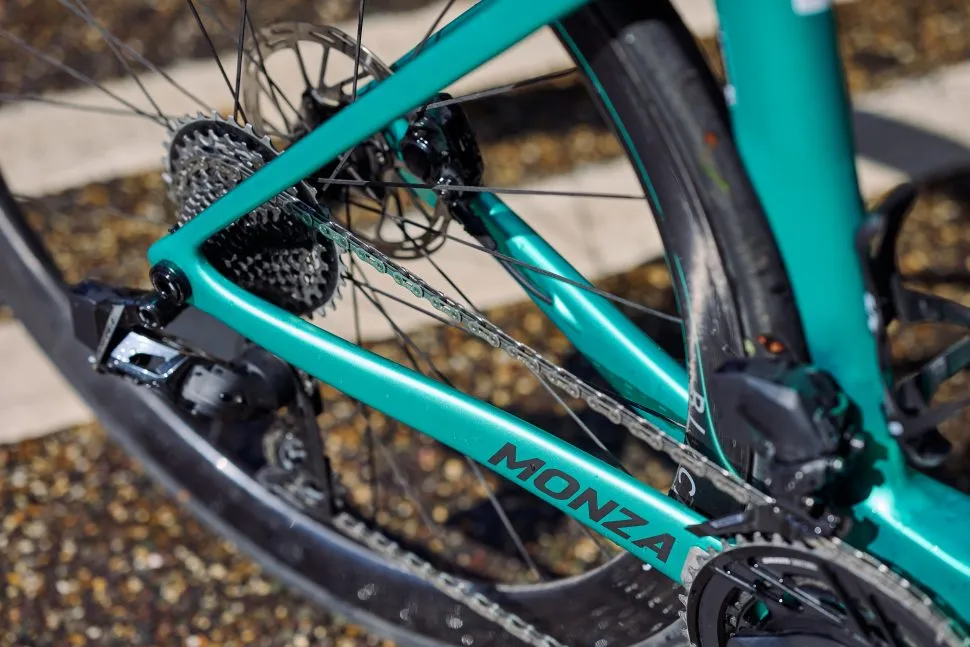
‘In terms of geometry, overall it’s a more appropriate fit for a broader use case,’ says Shrive. ‘It’s not necessarily as aggressive a bike; it’s not a Tour de France type fit.’
Think, all the hallmarks of the Ostro VAM – same head tube angle, fork offset and wheelbase – but a little more relaxed. On the size 58 test bike, that meant a 597mm stack and a 401mm reach which is 10mm taller but with the same reach. On other sizes, the Ostro’s reach is a couple of millimetres longer.
Riding the Factor Monza
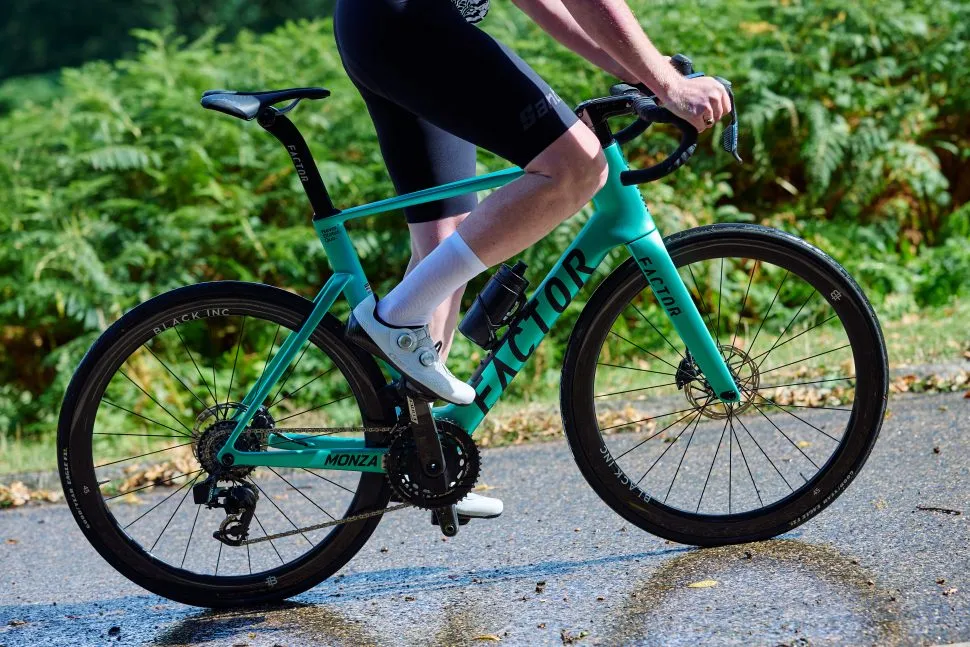
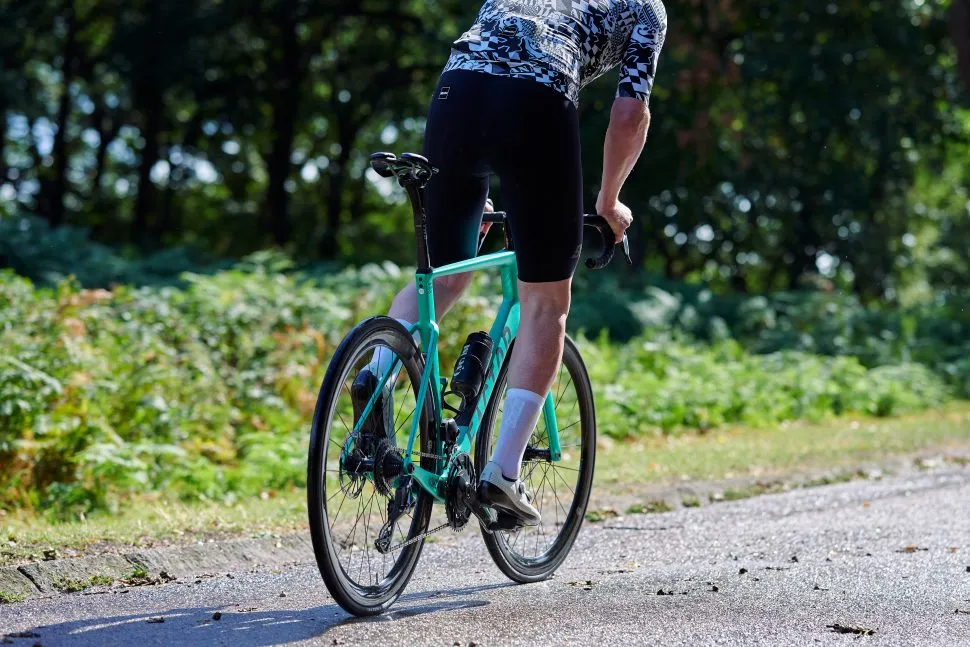
There is something reassuringly substantial about the Monza. Of course the muscular tube shapes, the sizable bottom bracket junction, and deepish wheels all contribute to this in their own way, but it’s a bike that feels like it’s almost part of the road – and that has both pros and cons.
Yes it’s an aero bike and unsurprisingly it does the aero parts very well. Tuck in on the flats or a decent descent and you – and anyone around you – will know about it. The Monza flies downhill and it’s hard to imagine the Ostro VAM overtaking you, though luckily I didn’t encounter any to find out. It benefits from the same razor-sharp handling as the Ostro VAM with the seat tube angle and the depth of the drops pushing my weight forward and encouraging direct, high-speed descending.
Since it’s partially for aerodynamic reasons, it bears mentioning that ditching the saddle bag for the down tube storage is definitely a pro. It’s utterly unfussy: the whole bottle cage snaps off with one button click. The system works seamlessly and silently, and there’s so much space down there – even once you’ve filled the little sleeve bag – that I’m still finding unused gels and electrolyte sachets now.
Going up those same hills wasn’t the Monza’s sweet spot. The stiffness of the frame and bars was helpful, but the weight was less so. That said, at 8kg it’s still lighter than other aero bikes I’ve tested recently, despite being a bigger size, so it’s not a significant (or surprising) drawback.
I can’t say I could feel the 10% drop in stiffness mentioned by Shrive. But what I could feel was the slightly dulled sensations of the frame. Sitting somewhere between additional comfort and something equivalent to a frame sedative, there is something sub-lively about riding the Monza.
If this is the result of the alternative carbon layup then so be it: it’s a subtle difference and one that has its positives too. But racers – who this bike is meant to be for – might feel denied the edgy, sparkiness of something cracklingly stiff and alive, a little bit like the safety car is out on the track.
I don’t think I’ve tested a bike more rigorously, on one day sentencing the Monza to a 300km out and back from Bristol to Dorset. The geometry, paired with the sensibly proportioned aero bars, somehow didn’t cause a moment’s issue. It was dialled in enough to enable a clearly aero position and yet didn’t do my lower back a mischief.
The only thing I would have changed was the tyres: 30mm if not 32mm tyres would have been more appropriate for the occasion. Factor fitting 28mm onto the Black Inc rims is definitely the lightest option, but I would certainly angle for larger whatever the negligible differences in speed. I also wasn’t a huge fan of the seat post clamp, which proved fiddly when transporting the bike around.
Factor Monza review verdict

If this is a practical bike then why not go further? Why isn’t there a thru axle lever, or a built-in rear accessory mount on the saddle? But that’s me nitpicking. For the DIY racer, who wants to absolutely tear their way around criterium courses on a super aero bike with the wherewithal to stuff in an emergency inner tube on demand, the Monza fits the bill.
Of course, there are a few compromises to be made in terms of materials, and Factor’s sub-premium bike is still hardly a snip at almost seven grand. But for a significant discount you get something that’s not an awful lot different from one of the best aero bikes in existence and it’s still an awful lot of fun.
The reviewed spec
Model: Factor Monza
Price: £6,999
Weight: 8.0kg
Groupset: SRAm Force AXS
Wheels: Black Inc 45
Finishing kit: Black Inc HB04, Selle Italia SLR Boost TI316 Superflow, Goodyear Eagle F1 R 28mm
Buy now: viresvelo.com