

China is turning to the ocean to tackle one of the biggest challenges in AI infrastructure. The country has begun building underwater data centers, using the sea’s naturally cold temperatures to efficiently cool the powerful servers that drive AI’s rapid growth.
As artificial intelligence continues to expand, the demand for computing power grows exponentially, placing an increasing strain on traditional data centers. These facilities, essential for storing and processing the massive amounts of data required by AI, use vast amounts of electricity to keep their servers cool.
The problem is that these cooling processes consume as much as 40% of a data center’s total energy use, making energy efficiency a critical concern. To address this, China is looking to the ocean as a solution, hoping to use the water’s natural cooling properties to reduce the environmental footprint of its data infrastructure.
The Mechanics of Underwater Data Centers
As stated by ZME Science, the initial underwater data center, located off the coast of Hainan, uses the ocean’s frigid temperatures to cool its servers. Cold seawater is pumped through radiators attached to the server racks, absorbing the waste heat generated by the servers. This method cuts down on the energy required for cooling, which is typically the largest energy consumer in a data center. By leveraging this natural resource, China’s submerged data centers require no freshwater or traditional grid power.
Additionally, the Shanghai project incorporates offshore wind energy as a supplementary power source, highlighting the ambition to make these centers as sustainable as possible. Each of the submerged units, or “cabin-pods,” weighs around 1,400 tons and is capable of housing 500 servers. These pods are designed to be modular, so if one fails, it can be lifted back to shore and replaced with a functioning one, minimizing the need for repairs on-site.
 An illustration of the underwater data center. Credit: Xinhua
A Reliable, But Risky Approach
One of the most significant challenges is maintenance, as underwater systems are difficult, if not impossible, to repair on-site. In case of a malfunction, the strategy is simple: swap the damaged unit for a new one. Most failures in these centers are caused by human error, dust, or humidity, so the sealed pods, surrounded by inert nitrogen, are designed to be much more reliable than land-based systems.
A 2020 study by Microsoft showed that oceanic data centers are eight times more reliable than their land-based counterparts. However, the complexity and cost of maintaining such a system remain a significant hurdle. Nevertheless, China is betting that the energy savings will outweigh the logistical challenges of servicing these submerged units, pushing forward with plans for larger-scale operations.
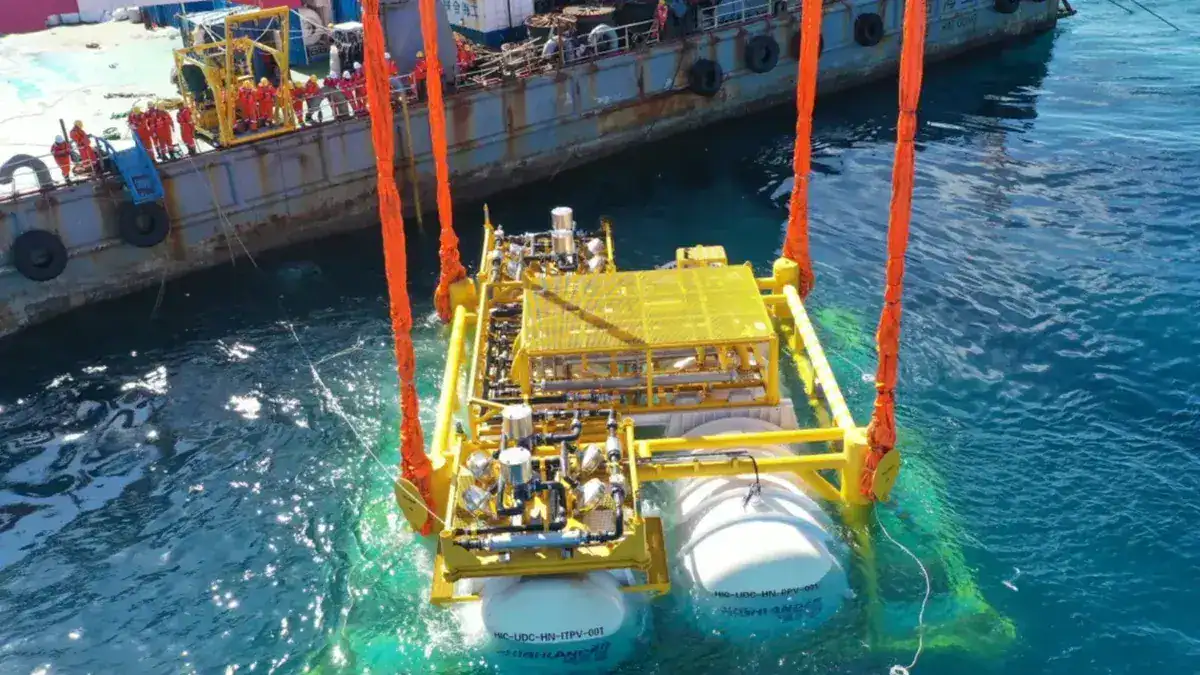 The 24-megawatt data center serves as the pilot project for a novel pproach to AI infrastructure. Credit: Shanghai Hailanyun Technolog
China’s Ambitious Underwater Data Center Expansion
China’s $226 million investment in the Shanghai underwater data center marks only the beginning. The Hainan project, already operational, is set to expand with a network of 100 cabin-pods. The Shanghai center, with a modest 24-megawatt capacity, is a prototype for future, far larger facilities, potentially reaching 500 megawatts in total. This ambitious expansion reflects China’s commitment to staying ahead in the race for AI infrastructure, even if it requires embracing a high-risk, high-reward strategy.
Microsoft pioneered similar underwater data center concepts with its Project Natick but halted the project in 2024, citing high logistical costs and operational complexities. In contrast, China’s continued investment signals a readiness to take on these challenges head-on. If successful, these underwater centers could revolutionize the data industry by combining cutting-edge technology with a sustainable energy model, potentially setting a global standard in digital infrastructure.
China on Tuesday officially launched the world’s first commercial underwater data center (UDC) project powered by an offshore wind farm in Shanghai’s coastal waters near the Lin-gang Special Area of China (Shanghai) Pilot Free Trade Zone, taking another bold step toward green… pic.twitter.com/mjEXkDMNIs
— People’s Daily, China (@PDChina) June 10, 2025