
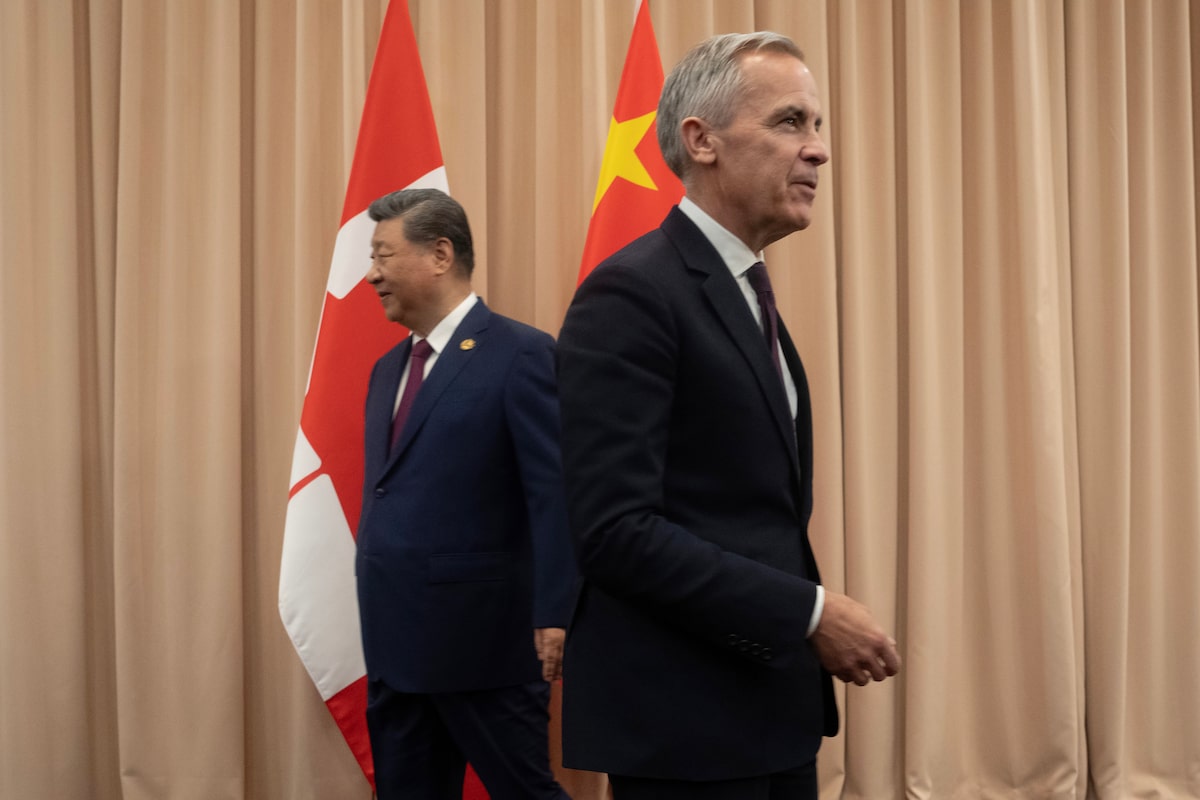
Prime Minister Mark Carney, right, and Chinese President Xi Jinping make their way to their seats after shaking hands at the start of a meeting in Gyeongju, South Korea, on Oct. 31.Adrian Wyld/The Canadian Press
Charles Burton is a former diplomat at Canada’s embassy in Beijing, senior fellow at Sinopsis.cz, a China-focused think-tank based in Prague and author of The Beaver and the Dragon: How China Out-Manoeuvred Canada’s Diplomacy, Security and Sovereignty
The remarks by Chinese President Xi Jinping and Prime Minister Mark Carney ahead of their bilateral meeting in Gyeongju, South Korea last week were shockingly revealing about the changing dynamic between Canada and China.
There’s a lot more being discussed than Ottawa lifting tariffs on Chinese EVs and steel in exchange for China removing tariffs on Canadian canola and seafood, whether Canada realizes it or not.
As an updated barometer of the relationship, Mr. Xi’s terse statement at the meeting made it clear that Canada is a supplicant to the Middle Kingdom, that we have been wrong and will change our ways.
“The Canadian side has expressed its willingness to promote the development of bilateral relations in a pragmatic and constructive manner,” he said. “The Chinese side is willing to work with the Canadian side to push China-Canada relations back onto the correct track of sound, stable, and sustained development at an early date.”
China approves group tourism travel to Canada after Carney-Xi meeting
Mr. Carney, in subordinate mode, echoed the Chinese messaging, promising “pragmatic and constructive” engagement. “Constructive and pragmatic” is specific Beijing propaganda code. What it means is, in return for access to our markets, you shall not voice criticism of Chinese actions that violate international norms.
That would include Canada perhaps ignoring situations like China’s interference in Canada’s democratic processes or its intimidation of Chinese Canadians and permanent residents.
Internationally, this may mean Canada does not challenge China over its policy regarding Hong Kong, Taiwan and the South China Sea or Beijing’s practice of providing surveillance technology to repressive autocrats to suppress democratic forces.
We should assume that Canada would no longer speak out about China’s policies of genocide against Uyghurs or its violation of the language, cultural and religious rights of Tibetans and other ethnicities.
But it was Mr. Carney’s final words before the leaders went into their meeting that were most revealing: “We will establish a road to seize the many great opportunities between our countries and also to have the platform that’s needed for the dialogue to help build a more sustainable and inclusive international system.”
Opinion: How Canada can properly use China as a hedge against Trump
“A more sustainable and inclusive international system” is Beijing’s favoured terminology to describe China’s planned new world order, which it calls “the community of the common destiny of mankind,” which it sees as buttressing its rise as global hegemon, supplanting a fading Uncle Sam.
China has already mapped out the rising and falling of empires. They plan a world that abandons the liberal democratic principles of the postwar United Nations Universal Declaration of Human Rights, international law against genocide and torture and the equal sovereignty of nations. Mr. Xi says this will happen by 2050; that would coincide with his 97th birthday, but Chinese Communist leaders are typically long lived.
Shortly before Mr. Carney met with Mr. Xi at the Asia-Pacific Economic Co-operation conference in South Korea, Kody Blois, parliamentary secretary to Mr. Carney, had been in Beijing along with Agriculture Minister Heath MacDonald. The statement from the Canadian Prime Minister’s Office about Mr. Carney and Mr. Xi’s meeting says, “both leaders directed their officials to move quickly to resolve outstanding trade issues and irritants.” The “irritants” certainly include Canada’s strictures against China, such as limiting access to mineral resources in Canada’s North and removing regulations that prevent China from legally importing Canadian dual-use military high tech.
Opinion: I’ve spent 50 years navigating Canada-China relations. Here’s what I’ve learned
Obviously, the spark behind Ottawa’s outreach to China is U.S. President Donald Trump’s economic and diplomatic belligerence. As Mr. Trump shreds the trading relationship that has long been the bedrock of Canada’s mercantile economy, Ottawa is under pressure to quickly find new partners and markets.
This is something China has the power to deliver.
If Canada agrees to revive the free-trade negotiations bungled by former prime minister Justin Trudeau in 2017, or even join China’s Belt and Road Initiative global infrastructure program to remake the world in Beijing’s favour, China could decide to buy much more Canadian grain, minerals and lumber by simply buying less from countries such as the United States, Australia or Brazil, and invest big-time in Canadian infrastructure.
But does this reset of our bilateral relations with China in a pragmatic and constructive manner fall into the biblical trap: “What is a man profited, if he shall gain the whole world, and lose his own soul?”
Last year, before he entered politics, Mr. Carney was in China in his capacity as board chair of the global financial and data company Bloomberg. One wonders if he fully appreciates that Canada-China relations are about a lot more than big business.