
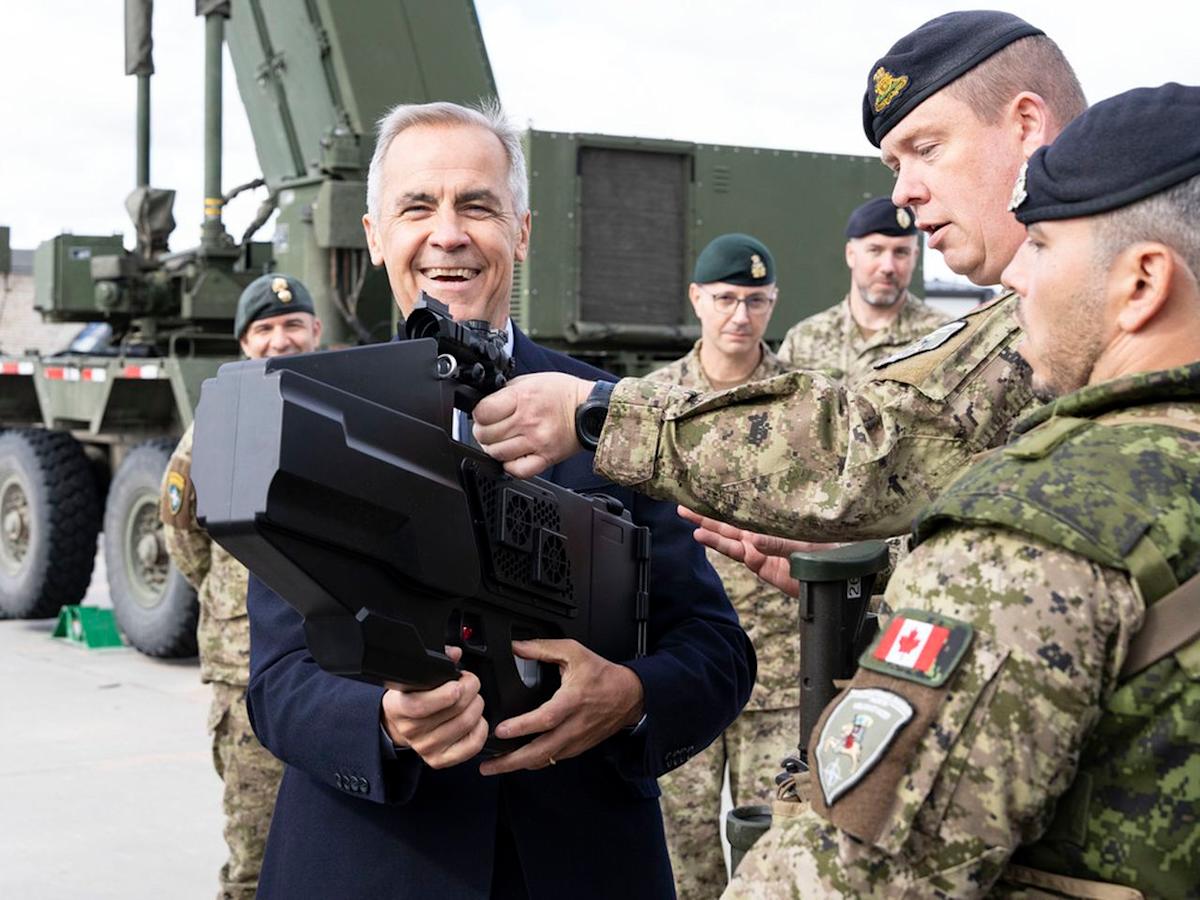
According to the Mark Carney Liberal doorstopper piece of economic fiction, the 2025 Canada Strong budget, Ottawa plans $81.8 billion in new military spending that will help boost the economy and create thousands of high-paying jobs. “Our government is making a generational investment in defence that will create good, high-paying careers for Canadians, and strengthen our economy and collective resilience.” The new military spending “will create good, high-paying careers for Canadian workers and drive investments that strengthen our economic, infrastructure, and collective resilience.” Ottawa, it repeated, will “reform defence procurement to make it easier and faster to buy Canadian-made equipment — supporting our domestic defence industry and creating high-paying careers.“
Unfortunately, the idea that defence spending and investment automatically boost economic activity and growth is far from being a solid pillar of economic theory. As the pressure grew on Canada to increase defence spending to up to five per cent of GDP as part of an expansion of NATO commitments, various economists issued papers over the past year that cast doubt on the links between defence spending and economic benefits.
Earlier this year, an RBC Wealth Management commentary inconclusively answered the question: “What does greater defence spending mean for Canada’s economy?” Applying short-term multiplier analytics, it looks like defence spending could have a “stimulative effect.” The benefit is mostly the result of higher multipliers associated with defence spending. Over the longer term, however, “it gets trickier.” The negative aspects of defence spending include possible “capital leakage, fiscal overspending, and the risk of diverting resources from more productive sectors of the economy.”
This is where we get to the “guns versus butter” debate.
Another paper captured the historic economic and political debate around military spending. Montreal economist Annabelle Fournier, in “Macroeconomic Effects of Increased Military Spending in Canada: A Review,” recalled a bit of history. “The debate — ongoing for over 50 years — persists in the economic literature under what is referred to as the ‘guns or butter dilemma.’”
Fournier, chair of macroeconomics and forecasting at the Université du Québec à Montréal, said the guns versus butter debate highlights the “trade off” between rising defence spending and the funding of other sectors such as health, education and infrastructure. One study found that the impact of military spending in Canada was either slightly positive or even negative.
Story Continues
Fournier concludes that research suggests “that the economic impact of increased military spending in Canada will depend closely on the specific types of expenditures undertaken, its military characteristics (capital intensity), and its ability to generate spillover effects within a military-industrial complex.” Which means that the deeper Canada becomes involved in the international military expansion boom, perhaps the economic impact will be positive.
A European Commission summary of the economic impact of higher defence spending failed to find positive evidence. “The available studies aligning with the Keynesian view argue that military expenditure stimulates aggregate demand, creating jobs and driving investment, particularly during economic downturns,” said the EC paper. On the other hand, the “neoclassical approach” to higher defence spending “highlights long-term crowding-out effects as higher military expenditure can reduce private investment and increase fiscal deficits.” The EC also casts doubt on Keynesian multiplier effects. Some studies support the defence-growth theory, “while others find negligible or negative effects.”
So we are left with the distinct possibility that Canada is unlikely to benefit economically from joining the expanding NATO military-industrial complex, a famous phrase coined by former U.S. president Dwight D. Eisenhower during his farewell address in 1961.
Eisenhower is also credited with reiterating the guns versus butter tradeoff during his first formal speech on assuming the presidency in 1953:
“Every gun that is made, every warship launched, every rocket fired signifies, in the final sense, a theft from those who hunger and are not fed, those who are cold and are not clothed. This world in arms is not spending money alone. It is spending the sweat of its labourers, the genius of its scientists, the hopes of its children.
“The cost of one modern heavy bomber is this: a modern brick school in more than 30 cities. It is two electric power plants, each serving a town of 60,000 population. It is two fine, fully equipped hospitals. It is some fifty miles of concrete pavement. We pay for a single fighter plane with a half million bushels of wheat. We pay for a single destroyer with new homes that could have housed more than 8,000 people …
“This is not a way of life at all, in any true sense. Under the cloud of threatening war, it is humanity hanging from a cross of iron. … Is there no other way the world may live?”
To curb the military-industrial complex, Eisenhower envisioned a process by which all nations would “set an agreed limit upon that proportion of total production of certain strategic materials to be devoted to military purposes.” Today, Canada has joined an international movement that aims to increase military spending to a new higher limit, claiming it will produce growth and higher-paying jobs.