
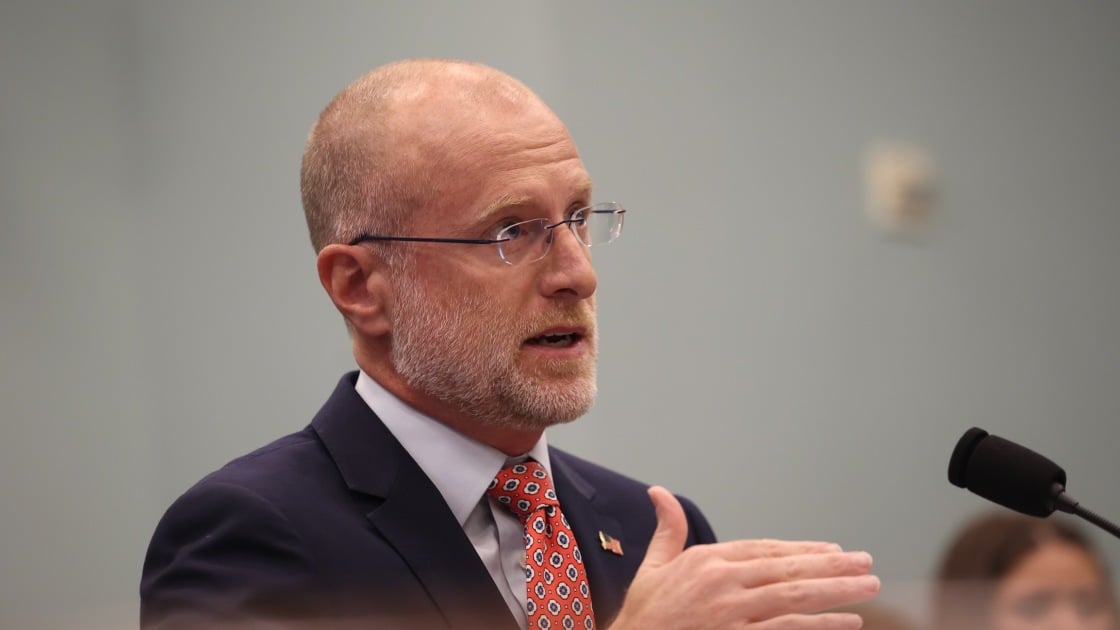
An FCC effort to raise the agency’s benchmark for high-speed internet from 100Mbps to 1Gbps is on the chopping block under Republican Chair Brendan Carr.
The commission will vote on a proposal to abolish “the long-term goal of 1,000/500 Mbps” for defining high-speed broadband, which the FCC first floated in late 2023.
As Ars Technica reports, the proposal would make it easier for internet service providers and the FCC to claim that more US regions have broadband access since the speed benchmark would remain at 100Mbps for downloads and 25Mbps for uploads. Abolishing the gigabit goal could also undercut the adoption of fiber networks, which provide speeds of 1Gbps and up.
In the proposal, the FCC justifies axing the 1 gigabit speed goal, citing Section 706 of the Telecommunications Act of 1996, which gives the commission the power to promote the deployment of high-speed communication services.
The FCC now says Section 706 doesn’t require any speed goals. Instead, the law merely says the commission “shall encourage the deployment on a reasonable and timely basis of advanced telecommunications capability to all Americans.”
“Not only is a long-term goal not mentioned in Section 706, but maintaining such a goal risks skewing the market by unnecessarily potentially picking technological winners and losers,” the FCC’s new proposal says.
The document goes on to claim that instituting a speed goal could violate the FCC’s “obligation to conduct our analysis in a technologically neutral manner.” That’s because other broadband technologies, such as satellite internet services like SpaceX’s Starlink and fixed wireless such as T-Mobile’s 5G Home Internet, offer speeds far below 1Gbps. Nevertheless, these services still offer relatively fast broadband while costing less than installing optical fiber.
“Further, assuming a long-term goal of 1,000/500 Mbps may be unreasonably prejudicial to technologies such as satellite and fixed wireless that presently do not support such speeds,” the document says. “We believe it prudent to continue to monitor technological developments and consumer preferences and adapt our current benchmark, as well as relevant high-cost support programs, accordingly.”
Recommended by Our Editors
The justification echoes the Trump administration’s motivations to overhaul the $42.5 billion Broadband Equity Access and Deployment (BEAD) program, despite protests. The Biden administration planned on using BEAD funding mainly for new fiber deployments. But last month, the White House revised the program to shift toward “technology neutrality,” paving the way for more funds to flow to satellite internet services and “terrestrial wireless.”
The FCC’s proposal adds that the commission’s focus is “evaluating strictly what the statute asks of us—availability,” raising questions about whether the agency will also factor in costs, a primary barrier to adopting high-speed internet.
The FCC is asking the public to comment on whether it’s worth preserving the 1Gbps broadband speed as a long-term metric. It’s slated to vote on the proposal during its Aug. 7 meeting as part of the Telecommunications Act of 1996, which requires the FCC to conduct an annual inquiry on deploying advanced communication capabilities in the US.


5 Things to Know About Starlink Satellite Internet

Get Our Best Stories!
Your Daily Dose of Our Top Tech News

Sign up for our What’s New Now newsletter to receive the latest news, best new products, and expert advice from the editors of PCMag.
Sign up for our What’s New Now newsletter to receive the latest news, best new products, and expert advice from the editors of PCMag.
By clicking Sign Me Up, you confirm you are 16+ and agree to our Terms of Use and Privacy Policy.
Thanks for signing up!
Your subscription has been confirmed. Keep an eye on your inbox!
About Michael Kan
Senior Reporter

I’ve been working as a journalist for over 15 years—I got my start as a schools and cities reporter in Kansas City and joined PCMag in 2017.
Read the latest from Michael Kan