
 Press enter or click to view image in full size
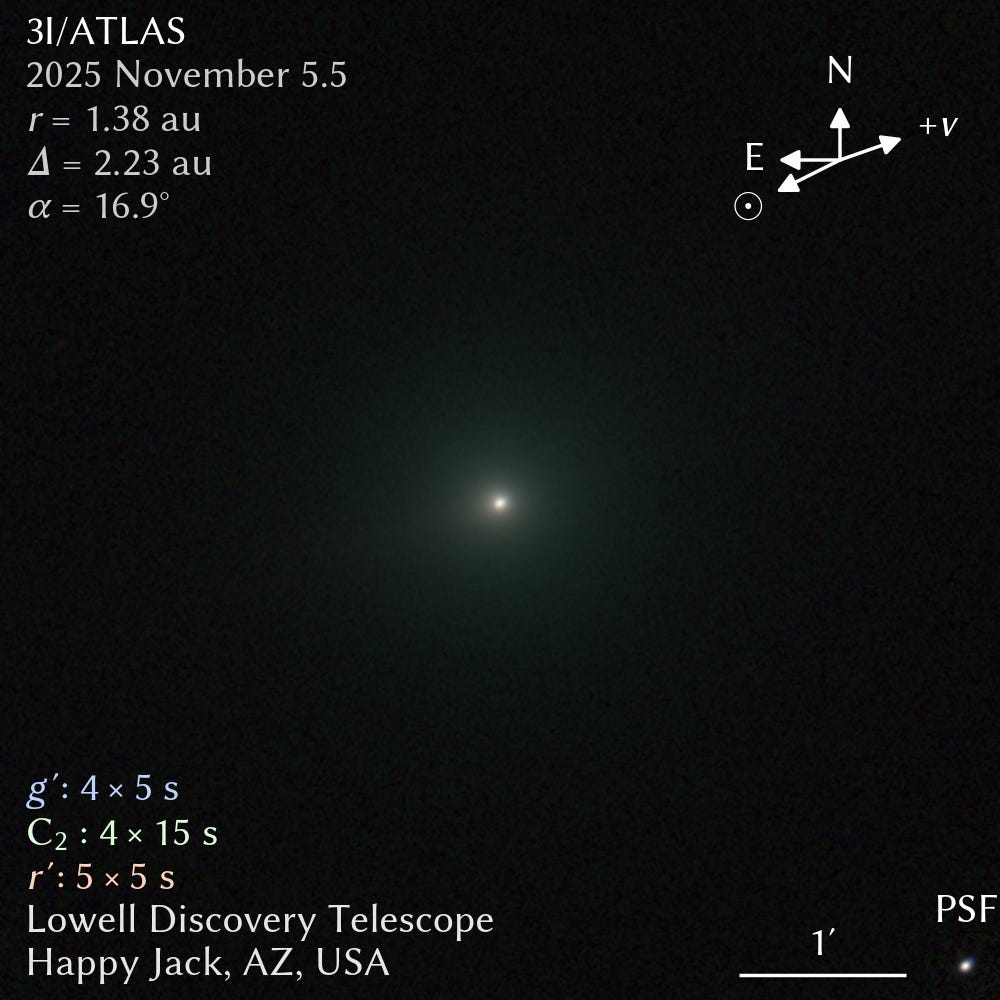
An image of 3I/ATLAS, taken on November 5, 2025 by the Lowell Discovery Telescope in Arizona. The arrows point to the direction of motion (+v) and the direction of the Sun (⊙). (Credit: Qicheng Zhang)
The latest image of the interstellar object 3I/ATLAS was just released. It was taken on November 5, 2025 by the Lowell Discovery Telescope in Arizona when 3I/ATLAS was at a distance of 1.38 au (namely 1.38 times the Earth-Sun separation) from the Sun and a distance of 2.23 au from Earth. 3I/ATLAS appears as a bright ball of light, comparable in size to the point-spread-function (PSF) that defines the resolution of the telescope. There is faint glow around it, akin to an atmosphere or a coma, but no clear evidence for a cometary tail. The atmosphere was viewed with a green filter, optimized to detect diatomic carbon molecules (C2). It is brightest in the bluest filter.
The new image does not show evidence for a dust tail pointing away from the Sun, as expected from massive evaporation of a natural comet near perihelion. This is surprising in view of NASA’s JPL report here of a non-gravitational acceleration for 3I/ATLAS. Based on momentum conservation (as discussed here), I derived here that the mass fraction lost during the perihelion passage of 3I/ATLAS is larger than 13% in case it is a natural comet. This should have resulted in a massive coma with dust and gas that would have been pushed by the solar radiation pressure and the solar wind to the shape of a typical cometary tail pointing away from the Sun.
The caveat is that this image was taken when 3I/ATLAS was only about 13 degrees away from the Sun in the sky. If the cometary tail is pointing away from the Sun, we are looking at it from an unfavorable perspective of being nearly head on. However, this was also the perspective of the Hubble Space Telescope when it imaged the anti-tail from 3I/ATLAS towards the Sun at an angle of 10 degrees on July 21, 2025 (see discussion here). Nevertheless, the anti-tail was evident in the Hubble image as an elongation by a factor of 2 in the sunward direction from 3I/ATLAS.
The angle between 3I/ATLAS and the Sun in the sky will grow to several tens of degrees in the coming weeks, allowing terrestrial observers to infer with confidence whether 3I/ATLAS has a cometary tail after perihelion, when its surface was irradiated by 770 Watts of sunlight per square meter.
As we wait for the verdict of future data, I attach below five new letters out of hundreds that arrived to my inbox today.
Letter 1
“Hi Dr. Loeb,
My name is Ava and I am a Chemical Engineering undergraduate, studying at the University of Toronto. I just wanted to say that I can’t remember the last time I was this curious or inspired about anything, as chemical engineering takes up most of my time and energy.
I recently have been questioning what I want to do with my life, as I am currently not enjoying engineering, but reading about 3i/atlas, and listening to your talks on Into the Impossible with Brian Keeting, I have just been so intrigued by this object, and it is all thanks to you. I feel a spark, for science, that I haven’t felt in a very long time and I so admire you pushing the critics to the sidelines and being authentic. What you said on the show about everyone being so dismissive of new ideas, because they are uncomfortable with the unknown, and it doesn’t fit into their existing “rules” for the universe, really resonated with me.
Anyways I just wanted to say thank you for reigniting my passion for science, specifically my passion for what is out THERE, and reassuring me about my future and the future of humanity, we need more people like you.
I look forward to continuing to hear from you, and to what this interstellar object brings next!
Kindly,
Ava”
Letter 2 (following a podcast interview with teenagers in Argentina)
“Dear Dr. Loeb,
I would like to express my sincere gratitude for the time and generosity you shared with us during the interview. For us, having the opportunity to speak with you is not only an academic honor, but also a profound source of inspiration.
Your clarity, intellectual openness, and courage to explore questions that still have no answers remind us of the true essence of science: the desire to understand, and the willingness to question. Each of your reflections leaves us not only with knowledge, but also with perspective and motivation to continue researching, sharing, and looking at the sky with an open mind.
From Astronomía Gualeguay, and personally, I receive this conversation as a deeply meaningful moment in my journey as a science communicator.
Thank you for your time, your dedication, and your humanity.
With respect and admiration,
Diego Larrosa
Astronomía Gualeguay”
Letter 3
“Dear Professor Loeb,
I hope this message finds you well.
My name is René-Peter Masoen [(or just Rene’) the male version], writing to you from South Africa. I’m in the Aerospace & Defense sector, my work involves operating on the business side of the industry, also a Commercial Pilot License Holder, and I sit on the Space Committee of South African Aerospace, Maritime, Defense Industry Association. I wanted to take a moment to express my sincere admiration for your recent work surrounding 3I/ATLAS, as well as for the clarity and courage with which you communicate science to the public.
What resonates with me most is not only the scientific substance — the anomalies, the possible interpretations, and the anticipation of incoming data — but also the spirit behind your research and message: that science is, at its core, a commitment to curiosity, humility, and evidence.
Like countless others around the world, myself and my colleagues find ourselves captivated by the unfolding story of this interstellar visitor. Yet, what I appreciate most about your approach is that you allow room for both possibilities: that 3I/ATLAS might be natural, or that it might be technological — without leaning on certainty where there is none. That balance is rare, and it is inspiring.
Your work has reminded many of us why we fell in love with science in the first place: the privilege of wonder, the willingness to question assumptions, and the courage to follow evidence even when it leads beyond the familiar. I have been following your interviews, articles, and commentary on the Galileo Project, Oumuamua, and now 3I/ATLAS, and each time I am struck by the clarity of thought and openness of inquiry you bring to the conversation.
Regardless of what future observations reveal about 3I/ATLAS — whether it proves to be a remarkable natural object or something far more unexpected — your leadership has already accomplished something deeply valuable: it has elevated global curiosity, inspired people, and reminded countless readers that science is not a closed club but an ongoing adventure.
Thank you for the work you do, for the way you communicate it, and for the excitement you have helped spark around this extraordinary moment in our scientific history.
With appreciation and warm regards,
René-Peter Masoen”
Letter 4
“Avi, I’m a retired commercial fisherman, from factory trawlers in the Bering Sea to my last, harpoon boats in Gloucester Mass.
You get heaps of emails from all kinds I imagine, but maybe by not so many fishermen
First just thank you! You are a breath of sea air, not afraid to say what’s on your mind.
Good on ya
A lifetime being waterlogged I’ve seen some amazing things in my lifetime. I have no doubt that the goddess? works in wonderful ways, and we share these wonders with neighbors from all over
Some near, some far away
Cheers from a fisherman, Corky”
Letter 5
“Dear Professor Loeb,
I wanted to take a moment to personally thank you for your dedication and courage in pursuing the truth about interstellar objects such as 3I/ATLAS. Your tireless work, curiosity, and scientific integrity have been both inspiring and refreshing, especially in a field where challenging established norms often meets resistance.
Your willingness to stand firm against pressure from powerful institutions — be they scientific, governmental, or corporate — demonstrates a rare kind of intellectual bravery. It reminds the world that science advances not through conformity, but through the courage to ask difficult questions and to follow the evidence wherever it may lead.
The implications of your research, particularly regarding the potential artificial nature of 3I/ATLAS, are profound. You’ve not only expanded the boundaries of what we consider possible but have also reignited public interest in exploring the unknown. Your work has personally renewed my own passion for science and space exploration, and it has even inspired my young granddaughter to take up stargazing with her first telescope.
For those of us who have long believed in the possibility of extraterrestrial life (or the belief they are already among us), your thoughtful and rigorous approach brings this conversation into the mainstream with credibility and wonder. Thank you for reminding us that the universe still holds mysteries worth chasing — and that asking “what if” is one of the most powerful questions we can ask.
With deepest appreciation and respect,
Brandi Lintz
Granger, Indiana — USA”
ABOUT THE AUTHOR
Press enter or click to view image in full size(Image Credit: Chris Michel, National Academy of Sciences, 2023)
Avi Loeb is the head of the Galileo Project, founding director of Harvard University’s — Black Hole Initiative, director of the Institute for Theory and Computation at the Harvard-Smithsonian Center for Astrophysics, and the former chair of the astronomy department at Harvard University (2011–2020). He is a former member of the President’s Council of Advisors on Science and Technology and a former chair of the Board on Physics and Astronomy of the National Academies. He is the bestselling author of “Extraterrestrial: The First Sign of Intelligent Life Beyond Earth” and a co-author of the textbook “Life in the Cosmos”, both published in 2021. The paperback edition of his new book, titled “Interstellar”, was published in August 2024.