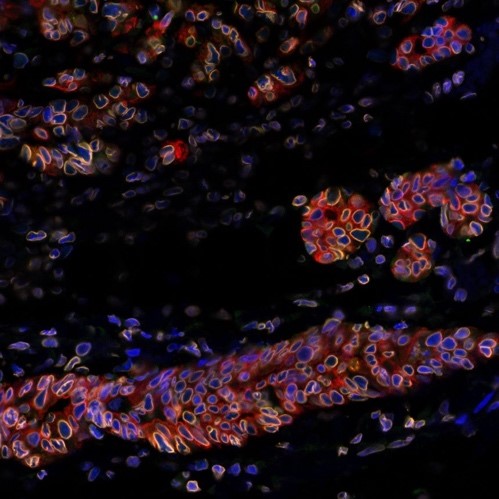
French researchers have identified a cellular resistance mechanism linked to relapses of triple-negative breast cancer, the National Center for Scientific Research (CNRS) announced on Thursday.
The finding could pave the way for new treatment strategies for one of the most aggressive and hard-to-treat forms of the disease.
Scientists from the CNRS, Institut Curie, and Université Paris Cité have identified how certain tumor cells temporarily resist treatment. They also pinpointed a key molecule that acts as an “on/off switch” controlling the tolerance of so-called “persistent” cells to therapy.
CNRS described the discovery as “a major step toward preventive medicine capable of anticipating and preventing relapses in aggressive cancers.”
Triple-negative breast cancer often responds well to combination chemotherapy. However, a very small number of tumor cells may survive treatment. These persistent cells can later regenerate cancer and trigger relapse, researchers said.
The study published Thursday found that persistent cells share a common transcriptional program across patients regardless of the treatments they receive.
Researchers also identified several molecules involved in this program that determine which genes are activated. Among them, the protein FOSL1 was singled out as a central “on-off” regulator of tolerance.
According to the CNRS, this non-genetic and reversible adaptation allows cells to modify their behavior to survive treatment before becoming sensitive again later.
The findings are based on experiments on mice using tumor biopsies from eight Institut Curie patients, the largest number ever used for this type of research. Sequencing technologies enabled scientists to analyze tumors at different stages and identify how tumor cells survive.
The next step is to identify biological markers linked to this resistance. According to the CNRS, the discovery could lead to new therapeutic strategies that seek not only to eliminate tumor cells but also to prevent them from entering the persistent state.