
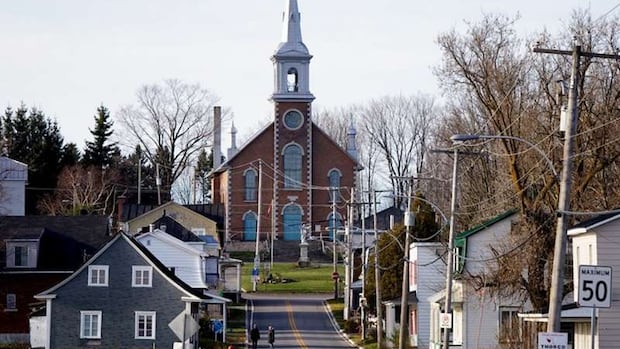
It’s often a struggle to get people out to vote in a municipal election, but apparently not in Saint-Thuribe, Que., located about 90 kilometres southwest of Quebec City.
The tiny community of about 300 people, centred around a small church and surrounded by farmland, had the highest voter turnout of any Quebec municipality in last Sunday’s elections, with about 85 per cent of eligible voters casting ballots.
Research suggests that smaller municipalities tend to have a higher turnout rate than big cities, given that citizens are more likely to know the candidates and have a shared understanding of important local issues. Still, not every small town had a high turnout rate on Sunday.
So, what explains the participation rate in Saint-Thuribe?
Guy Lachance, who won the race for mayor, said local residents were engaged from the start, with the prospect of a new mayor for the first time in 12 years.
While canvassing door-to-door, Lachance estimates he met with 90 per cent of eligible voters.
Some of those conversations lasted more than an hour, he said.
“I took the time,” he said in an interview. “People had a lot of interest and they appreciated that we met with them and listened.”
One of the biggest complaints he heard from residents was that they wanted the right to pose questions at council meetings — even if the topic wasn’t on the agenda. He included a commitment to allow them to do so in his platform.
Ultimately, Lachance beat out incumbent Jacques Delisle, 134 votes to 77.
Lessons for big cities?
Spending an hour with every prospective voter would be impossible, of course, in larger cities. Montreal had a 37-per-cent turnout rate, while about 31 per cent of eligible voters cast a ballot in neighbouring Laval.
But Samantha Reusch, executive director of Apathy is Boring, an organization devoted to engaging youth in democracy, said there are lessons to be drawn from villages like Saint-Thuribe.
It’s imperative candidates make connections with voters, whether that’s in person or online, she said.
“Municipal elections pose a unique challenge in that we’re relying on engagement with local media and local affairs that isn’t quite as robust as it was even 10-15 years ago,” she said.
Low turnout in municipal elections is a problem across much of Canada, she said, while provincial and federal elections tend to get far better participation.
In the federal election earlier this year, more than 68 per cent of eligible voters cast ballots.
Municipal elections are often less visible and perceived as less consequential, research has shown, with less media coverage and public information.
Reusch said she’s concerned the problem is getting worse, as more people get their information on social media, where algorithms determine what they see.
“With the lack of news in general on such large platforms as Meta — so Facebook, Instagram — you’re not even getting actual news,” she told CBC Montreal’s Daybreak.
“You’re getting more like fed creator-made content.”
She pointed to a recent poll that found that less than a quarter of people were even aware Meta had blocked news posts in Canada from Facebook and Instagram.
Yet the results in several races show the potential impact of a single vote. In Montreal’s Lachine borough and the City of Côte Saint-Luc, the mayoral race came down to a single ballot.
Across the province, 408 races were decided by fewer than 25 votes — and 43 of those races were for mayor.
WATCH | What’s with the low turnout? An expert weighs in: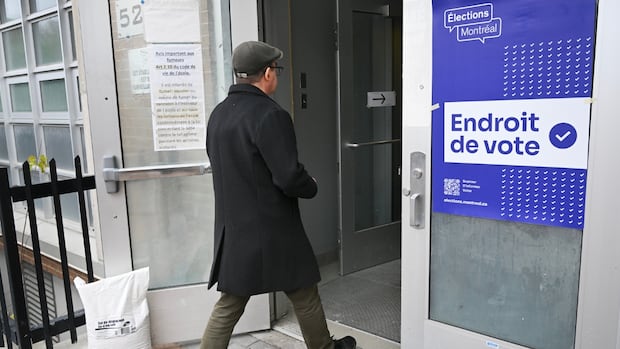
16% of eligible voters was enough to elect Montreal’s new mayor. What’s with the low turnout?
Citizen engagement expert Sabrina Jafralie argues the broader political situation, from provincial to international, has contributed to a growing sense of apathy or cynicism of politics and the democratic process among voters. Engaging with voters
As an example of a recent success, Reusch cited the mayoral race in New York City, which saw the highest turnout in decades at 41 per cent — nearly double the turnout in the last election.
She credited the victor, Zohran Mamdani, for engaging with voters in a meaningful way.
“What he critically did was get people online, and then he managed to mobilize them offline,” she said.
In Montreal, the main leaders failed to generate excitement, and there wasn’t a clear ballot-box question this time around, said Caroline Patsias, a political science professor at the Université du Québec à Montréal.
Among some voters, she says there was dissatisfaction with Projet Montréal, the party of outgoing mayor Valérie Plante. But Patsias also said there was “no strong enthusiasm for the opposition.”
Quebec City, by contrast, had a tramway project as one of several ballot-box issue, which helped drive turnout, she said.
A total of 51 per cent of eligible voters cast a ballot, compared with 45 per cent in the last Quebec City municipal election.
Soroya Martinez Ferrada, Montreal’s mayor-elect, said earlier this week the Canada Post and public transit strikes likely contributed to the low turnout.
“Would we like to have more participation? Absolutely. But I think that right now, the mandate I’ve been given is pretty clear,” she said.
Geneviève Guilbault, Quebec’s minister of municipal affairs, acknowledged that “it remains a challenge” to get people to vote.
Earlier this week, she told Radio-Canada the Canada Post strike made it difficult to get information out to prospective voters.
“There’s a lot of negativity circulating about politics,” she added. “I think we need to all think together about solutions.”