
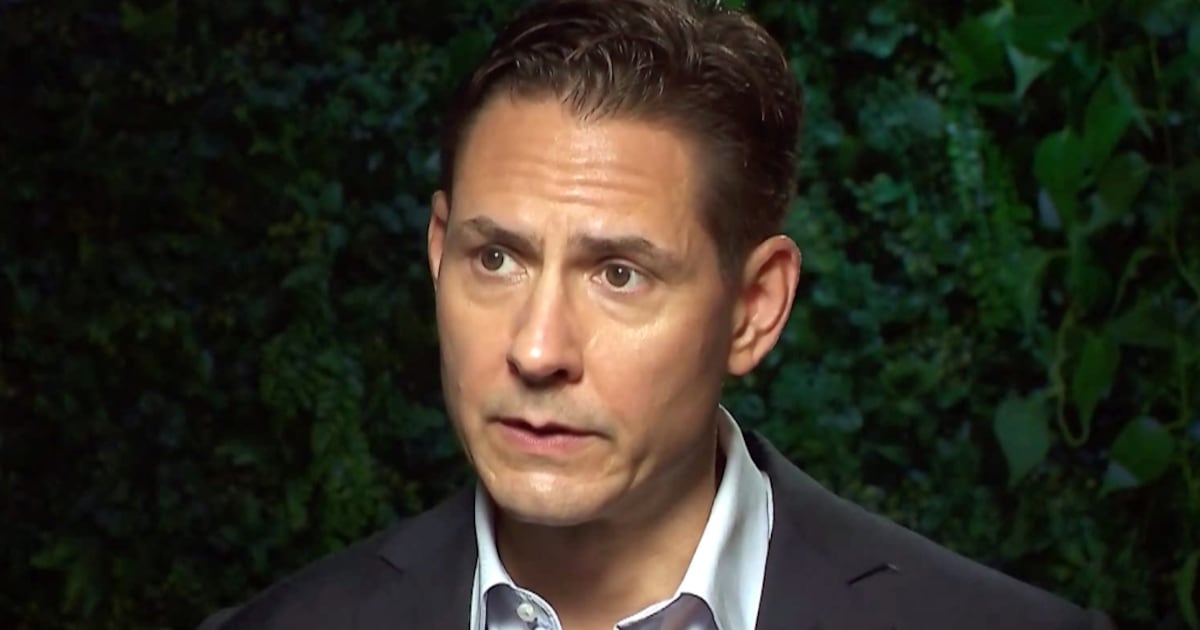
As Canada looks to recalibrate relations with China amid the ongoing trade war with the U.S., former Canadian diplomat Michael Kovrig is warning against making China “the core” of its economic diversification strategy.
“Making China the core of that strategy (is) not a good idea, because it’s not geopolitically a reliable partner,” Kovrig said in an exclusive interview with CTV’s Question Period airing Sunday. “As it’s demonstrated time and again, if you create dependency on China, it will weaponize it for political purposes and to silence Canada and constrain our foreign policy.”
Kovrig’s comments come one week after Prime Minister Mark Carney met with Chinese President Xi Jinping on the sidelines of the Asia-Pacific Economic Cooperation summit in South Korea. It was the first meeting between the countries’ two top leaders in eight years.
The relationship between Canada and China soured significantly in 2018, after Canada arrested Huawei executive Meng Wanzhou on behalf of the United States over bank fraud charges.
Days later, China detained Kovrig and fellow Canadian Michael Spavor over allegations of espionage — accusations they denied. Both men were eventually released after spending more than 1,000 days in a Chinese prison, not long after Meng herself was released from house arrest.
Allegations of foreign interference against China have also persisted, with the final report of the Public Inquiry into Foreign Interference calling China “the most active perpetrator of foreign interference targeting Canada’s democratic institutions,” earlier this year.
While Carney described his meeting with Xi as a “turning point” in the relationship, he also acknowledged differences between the two countries when speaking to reporters afterwards.
“We will be pragmatic,” Carney said. “We will be open and frank with each other on issues. There are issues of challenge and where we can find common ground, we will find common ground.”
When asked by host Vassy Kapelos whether Canada should turn to China as much as it turns away from the U.S., Kovrig said: “I would strongly avoid that framework.”
“As long as you make sure China doesn’t have too much leverage over any one Canadian company or sector, that can be part of a strategy,” Kovrig said. “But it’s got to be managed holistically that way.”
Should Canada lift tariffs on Chinese EVs?
In an interview with CTV’s Question Period earlier this month, China’s Ambassador to Canada, Wang Di said China will lift its canola tariffs if Canada drops its electric vehicle (EV) tariffs.
Canada is currently undergoing a review of its decision under former prime minister Justin Trudeau to levy 100 per cent tariffs on Chinese-made EVs. The policy was made in concert with the United States.
In retaliation, China levied a 100 per cent tariff on Canadian canola oil and meal, and a 75.8 per cent tariff on canola seed. China has also imposed a 25 per cent levy on some seafood products.
Following Carney’s meeting with Xi, the two leaders directed their officials to move quickly to resolve outstanding trade issues and irritants.
Carney afterwards said immediate action on reducing tariffs is not realistic.
Kovrig has previously said dropping tariffs on Chinese EVs would be a mistake and would give China too much leverage in future negotiations.
When asked by Kapelos whether he sees any reason to be optimistic because Canada has not yet conceded, Kovrig said U.S. President Donald Trump’s aim to disrupt the North American auto sector needs to be factored in.
“I think there’s a wait and see approach,” Kovrig said. “Canada has said that it is going to review those tariffs, so now I think there might be space for recalibrating them.”
“But the preferable scenario for Canada would be to shift that tendency more toward potential investments, rather than pure trade,” he added.
Kovrig also called China’s quid pro quo “not a real one.”
“Canada imposed those tariffs because the Chinese economic distortions are resulting in a massive dumping and overproduction, not just of electric vehicles, but of industrial products in general,” Kovrig said.
“(Canada needs) to hold firm that the fundamental premise is not fair. This is not a fair exchange,” he added.
Canadian provincial leaders are divided on the trade dispute, with Saskatchewan Premier Scott Moe and Manitoba Premier Wab Kinew calling on the federal government to drop its EV levies, while Ontario Premier Doug Ford wants them to remain.
Conservative Leader Pierre Poilievre, meanwhile, has said he opposes lifting the tariffs on Chinese EVs, though he is calling for Carney to do more to support farmers and get China to drop its levies on canola.
With files from CTV News’ Spencer Van Dyk