
It’s a bird, it’s a plane… it’s a… fireball?
That’s exactly what Maria Neufeld thought as a blazing streak suddenly tore across the southern Manitoba sky earlier this week. Driving home along Highway 14 near Plum Coulee, she says the fiery spectacle appeared out of nowhere.
“I was looking south-southeast, and all of a sudden this fireball came hurtling down,” Neufeld said. “I could literally see flames on it.”
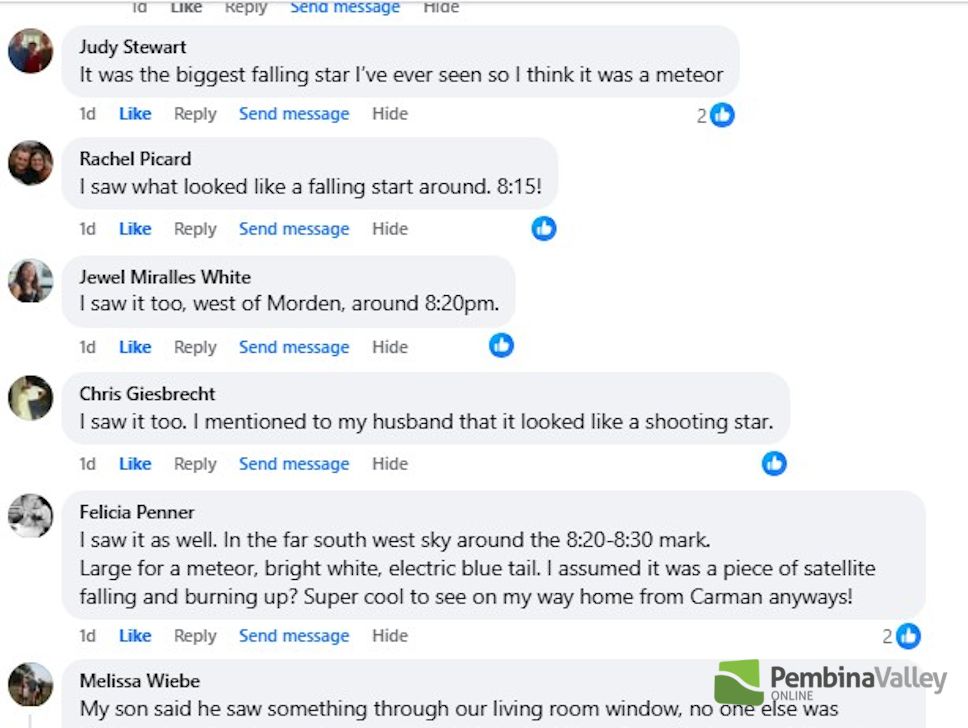
Upon sharing this tidbit of information on our social media platforms, others confirmed to have seen it too.
Astro club offers a possible explanation
The sighting led us to call on Kenton Dyck, founder of the PV Astro Club who joined us in studio to discuss what residents may have seen.
Dyck says it’s not the first time he’s been contacted about an unexplained light in the sky. This time, though, he believes there’s a strong possibility the event was linked to a rocket launch, not a meteor.
“There was an Ariane 6 launch that exact same day,” he said. “At that time, it would have been in the upper stages of our atmosphere. I didn’t see the event myself, but if I had to bet, that’s probably what it was.”
The European Space Agency’s Ariane 6 rocket launched earlier that evening, and Dyck says the timing lines up perfectly with reports from southern Manitoba around 8:45 p.m.
How rocket launches can look like fireballs
Dyck explains that when rockets reach high altitudes, they often separate their first-stage boosters, releasing leftover fuel into the upper atmosphere. The expelled fuel turns into ice crystals, which remain illuminated by sunlight long after the sun has set on the ground.
“Since those rocket launches happen much higher up, it’s still daylight up there,” Dyck said. “That sunlight hits the cloud of fuel, and it can make the sky look like it’s on fire.”
The light can vanish quickly once the rocket moves eastward into the Earth’s shadow, which, Dyck adds, fits exactly with Neufeld’s description of the object suddenly disappearing.
“You’ll see it glowing for a moment, and then it’s just gone,” he said. “That happens when the rocket moves out of sunlight.”
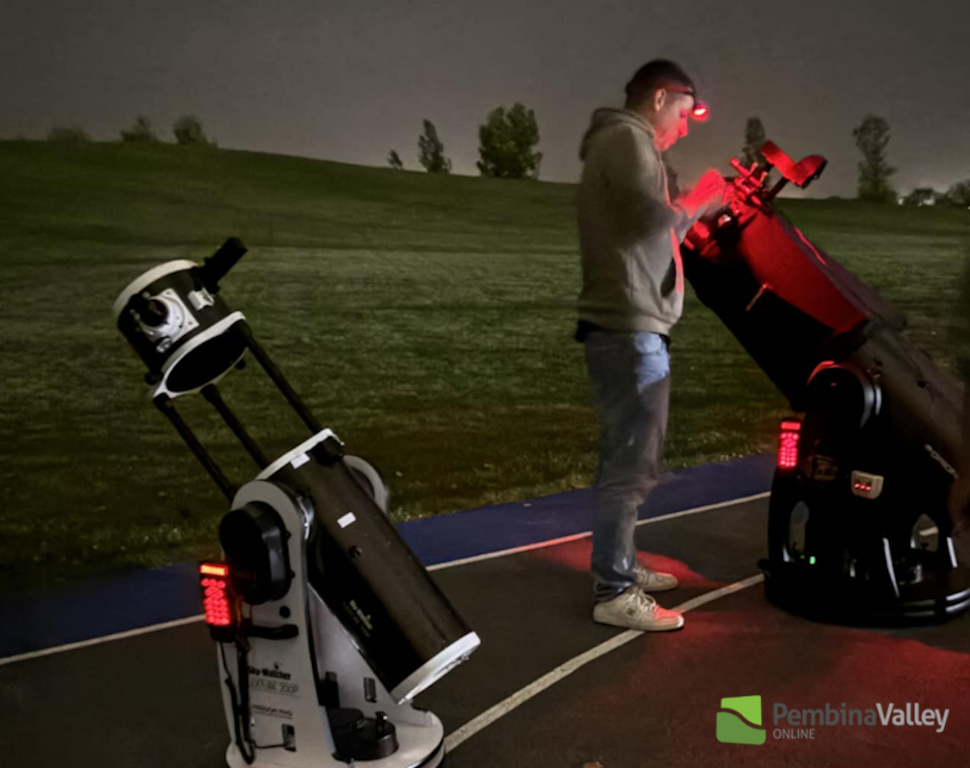
 Kenton Dyck (left), in studio with Jayme Giesbrecht
Not a meteor, but still a rare sight
While many residents immediately assumed it was a meteor, Dyck says the characteristics don’t fully match. A meteor or bolide typically burns up in a straight path, while a rocket stage can appear to drift or even change brightness as it moves.
Dyck recommends residents search for the “jellyfish effect” — a well-documented visual phenomenon caused by rocket launches that occur just after sunset.
“There’s a lot of footage online showing it,” he said. “If Maria compares what she saw to that, she might find it looks pretty similar.”
He adds that as more private and government agencies launch rockets worldwide, unusual sightings like this could become more common in Manitoba’s skies.
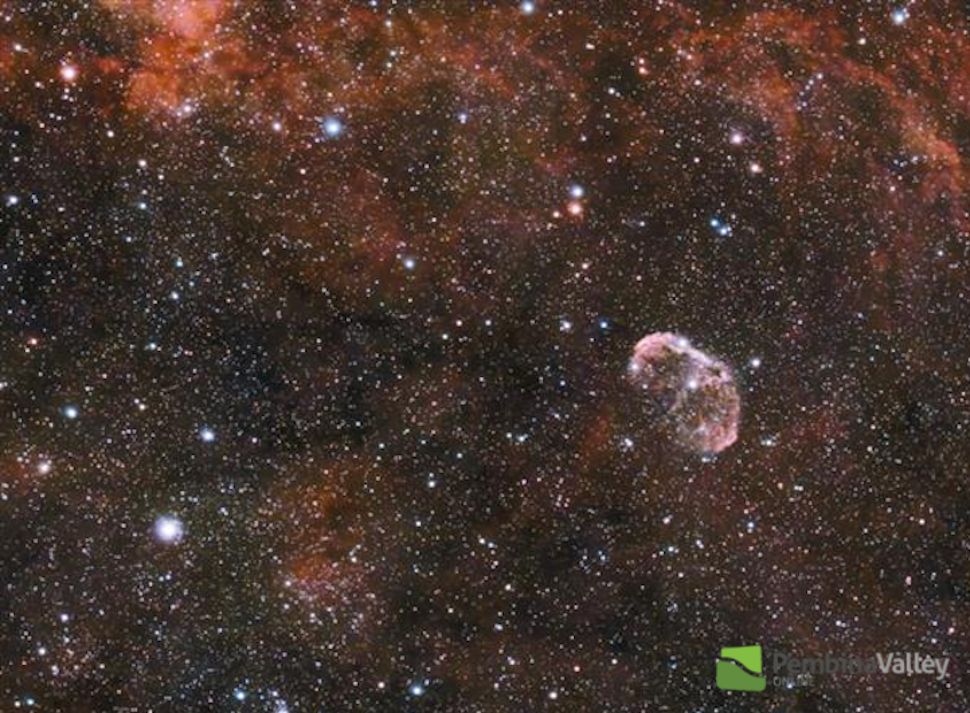 Submitted photo: Kenton Dyck’s newest project image, The Crescent Nebula (also known as NGC 6888 or Caldwell 27) is an emission nebula located about 5,000 light-years away in the constellation of Cygnus (The Swan). This photo features about 10 hour’s worth of imaging time.
Related stories:
Keeping eyes on the November sky
Dyck says there are several other celestial events worth watching for this month, including the Leonid meteor shower, expected to peak around November 17th.
“It’s one of the better ones to watch with the naked eye,” he said. “You don’t need a telescope — just a clear night and a bit of patience.”
The PV Astro Club continues to encourage residents to share their observations, whether through photographs, written reports, or simply word-of-mouth.
“The more people look up, the more we can learn together,” Dyck said.