
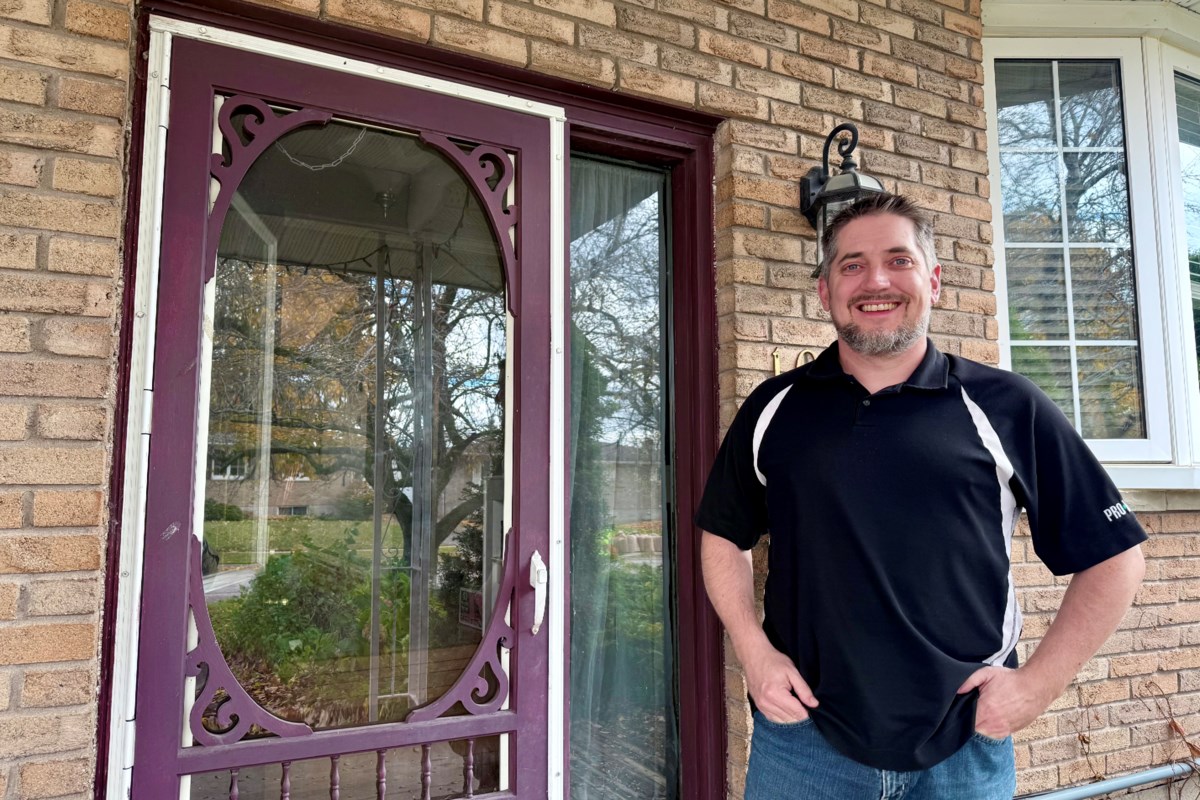
‘As an individual, you should be able to have your own personal rights to fight for yourself, to advocate for yourself,’ said Ian McLarty after his frightening experience
Ian McLarty went to the hospital this June after experiencing a dire set of symptoms – and learned he had a serious infection that’s still impacting his life today.
“It started with, one day, I just got a headache that wouldn’t go away, and (it got) progressively worse to the point where things like motor skills were affected, memory was affected,” he told SooToday.
After getting sent home following his first visit to the emergency room, things took a turn for the worse when he returned to the hospital the following day.
“The next day, I woke up even worse, feeling worse, to the point where I’d be sitting in the waiting area, holding onto my phone, and I would just lose grip on my phone,” the 48-year-old said.
“Eventually, I hit the floor with what they believed to be a seizure, and that’s when the doctors in the emergency room took me seriously.”
A CT scan and MRI left doctors suspecting it might be brain tumour, and McLarty was promptly flown to Sudbury to be treated by a neurosurgeon.
There, doctors determined he had bacterial abscess in his brain caused by Strep A.
“It was so big that it put pressure on my brain. That’s what caused all the motor functions, the headaches,” he said.
“So I had emergency surgery to drain the abscess.”
For weeks afterwards, McLarty healed with the aid of a “cocktail” of intravenous antibiotics and anti-seizure medications, and he gradually regained his life.
He moved from inpatient to outpatient treatment in his home in Sault Ste. Marie, and doctors ultimately determined it was a serious, one-time infection that had resolved – and gave him a clean bill of health in September.
“He said, ‘You know, it looks like the infection has been cleared up. Three months of very strong antibiotics have done their job. We can discontinue antibiotics. You’re good to go,’” McLarty said.
Despite that, his life continues to be impacted well after he was cleared by the specialists who oversaw his care.
Before his infection, McLarty’s family doctor retired – leaving him without a point of contact to navigate the bureaucracy of the healthcare system following such a serious condition.
Although his specialists said he had recovered, he experienced difficulty getting approvals to return to work, as well as regaining his driver’s license – which doctors had suspended as a matter of course at the outset of his infection.
In the meantime, he’s had to rely on others to help him with day-to-day tasks.
“A big part of this challenge has been leaning on people because I can’t drive and I’m a single father,” he said.
“I put a good chunk of my life on hold because I couldn’t just run to the store and buy something, or run an errand here or there.”
Without a family doctor, the available front-line options were not able to help – with walk-in clinics wary to sign forms for a patient whose history they are unfamiliar with, McLarty said.
“A walk-in clinic can treat what’s there in front of them, but they can’t look at a history and say, ‘You’re medically clear. I’ll sign a form saying you’re cleared to return to work,’” he added.
Fortunately for McLarty, there are doctors in his friend group, and they were able to make the calls necessary to get his former specialists to help him resolve the situation.
“Specialists don’t answer the phone from the public. They answer the phone from a doctor, so you need that referral,” he said.
“A friend of mine who’s a doctor in Thunder Bay … she made a call on my behalf to talk to my infectious disease specialist here in Sault Ste. Marie, and talked him into filling out those forms for me because he was the best suited for the situation.”
Ultimately, McLarty’s former specialist signed the forms he needed to return to work – where he’s been on a work-from-home basis for over a month – and filled out the required MTO paperwork to get his license back.
Without his friends advocating for him, McLarty’s convinced he would not yet be back at work.
“I would have been a medical orphan, sitting here,” he said. “I wouldn’t even have the first couple MTO forms signed. I wouldn’t be working because I wouldn’t have the form approved.”
Even with the help of his friends, however, McLarty has had a difficult time getting his license reinstated.
He said the forms provided by MTO fail to account for the nuance of his situation.
“The MTO forms are fun because there’s very few places on a form for the doctor to actually write words,” he said.
Even though both of his former specialists – in the Sault and in Sudbury – filled out forms for early reinstatement, the Ministry informed McLarty that its “medical review panel saw that check mark and said no.”
As of last week, his specialist in the Sault is submitting another form – with more explanation of his situation – to MTO in an attempt to get his license reinstated, but McLarty is frustrated with how difficult the process has been to coordinate.
“There’s a lot of things where having someone to fight for you, having the advocacy is lacking,” he said.
“As an individual, you should be able to have your own personal rights to fight for yourself, to advocate for yourself.”
When asked by SooToday, the Ontario Medical Association said they do not have data on the prevalence of cases like McLarty’s – but that his experience is a clear indicator that more family doctors are needed.
“This example highlights the need for a greater number of family physicians in Ontario,” OMA said in a statement.
“Family doctors are a vital link to specialist care and in this case, even to a patient’s ability to reclaim their mobility that’s essential to their employment and independence.”
According to MTO, the onus is on the driver to demonstrate they are cleared to drive, with supportive medical documentation from healthcare professionals.
“In Ontario, to have a driver’s licence reinstated after a medical suspension, a driver must provide satisfactory medical evidence that demonstrates they meet the national medical standards to drive safely,” MTO said in a statement.
“The driver is responsible for initiating the process to have their licence considered for reinstatement.”