

 We caught up with Sirus Co-President Justin Ziran, who’s spearheading the company’s recently announced move into miniatures (see “Sirius Launching Metal ‘D&D Minis“), last week to discuss the expansion of the company’s focus and plans for the line. Ziran joined Sirius as Partner and Co-President early this year from miniatures powerhouse WizKids (see “Ziran to Sirius“). The interview has been lightly edited for length and clarity.
ICv2: Why did Sirius decide to produce metal miniatures?
Justin Ziran: I’ve made a lot of miniatures in my life, in my career, and they’re near and dear to my heart. When I joined the team, I noticed that there wasn’t an official D&D metal miniatures licensee.
When we approached Wizards, we asked for the metal license with the intent of catering a release towards fans that would enjoy metal, a metal offering. I also wanted to take an opportunity to bring some of the more modern sculpting techniques that have come to bear over the last couple of decades that just weren’t there back in the ’70s, ’80s, ’90s when metal was in its heyday.
That mixing of the two worlds was intriguing to me and provided a nice offering. In my head, at least, I’m like, “Hey, what would I love to see?” A high‑definition metal miniature produced in the style of those classic releases, whether that was the box sets, or the first‑edition books, or the animated series was just intriguing.
That’s where we started with the whole idea. Fortunately, and thankfully, Wizard said, “Yes, let’s give it a shot,” so we did.
Why miniatures at all, are they a fit with Sirius Dice as a company? It’s not an immediately obvious connection.
When I joined the company, the plan was to broaden into accessories, not just dice. That is reflected more recently in the rebranding of the company, we’re moving from Sirius Dice to just Sirius. You’ll see that reflected on our website, on our packaging, and all of our collateral material on a go‑forward basis. The whole plan at the beginning was to broaden into non‑game but game‑play accessories.
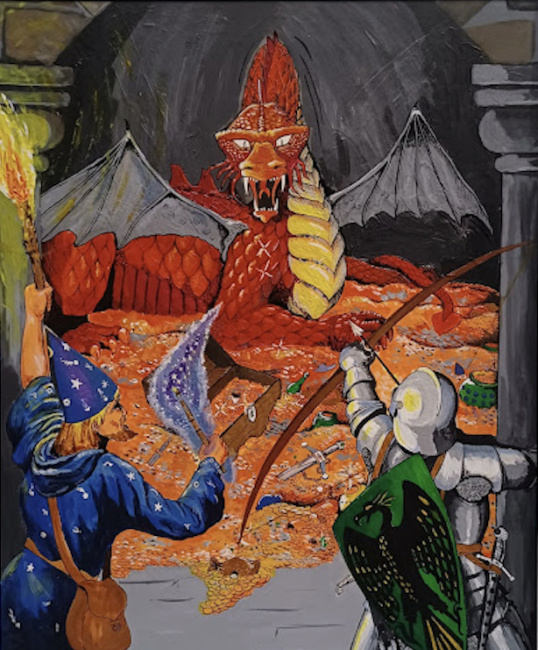 These are original sculpts, the new miniatures you’re making?
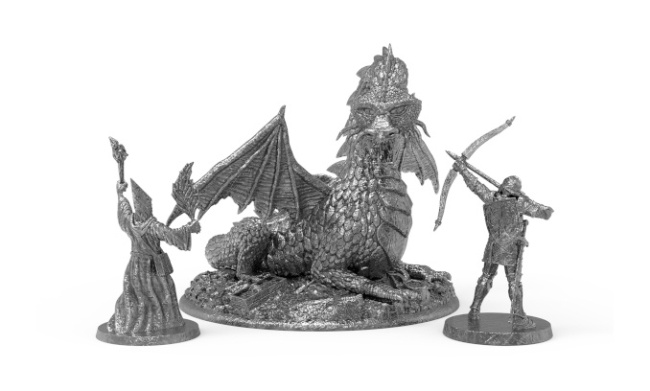
Yes. We took the David Sutherland cover art. Obviously, you don’t have the front of the wizard or the fighter. We had to do some interpolation, but yeah, we started from scratch and used that art and that style of art as the inspiration.
We had to do some interpretation on the front side of the miniature, which we did, but that’s the time‑consuming piece when you’re sculpting something so old and nostalgic, you just often don’t have complete turnarounds with all the figures like you do now.
Where are you manufacturing?
We’re manufacturing overseas, but we’re open to and continue to look at North American options as well. Metal miniatures are a higher touch operation than plastics. The minute you introduce human touch into the equation, prices skyrocket. Even with all the mayhem that is going around with tariffs and importation and all that stuff, it’s still more economical to manufacture in China.
 Are you going to use more retro art for inspiration?
We are actually going to continue on a retro plan. To me, the fit just doesn’t seem to be there for a modern interpretation on metal miniatures. The whole thing about this was the retro feel to the miniatures and the retro subject matter. With D&D at the height of its popularity, we thought it was just a good time to go back and revisit some of those older themes.
We will start with the 1977 D&D Holmes Box Set, and then we’ll move into the (they’re known in the industry or among players as) BECMI [Basic, Expert, Companion, Master, Immortals] series, but it’s the Larry Elmore box, that’s the Red Box, the Blue Box, etc. We’ll go down that path and probably throw in a little bit of the animated series as well.
It was mentioned in the original release that the metal miniatures could be used for play. The scale fits, but there will only be a few items at first. Are you seeing people using these in conjunction with plastic miniatures they already have? Or how do you see this being used in play?
The target is a game‑playable collectible, is what we’re looking at. It’s not blind purchase, it’s a visible purchase. They’re designed to be game‑playable. By no means am I saying that they shouldn’t be used for game play, I think they will be.
Given the subject matter and the themes and the retro look of it, I imagine people would have to make some choices there. You can play them side by side with the plastic miniatures, but we are putting them in what I’m going to call collector or display-quality packaging. If you think of higher‑end packaging that Apple comes in, or a nice watch, these figures will be displayed in. that way.
We’re actually trying to put them in the box the way they appear on the cover. When you open that box, you will recreate that little scene on your desktop or on your bookshelf or wherever you may put this thing, but also, you can pull them out of the box and play them if you need to.
Was cost one of the reasons that metal miniatures have become less popular, the cost versus plastic?
Yeah, that is definitely still in play. Metal miniatures in general are either made from pewter, zinc alloys, or copper alloys, all of which fluctuate on the commodities market.
Pricing is not as stable as one would want it if you were doing a full line of millions of miniatures per release, but on a boutique kind of release that is targeted pretty narrowly, it just made sense to me. Yes, they’re a little bit more expensive, but the fit with the target audience and that nostalgia collector and player is just too good to pass up.
Sounds like the positioning then isn’t really competitive with plastic, you’re seeing the user using them in different ways: it has more of a collectible element and display element than the plastic miniatures. Is that fair?
Yeah, for sure. The plastics market is pretty well served by WizKids and other offerings out there. It just didn’t make a lot of sense to come out with the pre‑painted offering or something that was trying to compete on that, especially when the cost basis of metal is just higher. The fact still remains that that market is well served at this point. Targeting that market just wasn’t part of the equation. It was really going after a nostalgia play.
That said, it doesn’t seem like these are hugely more than the same scale of plastic miniatures would be, so that’s a positive.
I was surprised at the cost, but it is definitively more expensive. It’s just not as expensive. Back in the day when the big switch from pewter to spun resin, or PVC, or ABS happened, I remember in the pewter market, the commodity price just skyrocketed, it 10Xed in one month, and then everyone went crazy and had to pivot. Sometimes I think about that situation compared to where we are now with tariffs, and it’s not that dissimilar. There’s a market force that does something and you have to react.
I remember everyone going to spun resin, coming up with pre‑painted plastics or plastics at that time. It was quite an ordeal. Going into it, I thought, “OK, this is going to be 10 times, 20 times more expensive.” It wasn’t. It’s actually rather reasonable.
It’s no longer just pewter. There are zinc alloys that you can look at. There are copper alloys that you can look at that are all very, very good, and quite honestly, hold more detail than the original pewter did.
Let’s talk about where you plan to take this line. The first question is, what’s your release cadence going to be on these box sets?
You’ll see a cadence of approximately one box set per quarter. If you look at the covers of the Red Box cover, the Experts, the number of minis is actually rather small. Some of these covers have two miniatures, a dragon and a fighter on it, or a horse, a fighter, and a dragon on it. We’re talking small miniatures counts released once a quarter, probably with a special release at Gen Con.
Then we’re also wondering about products that fit Sirius or the market that might fit with this. Is there ever going to be blind packs of metal miniatures?
No, it didn’t make a lot of sense. I’m just referring back to the previous comment, where I think that market is pretty well served and coming out with a multi‑blind pack. It’s probably talking $30, $40 per pack of miniatures, which just doesn’t land well. I don’t think it lands well with me, let alone a DM that has to buy hundreds of miniatures. There’s no plans for a multi‑pack blind pack. We may throw a miniature in some of our mystery packs. We do treasure packs for D&D. I could see a miniature showing up in there every once in a while, but not as a delivery mechanism for metal miniatures.
Then what about non‑licensed versions or products related to other licenses?
We’re certainly open to other licenses. In general, just as a long‑time licensee, I don’t like competing with our licensers. Wizards has been very good about creating very definitive swim lanes, so all the licensees aren’t stepping all over each other. I just see no reason to coattail on all the hard work that they’ve done with their brand just to make a knockoff or like item. They’re letting us make the official D&D miniatures. We’re happy about that, and we don’t see any reason to make unbranded generic figures.
In terms of other licenses, we’re very open to other licensing. In fact, we probably have some other licensing in process. Again, we like to keep very definitive swim lanes.
What are your thoughts about paint as a line for Sirius, or what should those who want to paint their metal miniature be looking at?
The modern formulations of paint all work on metal very well. In fact, I think metal has some advantages in that the surface is generally a little bit more porous and a little bit rougher, so priming isn’t as big of a requirement.
On plastic miniatures, made from petroleum, petroleum‑based paints or acrylic water‑based paints tend to have hydrophobic characteristics. When you put a water‑based paint on a miniature that is made with an oil derivative, the oil and water want to separate and push apart, so priming becomes very, very important. You don’t have that issue in metal.
Now, some people like to prime just to improve the adherence of the paint, but it’s not a total necessity. Modern formulations of all the paints should work fine, but we don’t have any impending plans to launch a paint line. Having been there and done that, it’s out of scope for what the company does.
You joined Sirius from WizKids after the company had been formed and been running for a few years, but it brought you back together with people that you’d worked with before in previous companies. What has that experience been like, and how do you feel about the team at Sirius now?
It’s great. Both Lax [Chandra] and Tina [Trenkler], the founders, have been part of my career in different ways, at different times. Tina was part of the team at Wizards of the Coast that onboarded me into Wizards of the Coast onto the project management team. I’ve known her for decades, the better part of 25 years at this point.
Lax was the president of WizKids in Seattle, Topps WizKids, Seattle. He was the hiring manager for the position there. Individually, they became very influential people in my career. I have a lot of love, a lot of respect for them both. They’ve had a pretty big impact on my career, so getting to join them and work with them has been wonderful.
It’s the best of all worlds. I get to work on Magic, D&D and other game licenses that I love, and I get to do it with people that I love and respect.
One of the criteria that I wanted was a smart, fast company: speed and smarts are the two requirements I had. I just don’t like to get bogged down in committees and big meetings. That’s one good thing about Sirius. Nice, small, tight team, quick decision-making, a lot of experience, and so we can move pretty quickly. It’s been really nice.
Anything else you want to communicate to our readers?
I hope that they enjoy the miniatures. There’s a lot more coming, there’s a lot more category expansion coming, most of which hasn’t been announced. You’ll see forthcoming announcements.