
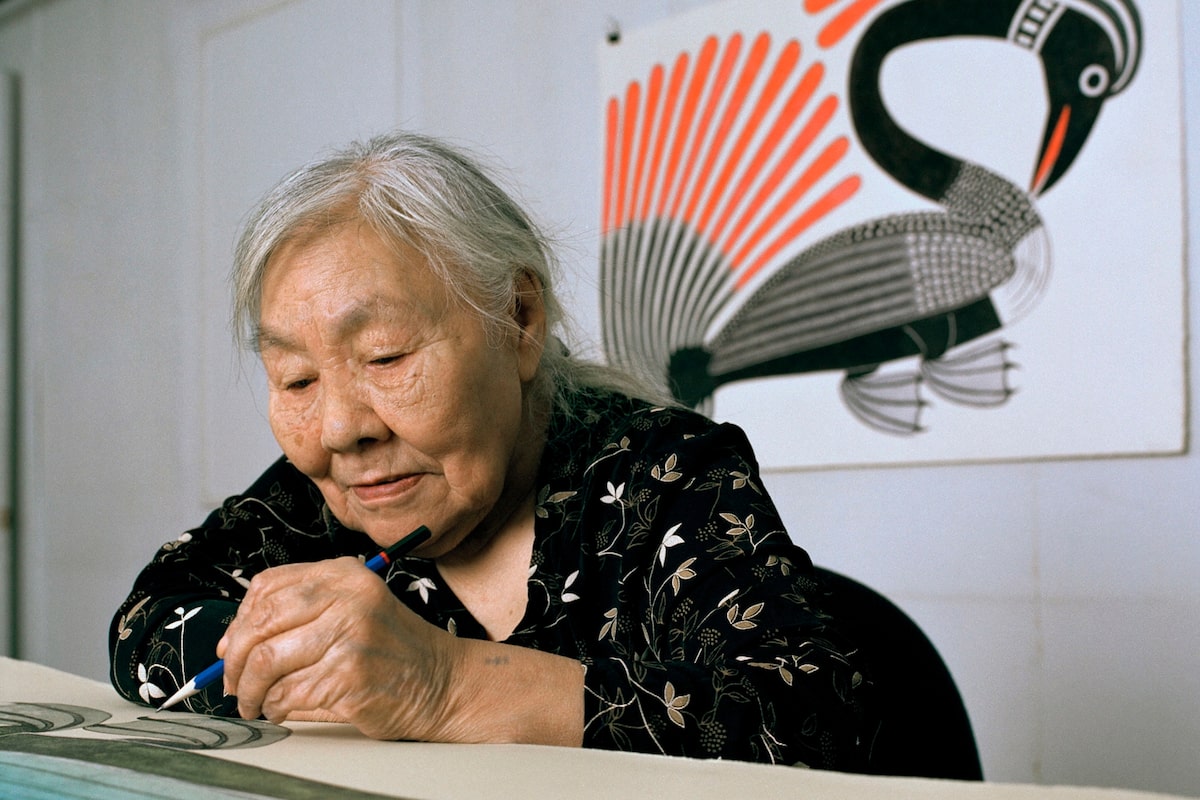
The late Inuk artist Kenojuak Ashevak, who sold a work called Enchanted Owl in 1960 for $24. That piece later sold for $240,000 at an auction house.Mark Lipman/The Canadian Press
Painters, sculptors and other visual artists are poised to get a slice of the proceeds when their art is resold, under changes designed to boost their incomes to be brought forward in an omnibus budget bill.
The government announced plans in its budget last week to change copyright law to create an Artist’s Resale Right in Canada, so visual artists benefit from future sales of their work, including if they are resold at auction.
The move would bring Canada in line with many other countries that have similar royalty regimes, including Britain, Australia and France.
Canadian artists currently get no financial benefit, even if their work is resold for many times the original price.
A national body representing artists has been calling for the change for years and wants the royalties to apply to works sold for at least $1,000. Canadian Artists’ Representation estimates that, based on a recent analysis of auction sales it carried out, the copyright change could mean an extra $3-million to $5-million for Canadian artists annually.
It predicts that Indigenous artists, some of whose work has been sold at auction for many times the value they sold it for, stand to particularly benefit from the proposed update to the copyright act.
Kinngait drawings at the McMichael reveal breadth of Inuit art
Inuit artists have seen their paintings, original prints and sculptures achieving sums hundreds of times their original price at auction or in galleries, years after they sold them.
The late Inuk artist Kenojuak Ashevak sold a work called Enchanted Owl in 1960 for $24. It sold last year at a Canadian auction house for $240,000 – 10,000 times its original value.
“We’ve already begun building a database of artists whose works would qualify,” said April Britski, national executive director of CARFAC. “Many people think that well-known artists are thriving financially, but that’s not always the case. Half of all visual artists earn only $20,000 a year.”
Ms. Britski said even award-winning artists can struggle to earn a living from their art, with some years being profitable and others not.
“The markup on Indigenous art can be huge, with many of the artists seeing a tiny fraction of their work’s value,” she said. “Seniors have similar issues. Even when they’re still alive and producing new work, people want the stuff that made them famous – and that is often their earlier work.“
She said a painting by the late Ron Bloore, a Saskatchewan artist known for his monochromatic paintings, sold at auction for $55,200. But he received nothing from the sale.
The estates of artists are likely to receive a slice of the resale value after their deaths, in line with copyright rules under the changes in the federal budget.
Artist Kenoajvak Ashevak works on a new print inside the Kinngait Co-operative print shop in November, 2010.Peter Power/The Globe and Mail
“It would be nice for artists to be able to reap the rewards of their work while they are still alive,” said Ottawa-area artist Linda Banfalvi, who is known for her landscapes and seascapes.
The proposed Artist’s Resale Right was announced in last year’s fall economic statement but it failed to progress into law before the election was called. It was flagged in an annex to the budget this month, one of 75 legislative changes the government included and will likely feature in an omnibus budget bill.
“Artists, particularly visual artists, are great contributors to Canada’s cultural scene and among the lowest income earners in Canada despite their significant cultural contributions,” according to an annex to the budget signalling the proposed change to the law. “An Artist’s Resale Right provides the creators of original visual artwork with a royalty whenever their work is resold through an eligible sale, providing an additional income stream.”
The details of how much artists will benefit from the change has not yet been set out. In many other countries visual artists receive 5 per cent when their work is resold through an intermediary such as an auction house or commercial gallery.
“Art and artists are at the heart of our identity, our culture, and a key driver of our economy,” said Hermine Landry, spokesperson for Canadian Identity Minister Steven Guilbeault. “When artists thrive, Canada thrives.”