
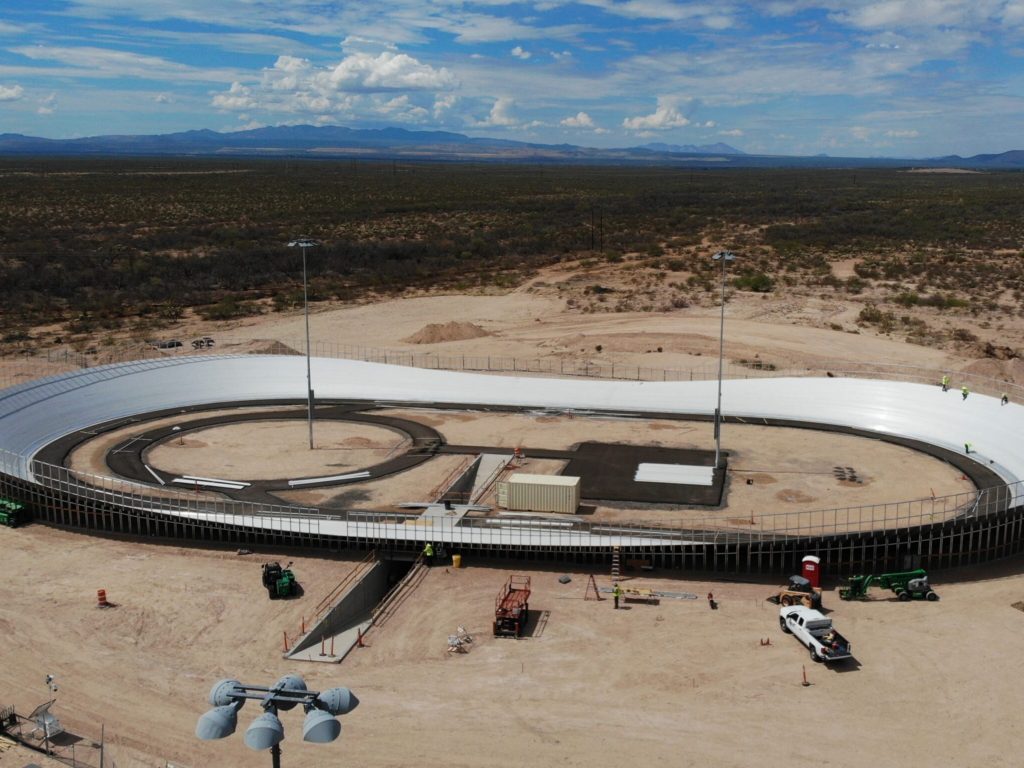
Tucson is preparing to unveil Arizona’s first Olympic-style velodrome, offering a new venue for cyclists of all levels—and it was designed by a Canadian.
A ribbon-cutting ceremony at 6:30 p.m. Wednesday will provide a first look at the state-of-the-art facility.
The track was built by Canadian designer Peter Junek and is made entirely of aluminum. Which, by the way, is a first in velodrome construction.
Tucson has long been a winter training destination, thanks to its sunny weather and challenging roads. There’s also the 40-km climb up Mount Lemmon—and extensive cycling infrastructure. The area regularly hosts professional and national-level riders, as well as group rides and training camps.
Junek has designed tracks across the globe, including the high-speed velodrome in Aguascalientes, Mexico. In Canada, he created the Fonthill Velodrome in 1990, followed by a 166 m track in Hamilton, a 200 m track in Quebec, and a 250 m track in New Brunswick. He also built a 250 m track for the 1999 Pan Am Games in Winnipeg and recently designed the new Centre National de Cyclisme in Bromont. His portfolio spans dozens of tracks worldwide, from Sweden to Portugal and Turkmenistan to Chile. The Tucson facility will be his 37th velodrome.
Unlike most velodromes, which use Siberian pine indoors or concrete outdoors, this track’s aluminum construction sets it apart, promising durability under the hot sun.
Canadian Cycling Magazine spoke with Junek earlier this year and did a deep dive into the construction of the track. He mentioned scrap aluminum is worth 30 per cent of new aluminum. “In the worst case, if they need to scrap it 10 years down the road,” Junek said, “but the main thing is weather resistance.”
The surface can be powder-painted with aluminum paint containing small particles to create friction similar to wood or smooth concrete. For the Tucson track, they sandblasted it first, which is a more cost-effective method.
You can learn more about the venue here: TucsonVelodrome.com