
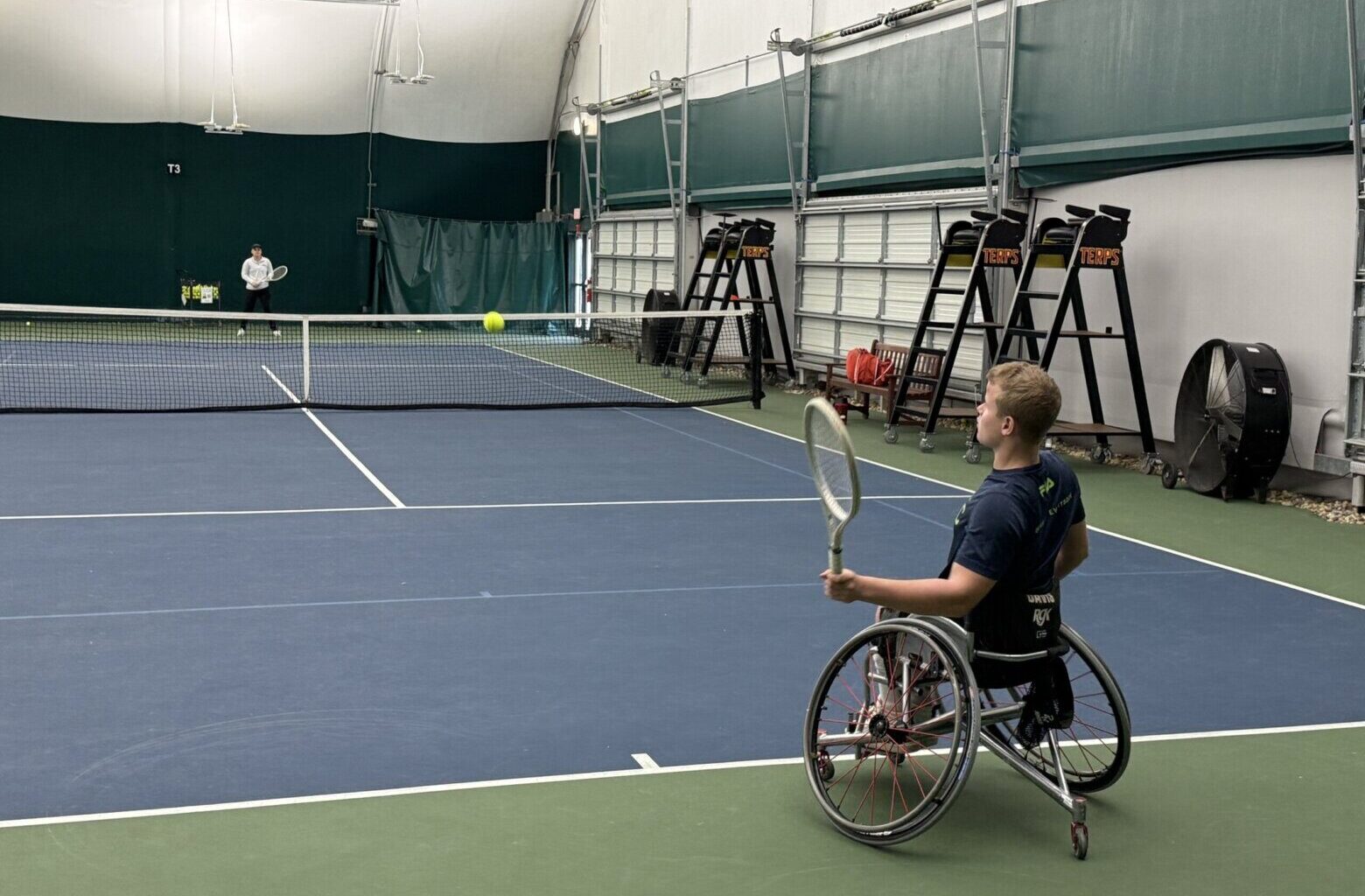
A tennis coach from College Park is one of many coaches participating in a program by the U.S. Tennis Association that trains wheelchair players and others with various physical challenges.
This page contains a video which is being blocked by your ad blocker.
In order to view the video you must disable your ad blocker.
The training center proving that tennis is for everyone
Millions of Americans play tennis, and the sport is seeing a recent resurgence in popularity. The U.S. Tennis Association is working to increase those numbers even more, offering a new program to train more coaches — especially those who can coach players of a different kind.
On a Tuesday afternoon this month, Gabby Hesse had 15-year-old Spencer Davis, of McLean, Virginia, maneuvering around cones and returning volleys — both forehand and backhand.
With one hand holding a racket, Davis used his other hand to push his wheelchair, moving himself back and forth across the tennis court.
“I think some people kind of have the misconception that people who have disabilities want to stay at the house and just do whatever — they don’t want to be active and they don’t want to try to improve, whether that’s physically or mentally,” Davis said. “But a lot of people that I know who have disabilities, including myself, we want to go outside and be active and get stronger mentally and physically.”
Davis is one of hundreds of players with physical disabilities who receive coaching at the Junior Tennis Champions Center in College Park, Maryland, where Francis Tiafoe got his start.
Coach Hesse had never shared a court with someone in a wheelchair until college, where one of her assistant coaches was in a wheelchair.
“When we create opportunities, people show up, and that’s really what this model has proven,” Hesse said. “So we’re hoping that more tennis centers around the country take this on, because it’s created a really beautiful, inclusive environment at JTCC, where our mission is tennis for everybody.”
Davis has been playing tennis for years. He was born with spina bifida and is paralyzed from the waist down. But that means he can still swing a racket. Doing it while in a moving wheelchair isn’t easy, and sometimes, he plays against athletes who aren’t dealing with any physical challenges.
“It’s definitely really rewarding to figure out this is how you hold it, and this is how you push and the different movement patterns,” he said. “And it’s really fun to be able to kind of figure out that puzzle and improve and get better.”
It’s not just his skills that improve either, it’s his physical and mental health, and his overall quality of life.
“It’s really nice after a long day to go play tennis, because you don’t have to worry about other stuff,” he said. “You can just hit a tennis ball.”
This week, the U.S. Tennis Association launched its USTA Coaching program, which aims to address what it says is a shortage of tennis coaches. It’s a free opportunity for anyone looking to make tennis more accessible to anyone, whether they’re in a wheelchair or not. But working with adaptive athletes in particular is something Hesse said has made her a better overall coach.
“It’s all these techniques you need to do to be able to put the player first, figure out what they need, figure out what their goals are, and really meet them where they are and help them get to that next level,” she said. “So it applies, not just in adaptive tennis, but in tennis overall.”
And in tennis, you can’t coach someone up until you establish a relationship with them, Hesse said. You have to know them and understand what makes them work. But she said when that happens, and she sees a learned skill begin to click and a player “get it,” there’s no greater satisfaction.
“There’s just nothing like it. It’s almost like humanity at its finest,” she said. “We’re both working to achieve a goal, and when that goal is achieved, it’s just the most exciting feeling.”
Davis said the coaching helps him beyond the court.
“It’s really crucial that we’re able to have this because it really helps us improve our lives,” he said. “We’re able to just be with so many people in such a loving and caring environment, and we’re able to grow in so many different ways.”
Get breaking news and daily headlines delivered to your email inbox by signing up here.
© 2025 WTOP. All Rights Reserved. This website is not intended for users located within the European Economic Area.