
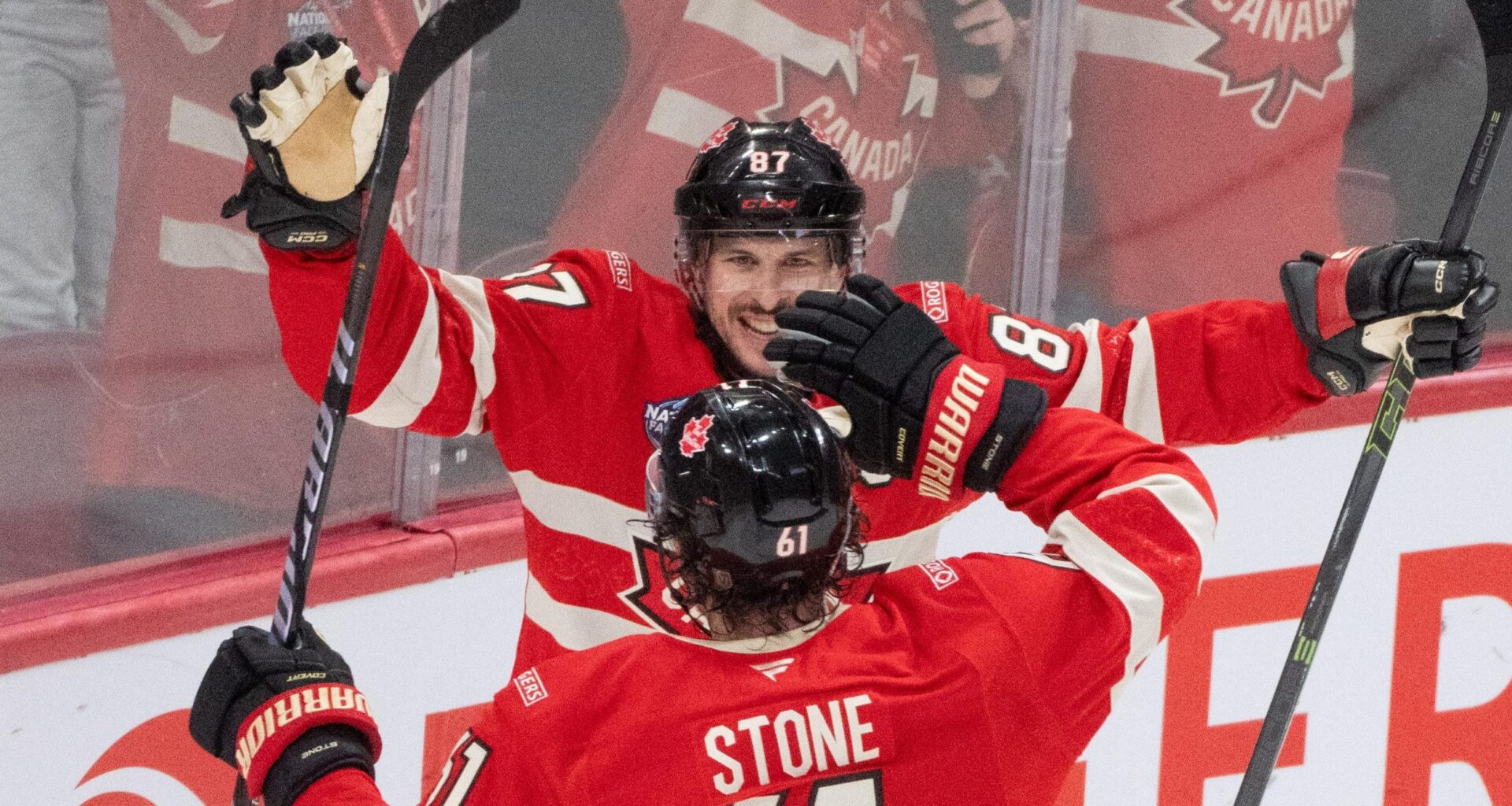
THE CANADIAN PRESS/Christinne Muschi
November 13, 2025


Where does one begin when it comes to Sidney Crosby? Few athletes are as synonymous with their national sport as the 38-year-old from Cole Harbour, Nova Scotia is with Canadian hockey.
Crosby donned a Team Canada jersey for the first time as a 16-year-old playing at the 2003 U18 Junior World Cup. Little did the country know how iconic Sidney Crosby in a Team Canada jersey would become.
Ask most Canadians over a certain age and they can remember where they were when Crosby scored the “golden goal” in overtime against Team USA to win Canada the Olympic gold medal on home ice at Vancouver 2010. Crosby went on to captain Team Canada to a second straight Olympic gold at Sochi 2014.
He was the first player in the world to win an Olympic gold medal, a world championship title, and a Stanley Cup as the captain of all three teams. Crosby was also captain of the victorious Team Canada at the NHL’s first 4 Nations Face-Off tournament this past February.
Crosby’s last Olympic appearance was at Sochi 2014—because that was the last time NHL players participated. But at Milano Cortina 2026, they’re back, and so is Crosby.
Crosby was named as one of the first six players to Team Canada’s roster along with five others who rank among the best of the best in the NHL: Connor McDavid, Nathan MacKinnon, Cale Makar, Sam Reinhart, and Brayden Point. They’re also players that grew up looking up to Crosby, who were kids watching the golden goal at home.
Olympic.ca spoke to Crosby about his favourite Olympic memories, the best advice he’s received, and what it means to him to represent the maple leaf.
Has the meaning of playing for Canada changed for you over the years?
I don’t think it’s changed. I think that whether it was World Juniors, the first time I played for Team Canada, or now, it’s a sense of pride. You dream of that as a kid. I think that passion, that pride, it hasn’t changed.
What Canadian values do you carry into the game?
I think just work ethic, passion, trying to be a good team player. Obviously, it’s a team sport and that’s a big part of it. When you’re getting together on an Olympic team with so many great players, it’s the ability to come together and play as a team that’s so important.
What sport, besides hockey, are you most looking forward to cheering on at the Olympics?
Oh, that’s a tough one. The speed skating is pretty exciting. Usually the mountains are a little further from where we are, so we don’t usually get to get to those events, but those would be fun to see live.
What’s one piece of advice you would give to younger athletes?
I think just work hard and have a passion for it. That’s the biggest thing. It’s a great time when you’re young and you’re learning and you’re aspiring to get to a certain point. And regardless of if you’re younger or in my position, you can always learn.
What’s it like playing with guys that looked up to you growing up? For many of them, your golden goal at Vancouver 2010 is a core memory.
You know what? It’s fun.
It’s something that I think pushes me, it gives me energy. I think it’s contagious when you’re around people that are enthusiastic, that are passionate. So it’s been a lot of fun being around a lot of young guys that are really happy to be part of Team Canada and excited for just the opportunity that they have. So it’s fun to be around that energy, for sure.
Most people would probably assume that the golden goal is your standout memory. But is there anything else that has stood out from your Olympic career?
I mean, that moment in Vancouver is pretty special. That one always comes to mind.
But I think the entire tournament in Sochi is a standout memory. Playing on the big ice was a big challenge. I think a lot of people probably don’t realize that it’s a bit of an adjustment. And when you’re playing a short term event like that, you really have to play well as a team. I think we were able to come together so quick there. That’s something I think, as a group, when I look back, we’re proud of that.
Are there any core Olympic memories or Team Canada memories that you have?
There’s a lot. I look back to my first Olympics, you don’t really understand the feel of an [Olympic] village until you’re there. Going to the cafeteria or meeting other athletes hanging out in the lounge, those are some of my fondest memories of the Olympics— just meeting other athletes, playing ping pong, sitting around, watching other events. And that’s a really cool thing to be a part of.
What’s the best piece of advice you’ve ever received?
It’s pretty simple: work hard and have fun. That was probably the simplest advice you could give. But it couldn’t be more true in so many situations that I’ve experienced.