
Exploring the potential of buckled arsenene monolayers for green hydrogen production
Hydrogen is poised to become a versatile clean fuel of the future, but currently, most commercially available hydrogen is produced using fossil fuels. Green production methods are too inefficient to compete with traditional techniques, at least not without the assistance of catalysts.
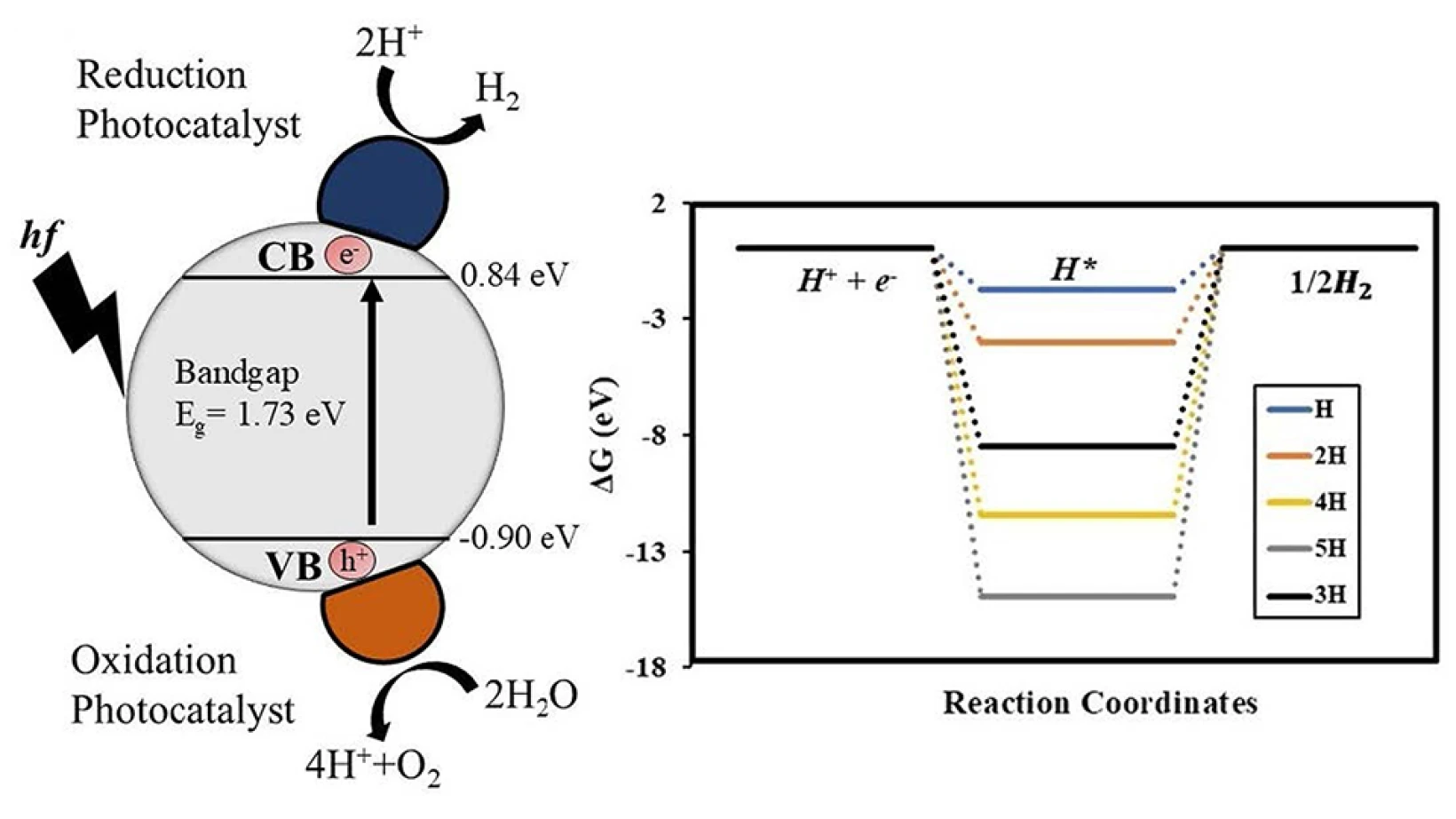
Panchal et al. explored the application of the emerging semiconductor material arsenene as an efficient photocatalyst for water splitting. They used density functional theory (DFT) to examine its structural stability, electronic properties, and catalytic activity.

Photocatalysis uses a catalyst to harness energy from sunlight to split water molecules into hydrogen and oxygen. Most traditional photocatalysts are either unstable, composed of toxic materials, or not efficient enough. Emerging 2D semiconductor materials, such as graphene, phosphorene, and arsenene, have the potential to overcome these limitations.
Author Sanjeev K. Gupta, said:
2D materials, especially arsenene, with unique electronic and surface properties, offer a pathway toward efficient, visible-light-responsive, and stable alternatives,
Using DFT simulations, the authors analyzed the structure and performance of buckled arsenene monolayers, one of the two stable configurations of arsenene, employing phonon dispersion to confirm stability and electronic band structure analysis to evaluate the material’s photocatalytic potential.
They found that buckled arsenene possesses the right combination of stability, electronic structure, and catalytic activity for water splitting. Its band gap allows for efficient solar absorption, while strong hydrogen adsorption supports the effective creation of molecular hydrogen from free protons.
The authors plan to continue analyzing buckled arsenene to further demonstrate its effectiveness as a photocatalyst.
Gupta, said:
The next steps of research may include studying doping, heterostructures, or defect engineering to further tune photocatalytic performance,
“We also plan to explore multi-atom adsorption processes to better simulate real catalytic environments.”
READ the latest news shaping the hydrogen market at Hydrogen Central
Exploring the potential of buckled arsenene monolayers for green hydrogen production, source