
Raymond Biesinger is an illustrator and the author of 9 Times My Work Has Been Ripped Off: An Informal Self-Defence Guide For Independent Creatives.
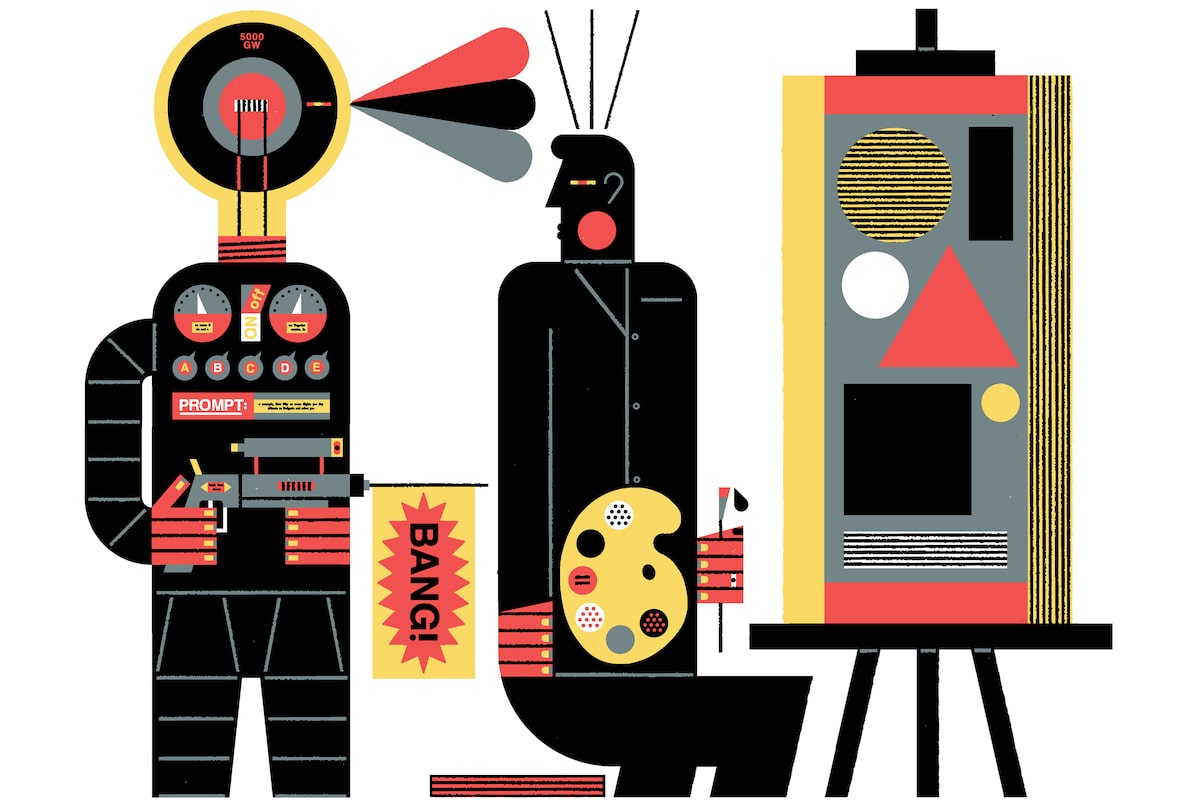
When creative people hear the word “rip-offs” in 2025, their minds most often jump to questions about generative artificial intelligence. It makes sense that we’d connect those two things; without permission, Silicon Valley has used our work to “train” their AI creations. Additionally, when Open AI made its image-based AI model DALL-E 2 available for all to use in September, 2022, it felt like they were out to replace us creatives.
The funny thing is, three years after DALL-E caused untold anxiety in the creative world and Cosmopolitan published the world’s first AI-illustrated cover, we still can’t see much evidence of AI “labour saving” in the creative world.
In mid-September, I was walking down rue St-Laurent in Montréal and huge poster caught my eye. It showed a competently drawn roller skater in a big-headed and big-eyed style, surrounded by a crowd of other joyous roller skaters. It advertised “Roller-Disco du Patin Libre,” a giant free skating party in the Quarter des Spectacles sponsored by the Ville de Montréal and Québec.
I looked for a signature on that poster, but there was none. Then I eyed the very inadequately drawn people surrounding the central figure. Included in the crowd were: two sets of “melted” twins wearing the same clothes but drawn at different scales; someone who looked like Freddy Krueger; a lady with no eyes and some ambiguous footwear that seemed like it could’ve been roller skates, inline skates, ice skates, shoes or high heels. Also, someone had two noses, a lady had three eyebrows and a cyclops could be seen at far right. These weren’t “cute” or “funny” or “odd” intentional additions, all of which I enjoy adding to crowd scenes. The tone was more oven-blasted wax museum and low-effort meme, and quite obviously AI-made.
And of course, it was internet catnip.
When I showed it to my followers on Instagram, the amount of engagement it garnered was off the charts. The flip side of AI being crammed everywhere is that, when given a chance to express resentment of it, many, many, people are delighted to do so. Commenters also pointed out other instances of AI replacing illustrators, but I’m happy to report that the 30,000 people who saw the free skate image were only able to come up with six examples of paying illustration gigs that AI had scooped up. Also of note: Most of these examples included the AI-users vowing to not use AI again in such a way, and this included the roller-disco organizers.
This is not the vaporization of my livelihood, and realizing this was a relief to me. But if I put on my fantasy accountant hat and look at the bigger picture of AI and economics, I’m convinced a big chunk of the American economy is propped up by misplaced enthusiasm for that technology. However safe my job might be, the economy itself seems due for a big hit.
To dig into some numbers: Open AI is the industry-leader in AI, and they’re worth US$500-billion. NVIDIA makes the chips that power AI, and they’re worth an enormous US$5-trillion. As the linchpins of the AI world, both of them have had a few incredibly successful years marketing AI as everything from “inevitable” to “mandatory.” It’s no surprise Canadian politicians are feeling the pressure to ensure our country keeps up.
Opinion: We can’t let Canada’s AI moment slip away
“We have funded our tech […] in a sprinkler system,” said Evan Solomon, minister of artificial intelligence and digital innovation, recently, speaking about the AI sector. “We have to be more focused. We have to build pools.” After all, no one wants to miss a pool party.
But in August, MIT NANDA’s State of AI in Business 2025 study found that among 300 businesses that’d collectively spent US$3-billion on AI pilot programs, 95 per cent of those pilots reported no return on investment. A month before that, Goldman Sachs’ head of stock research reported that “despite its expensive price tag, the technology is nowhere near where it needs to be in order to be useful.” Given that global management consultant firm McKinsey estimates that AI data centres alone will require US$7-trillion in investment to keep up with data demand between now and 2030, AI’s profit and loss spreadsheet is looking dismal for the next half-decade, at least.
Artificial intelligence: the good, the bad and the ugly environmental costs
Yes, there are some use cases for this technology – I’m sure you can probably think of a small way AI has improved your work life. But collectively, those small improvements are not a thing Open AI and NVIDIA can balance upon indefinitely. Those small improvements are not a thing we should prioritize, as a country, either.
So, those AI “pools” that Mr. Solomon wants us to build? Those pools are full of something, but definitely not water. I don’t think you should be swimming in them.