
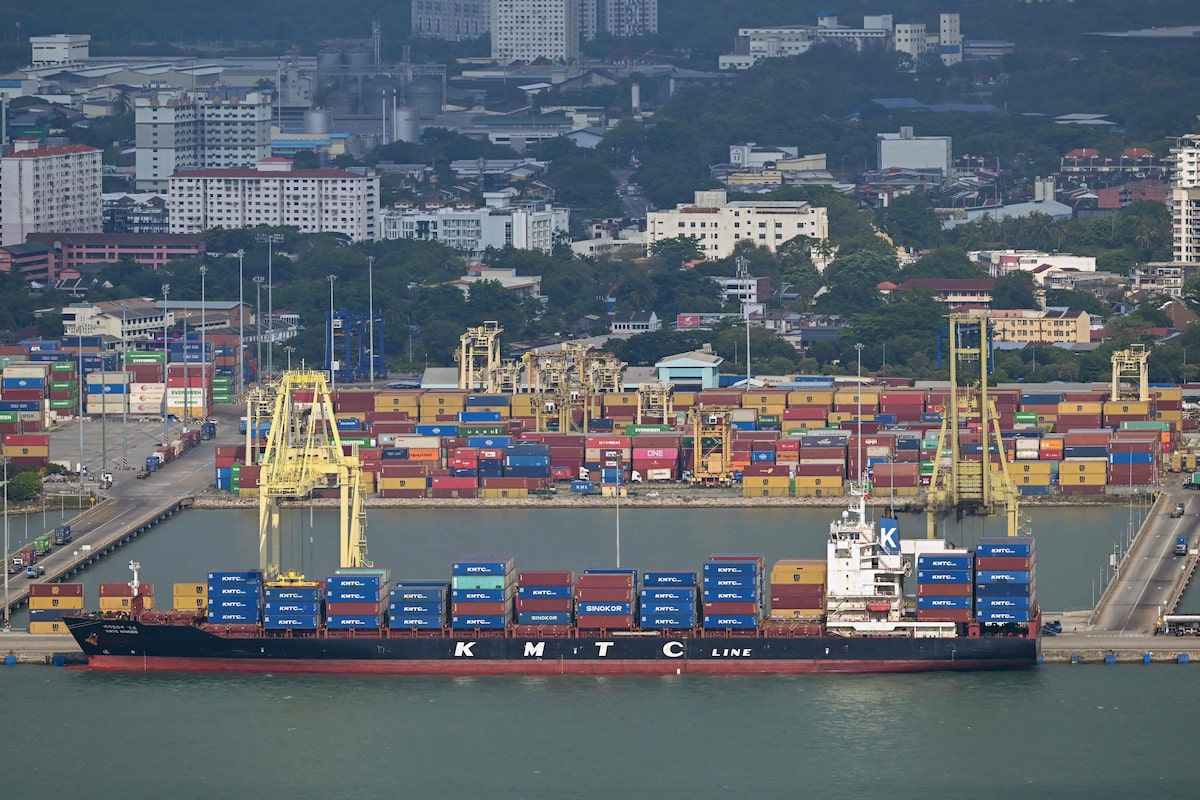
A cargo vessel docked at a port in Malaysia. Asian countries were given flimsier protections in their recent deals than Canada and Mexico secured as part of USMCA.MOHD RASFAN/AFP/Getty Images
The United States is expanding its use of poison pill provisions in international trade agreements, a worrisome development that foreshadows more trouble for Canada in the upcoming review of the U.S.-Mexico-Canada Agreement.
Specifically, the Trump administration insisted on the inclusion of what are essentially expulsion clauses in the recent U.S.-Cambodia and U.S.-Malaysia trade pacts. They are more potent versions of a precedent-setting provision that Washington forced into the USMCA in 2018 to pre-empt Ottawa from signing a trade deal with China.
Known colloquially as poison pills, the restrictive provisions are ostensibly intended to give Washington an economic edge against Beijing. The clauses allow the U.S. to nix the deals if either Cambodia or Malaysia signs new agreements to expand trade with countries deemed problematic by the White House.
Both trade agreements offer the U.S. broad discretion to nullify the deals, while the Asian countries were given flimsier protections than Canada and Mexico secured as part of USMCA.
Editorial: Canada must be prepared to stand on its own
Auto giants urge Trump administration to extend USMCA
For instance, the Cambodia deal can be terminated if Phnom Penh “enters into a new bilateral free trade agreement or preferential economic agreement” and the U.S. considers it “undermining” to their existing pact – or if it “otherwise poses a material threat to economic or national security.”
Whereas the Malaysia deal allows Washington to pull the trigger if Kuala Lumpur signs “a new bilateral free trade agreement or preferential economic agreement with a country that jeopardizes essential U.S. interests.”
Although the clauses included in the Cambodia and Malaysia deals differ from each other, both references are euphemisms for China.
“These provisions amount to loyalty tests and should be seen in the context of intensifying U.S.-China competition for global influence,” wrote Simon Evenett, a professor of geopolitics and strategy at IMD, a business school based in Lausanne, Switzerland, in a report published on Oct. 30.
He later added: “Ultimately, poison pill provisions transform trade agreements from purely commercial instruments into tools for managing partner countries’ broader foreign economic policy orientation.”
As Mr. Evenett points out, the poison pills included in the two Asian deals diverge from USMCA Article 32.10, which uses its own coded language to refer to China (“non-market country”) and restricts Canada’s ability to enter into a free trade deal with the Asian giant – albeit with narrower parameters.
Article 32.10 includes a “termination right” that was the brainchild of the U.S. and foisted on Canada (and Mexico). But it can technically be triggered by any of the trading partners.
If Canada and China wanted to pursue trade talks, for example, Ottawa is required to provide the U.S. and Mexico with advance notice of three months.
Canada would also be compelled to share information about the trade negotiations (if asked to do so) with the U.S. and Mexico, while also allowing them to review the full text of any resulting trade deal at least 30 days before signing it.
The U.S. and Mexico, meanwhile, would reserve the right to terminate USMCA with six months’ notice and could convert it into a two-way deal if Canada were to enter into a free trade pact with a non-market country.
This poison pill is different from a separate clause baked into USMCA that allows any of the signatories to withdraw from the deal with a six-month heads-up to the others.
Back in 2018, experts widely criticized the USMCA poison pill as an attack on Canadian sovereignty because it gave the U.S. a veto over Canada-China trade.
Then U.S. commerce secretary Wilbur Ross, who served in the first Trump administration, hinted that Washington was eager to replicate the USMCA poison pill in future free trade deals.
Canada does have a bit of a buffer – but not enough of one to completely neutralize this threat.
“From a Canadian perspective, it is fortunate that Canada and Mexico already have a free trade relationship in another multilateral treaty – the newly formed Comprehensive and Progressive Agreement for Trans-Pacific Partnership (CPTPP),” stated an article published in the Vanderbilt Journal of Transnational Law in 2020.
(The U.S. withdrew from the CPTPP’s predecessor agreement in 2017.)
Fast forward to the present day, and Canada risks losing some protections on poison pills in next year’s USMCA renegotiations if sweeping clauses become the new norm for Washington.
Sure, recent U.S. deals with the European Union, Japan and Britain did not include formal poison pills. Canada, though, likely has less negotiating leverage than those countries because of its export dependence on the U.S.
Prime Minister Mark Carney, of course, has made no secret of his goal to double non-U.S. exports over the next decade.
It’s unknown how China, already Canada’s second-largest trading partner, will figure into his plan.
What is clear, however, is that Canada risks sustaining more collateral damage because it, like other middle powers, is stuck in the middle of an increasingly warped U.S.-China trade war that is blurring the lines between friend and foe.